Answers Are Cheap. Judgment Is Not.
Employer surveys, labor data, and international assessments keep naming the same short list of skills. The harder finding is that the entry-level work which used to build them is gone.
A short intro to this piece, if you would rather watch than read.
Every employer survey says the same thing, and has for years. Students graduate without the skills that matter.
The U.S. Chamber of Commerce asked 500 hiring managers in 2025. Eighty-four percent said most high school graduates are not prepared for the workforce. Eighty percent said this generation is less prepared than the last one. Only 38 percent said it is easy to find candidates with the right skills.
That is the readiness gap everyone already knows about. But the more useful finding is quieter, and it sits in the research I keep on my own machine. It is not a gap between what schools teach and what employers want. It is a gap between what school leaders believe they have delivered and what students and teachers say they actually received.
The gap is inside the building
Microsoft's most recent AI in Education report surveyed students, educators, and education leaders across grade school through higher education. Three findings matter more than the headline numbers.
First, adoption is not the problem. Ninety-two percent of students, 92 percent of education leaders, and 88 percent of educators have used AI for school-related purposes. Fifty-eight percent of students say at least three use cases are now easier because of it.
Second, the training is missing. Seventy-seven percent of students and 53 percent of educators say they have not received formal AI training from their school or district. At the same time, seven in ten education leaders believe at least half of the people in their building have been trained.
Third, and this is the one I would put in front of any board: four-fifths of education leaders rated their institution's AI guidance as clear. Half of students and teachers called that same guidance neutral or absent.
Microsoft's Mark Sparvell said the quiet part on the record. "Education leaders say they're delivering the content, but the end audience says they're not receiving it. That deserves a closer look."
That is not an AI problem. It is a communication and implementation problem, and it will repeat with every technology we adopt until we learn to check what actually landed.
The research converges on the same short list
Run the global labor projections and the classroom frameworks side by side, and the overlap is not subtle.
The World Economic Forum surveyed more than 1,000 employers representing 14 million workers across 55 economies. Its Future of Jobs Report 2025 found analytical thinking is the most sought-after core skill, named essential by seven in ten companies. Eight of the ten core skills for 2030 are durable skills. The report also projects that by 2030 about 66 percent of all tasks will still require human skills or a combination of human and machine.
The National Foundation for Educational Research spent five years on the Skills Imperative 2035. It landed on six Essential Employment Skills that complement technical work: communication, collaboration, creative thinking, information literacy, organizing and prioritizing, and problem solving and decision making.
America Succeeds and Lightcast analyzed more than 75 million job postings. Seventy-six percent of roles now require at least one durable skill. Forty-seven percent call for three or more, a 13 percent increase since 2021.
The U.S. Chamber's hiring managers said the same thing in plain language: 94 percent prioritize critical thinking and problem-solving. Financial literacy was named essential by 96 percent.
ACT asked high school students what they think matters for their future careers. Students and employers agree on the top four: communication, work ethic, critical thinking, and collaboration. The gap is not that students have the wrong list. It is that they are not sure they are good at the things on it.
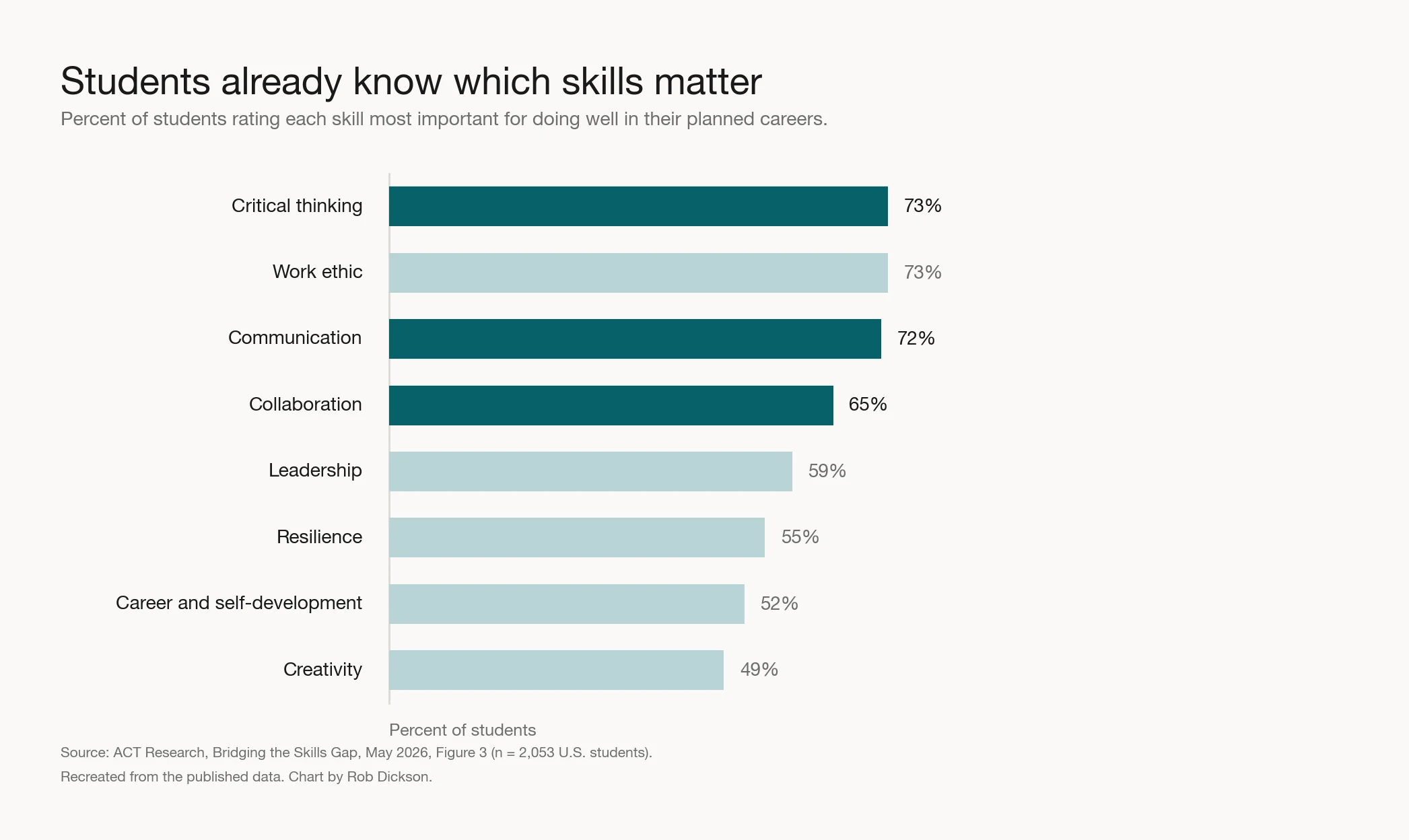
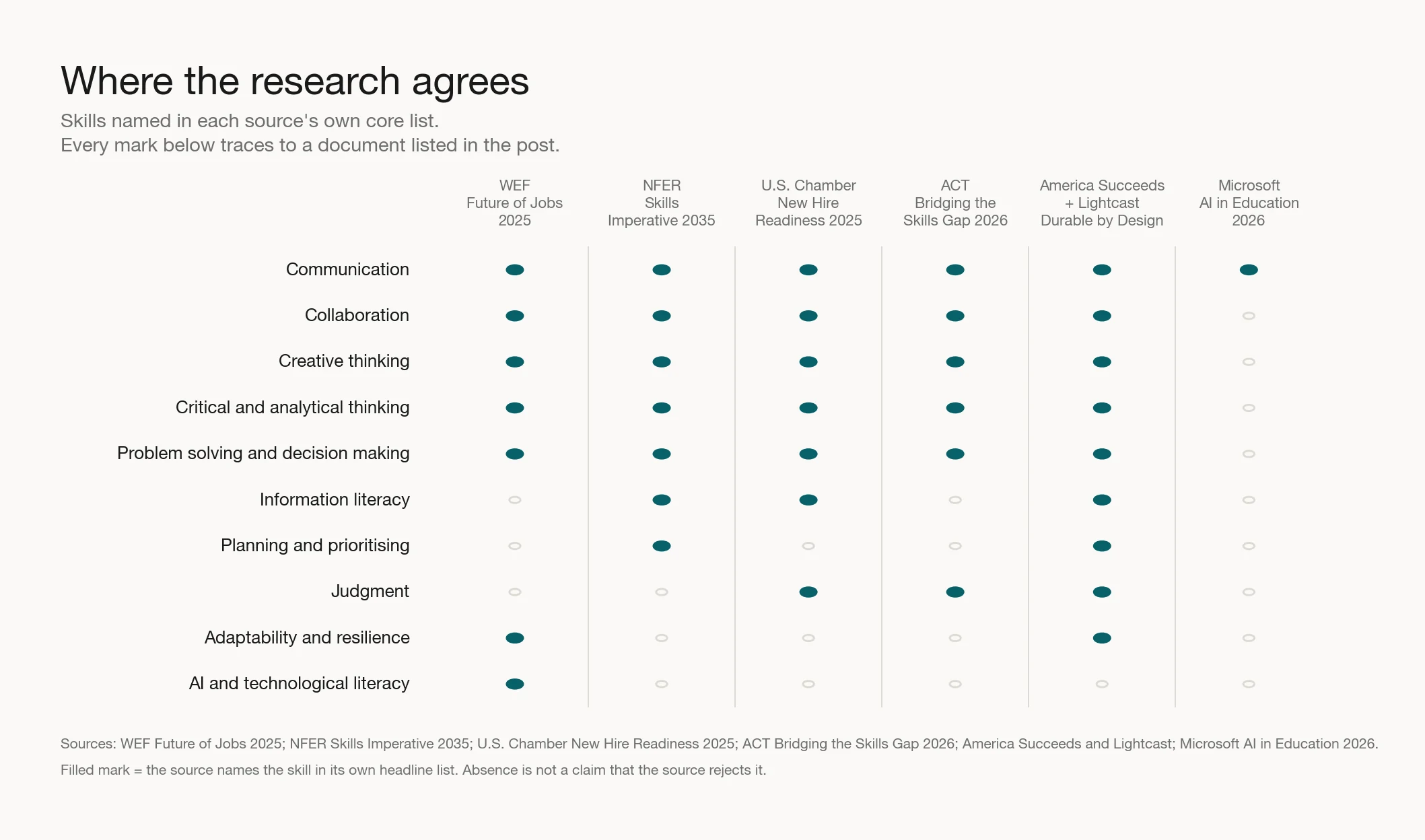
Six different research programs, six different methods, the same short list. The overlap is the finding.
A list is not a curriculum, and I made that argument at length last week in AI can do the grunt work. Wisdom still needs shared experience. It started from Daisy Christodoulou's case that these skills are not free-floating muscles you can train in one place and then use anywhere.
What industry actually wants from a graduate
Microsoft asked experts across nine industries what AI readiness requires of a student entering the field today. Five answers came back consistently.
One, entry-level expectations are higher. Recent graduates are expected to manage workflows and evaluate AI output from day one. Entry-level roles used to be where you learned the ropes. That apprenticeship is shrinking.
Two, working with AI is a partnership skill. Students have to direct it, assess what it produces, and refine it. Not just prompt it.
Three, context engineering. Preparing the data, the constraints, and the framing that get a useful result.
Four, judgment, voice, and the human standard. In a world flooded with generated content, discernment and a distinct point of view are what separate professional work from acceptable work.
Five, credentials to capabilities. Employers are hiring for what you can do, not where you studied.
Point four is the one that should reorganize a curriculum. Microsoft's 2026 Work Trend Index found that quality control of AI output was named by 50 percent of respondents as an emerging critical skill, with critical thinking at 46 percent. Those are not side effects of AI adoption. They are the new core.
AI makes the basics harder, not easier
There is a tempting story that AI makes the hard skills easier. The evidence says the opposite.
As routine and procedural tasks get automated, the skills that remain get harder. Writing, mathematical reasoning, and research now demand that a student direct, evaluate, and challenge AI output instead of just producing it. You cannot judge a good argument if you cannot build one. You cannot catch a subtle error if you never learned the underlying concept.
Microsoft's own numbers make the case. Roughly half of Copilot Chat use supports analysis, reasoning, and decision-making. That is high-value work that used to require deep expertise. The tool is doing more of the floor-level work, which means the human has to bring more of the ceiling.
LinkedIn's labor data, cited in the same report, projects that roughly 70 percent of the skills used in most jobs will change between 2015 and 2030. And job postings listing AI literacy as a requirement increased sixfold in a single year. The labor market is not waiting for schools to catch up, and it is not asking for a technology course. It is asking for people who can think with these tools.
What PISA 2025 just showed us
The OECD published the first volume of PISA 2025 on September 8. More than 760,000 fifteen-year-olds across 91 countries and economies. It is the best evidence we have on what is actually happening to the skills this post is about, and it is not encouraging.
Reading fell 28 points across OECD countries between 2015 and 2025. That is the steepest drop of the three domains. Mathematics fell 22 points over the same decade. Science slipped more modestly. OECD countries posted their lowest average scores ever recorded in all three.
The reading decline is the part that matters here, because it is not spread evenly. The OECD is explicit that the losses are concentrated in the skills that matter most in an AI age: evaluating information, making connections across multiple sources, and thinking critically about what you read. Instances of what they call hasty reading, where a student reads quickly and inaccurately, nearly doubled to 9 percent between 2018 and 2025.
Then there is the AI finding, and it is the one I would put in front of every school board in the country.
Students who use AI for specific schoolwork tasks, summarizing a text, drafting, doing preliminary research on a new topic, score lower in science than students who do not. The gap runs about 20 points, which the OECD describes as roughly one year of schooling. Students who use AI weekly for general purposes perform about the same as people who never touch it.
But here is the nuance that keeps this from being a simple cautionary tale. Students who use AI regularly for general purposes and also have opportunities at school to build AI literacy tend to score slightly higher in science. The trouble is who gets those opportunities. They are more common among socio-economically advantaged students, which is how an AI divide gets built while everyone is busy arguing about whether to allow the tools.
So the finding is not that AI is bad. It is that unstructured AI use in place of the work makes you worse, and structured AI literacy alongside the work makes you better. That is a design problem, and it is squarely a school's problem. It is also the same argument I made last week in AI can do the grunt work. Wisdom still needs shared experience., arriving from a completely different direction.
One more number, and it is the one that should keep us up at night. Fewer than half of students, 46 percent across the OECD, both check the credibility of their sources and place more trust in scientific evidence than in common sense. Thirty-seven percent check sources but still default to common sense. Eleven percent trust the science without verifying anything. Five percent do neither.
That is more than half of fifteen-year-olds who can be moved by a confident claim. In a world where fluent generated text is free and unlimited, that is the vulnerability.
Carl Sagan made this case forty years before any of those reports were written, and it has not aged. A body of knowledge is not the same thing as a way of thinking, and a person who cannot ask a skeptical question is available to whoever comes along next with confidence.
That is the argument for teaching judgment rather than facts alone. Not because facts stopped mattering. Because knowing a handful of them does not protect you from a fluent claim.
PISA also added a new assessment this cycle in computational problem-solving: using modelling and programming tools, running experiments, and building digital products. About two thirds of students across the OECD reached the level where they can progress quickly, and about a quarter hit the top two levels. Which is real evidence that this is teachable rather than innate.
The missing rung
Here is the problem nobody has solved yet, and the strongest evidence in this whole piece.
Every profession built its judgment the same way. You did the low-end work. You drafted the memo nobody read. You triaged the queue, logged the ticket, wrote the first pass, got it wrong, and fixed it. The reps were boring on purpose. They were how you earned the pattern recognition that later let you make good calls fast.
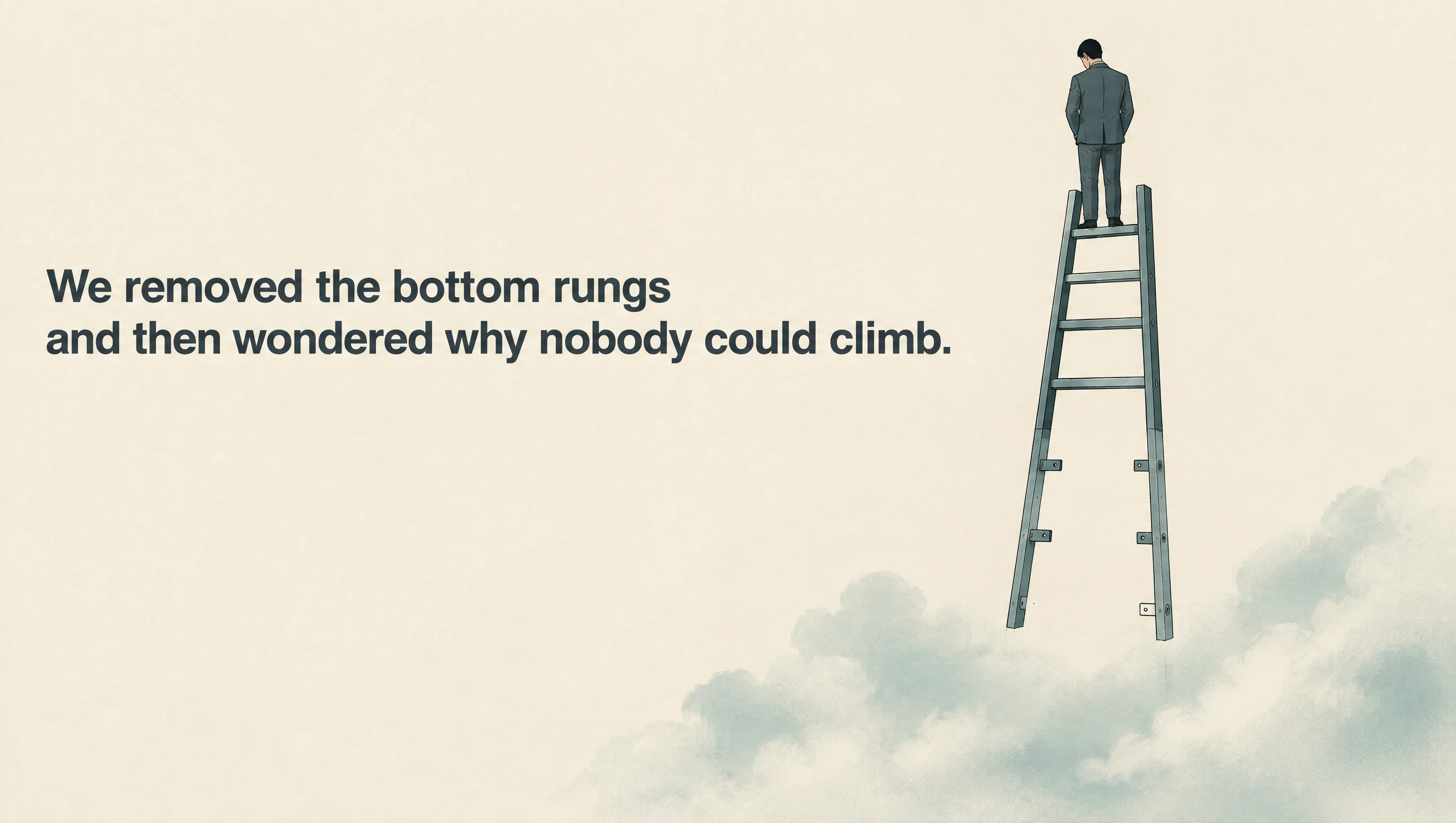
AI now does most of that work. That is the point of it. But it means we are removing the bottom rungs of the ladder and then wondering why nobody can climb.
The data is now unmistakable. Stanford's Digital Economy Lab, using payroll records from ADP covering millions of U.S. workers, found that employment for workers aged 22 to 25 in the most AI-exposed occupations now sits about 19 percent below where it would be if it had kept pace with their less-exposed peers. That gap was 15 percent a year earlier. It is widening, and it shows up in reduced hiring, not layoffs.
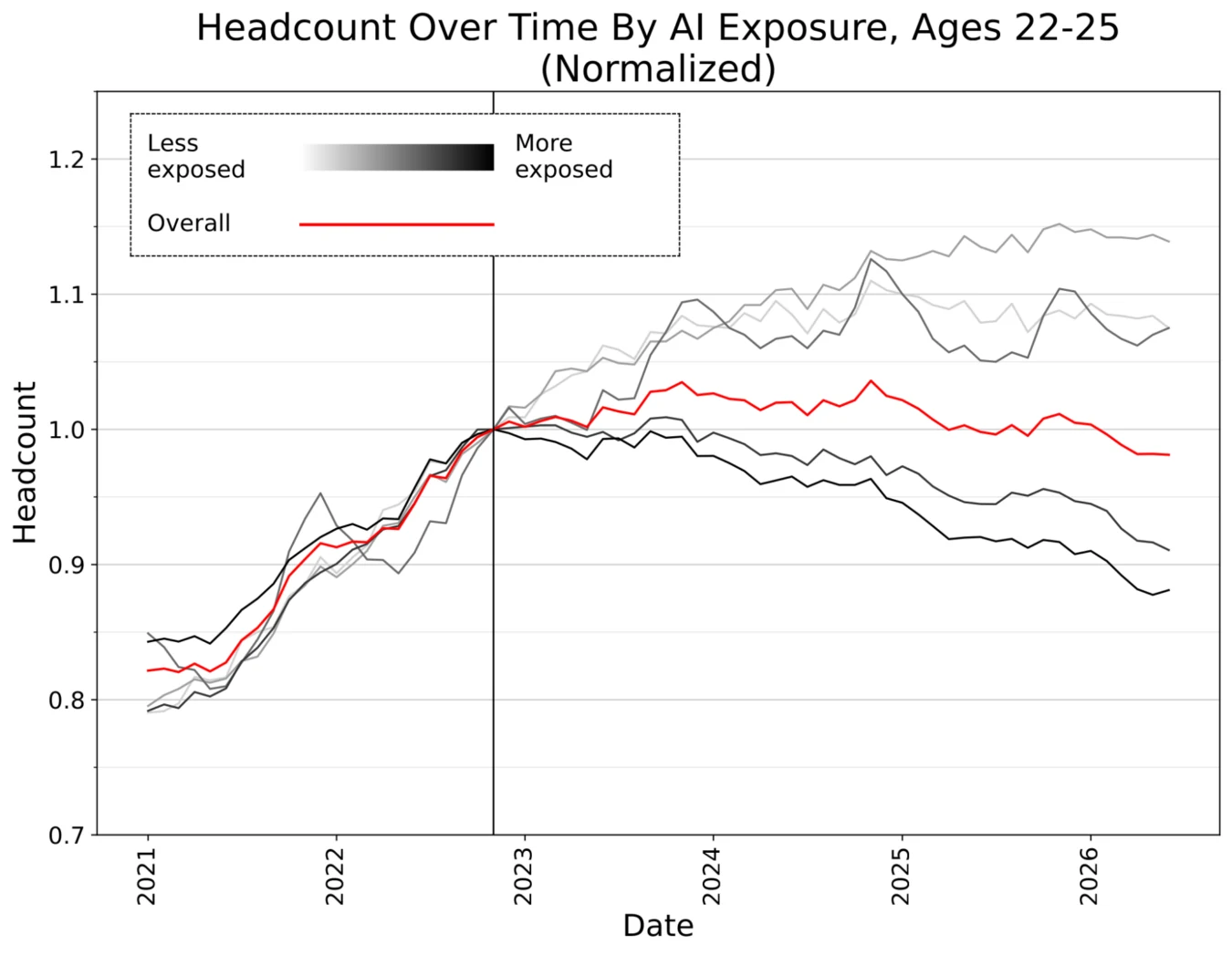
Look at the same chart for all workers aged 22 to 70 and the pattern nearly disappears. Aggregate employment is not collapsing. The damage is concentrated entirely on the youngest workers.
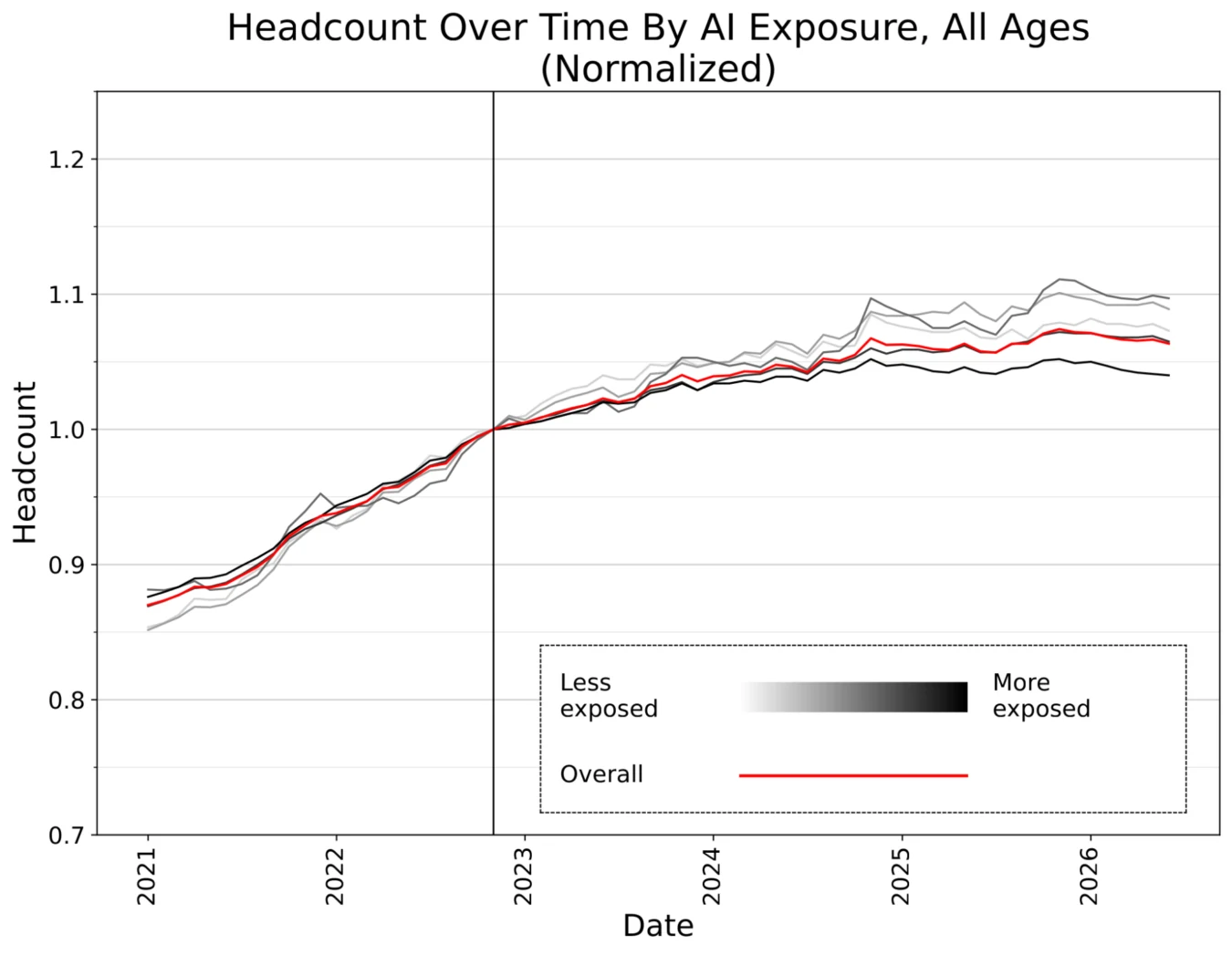
Harvard researchers tracked roughly 62 million workers across 285,000 U.S. firms and found junior headcount at AI-adopting companies fell 7.7 percent within six quarters, while senior employment kept rising. In wholesale and retail, junior hiring fell 40 percent per quarter compared to firms that had not adopted AI. Their warning is blunt: this erodes "the bottom rungs of these ladders."
The consulting data points the same direction. Gartner found 22 percent of chief HR officers say at least one business unit has stopped hiring entry-level staff because AI is doing the work. An Oliver Wyman and NYSE survey of 415 CEOs found 43 percent are cutting junior roles, up from 17 percent the year before.
And the roles that survive are not the same roles. PwC's 2026 AI Jobs Barometer found the most AI-exposed junior roles are seven times more likely to demand traditionally senior skills like leadership. New tasks added to those roles are 2.5 times more likely to rely on empathy, judgment, and creativity. Early-career postings have flatlined, while "seniorised" entry-level roles grew 35 percent since 2019.
Read that again. The entry-level job is not disappearing. It is being redefined to require the judgment that entry-level work used to teach.
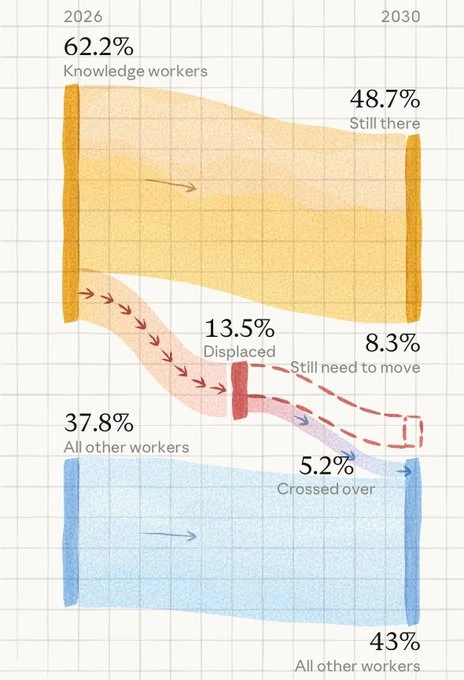
The Stanford team named the mechanism precisely. Employment is falling in occupations built on codified knowledge, the formal and documented kind you can learn from a textbook. It is rising for experienced workers in occupations built on tacit knowledge, the kind you acquire through practice, mentorship, and repeated exposure to real situations. That is exactly what generative AI is good at: reproducing knowledge that has already been written down. What it cannot replicate is experience, and experience is what we stopped letting young people get.
Set aside whether any of this is fair. Ask where those graduates were supposed to build the judgment we now demand of them.
The honest answer is that the question is not fully settled. Stanford is careful to say these are descriptive patterns, not causal proof, and that remote work is a competing explanation. But every alternative they tested, interest rates, remote work, industry mix, alternative exposure measures, leaves the age-specific gap standing. When multiple independent datasets from different countries and methods converge on the same finding about the same narrow group, you do not get to call it noise.
This is the part of the AI era that gets the least attention, and it will do the most damage. It is not the jobs that disappear. It is the apprenticeship that disappears with them. White collar, blue collar, clinical, legal, trades, all of it. The first two years of nearly every career have been compressed into software, and the people coming up behind us are expected to skip straight to the part that used to take a decade to earn.
Simulations are how we put the rung back
You cannot hand a fourteen-year-old a real client, a real patient, or a real budget with real consequences. That is the whole reason we never gave them the real reps in the first place.
So we build the reps.
Not gamification. Not a chatbot wrapped in a lesson. Structured simulations with stakes, ambiguity, and a decision the student has to own. A scenario that forces a call, shows the consequence, and then makes them defend the reasoning out loud. Do that a hundred times and you get something a worksheet can never produce: judgment under uncertainty.
The research on expertise has been clear for decades. Skill develops through structured, demanding, feedback-rich practice. Observation does not produce judgment. Watching a more capable system do the work on your behalf definitely does not.
That is the trap we are walking into. If the AI handles the low-end work and the senior person reviews it, the junior never gets the reps. PwC's "seniorised" roles are the tell: we are asking entry-level people to do senior work without giving them the years that made seniors senior. The only way to square that circle is to manufacture the experience deliberately, in school, before they are on a payroll.
Microsoft's report names the human skill that matters most as "judgment, voice, and the human standard." That is exactly what simulations build. You cannot lecture a student into discernment. You have to put them in a situation where the answer is not in the back of the book, make them choose, and let them live with it.
I called simulations the cheapest wisdom transfer we know how to build in AI can do the grunt work. Wisdom still needs shared experience. and I stand by the phrasing. When the real setting is scarce, dangerous, or licensed, a good simulation buys many varied reps in a compressed window, with a supervisor close enough to correct the work.
The good news is we already know how to build this. It is called project-based learning when the stakes are real. It is called clinical rounds, moot court, design critique, and case method at every level that ever took training seriously. What changes now is that we have to do it earlier, more often, and in more contexts, because the real-world version has been automated out from under our students. The simulation is not enrichment. It is the replacement for the job that used to teach them.
What we are actually building
I do not have to speculate about any of this. Wichita Public Schools has been building the alternative for four years, in three places, on purpose. I wrote about all three in detail last week in AI can do the grunt work. Wisdom still needs shared experience. Here is the short version, plus what changed this year.
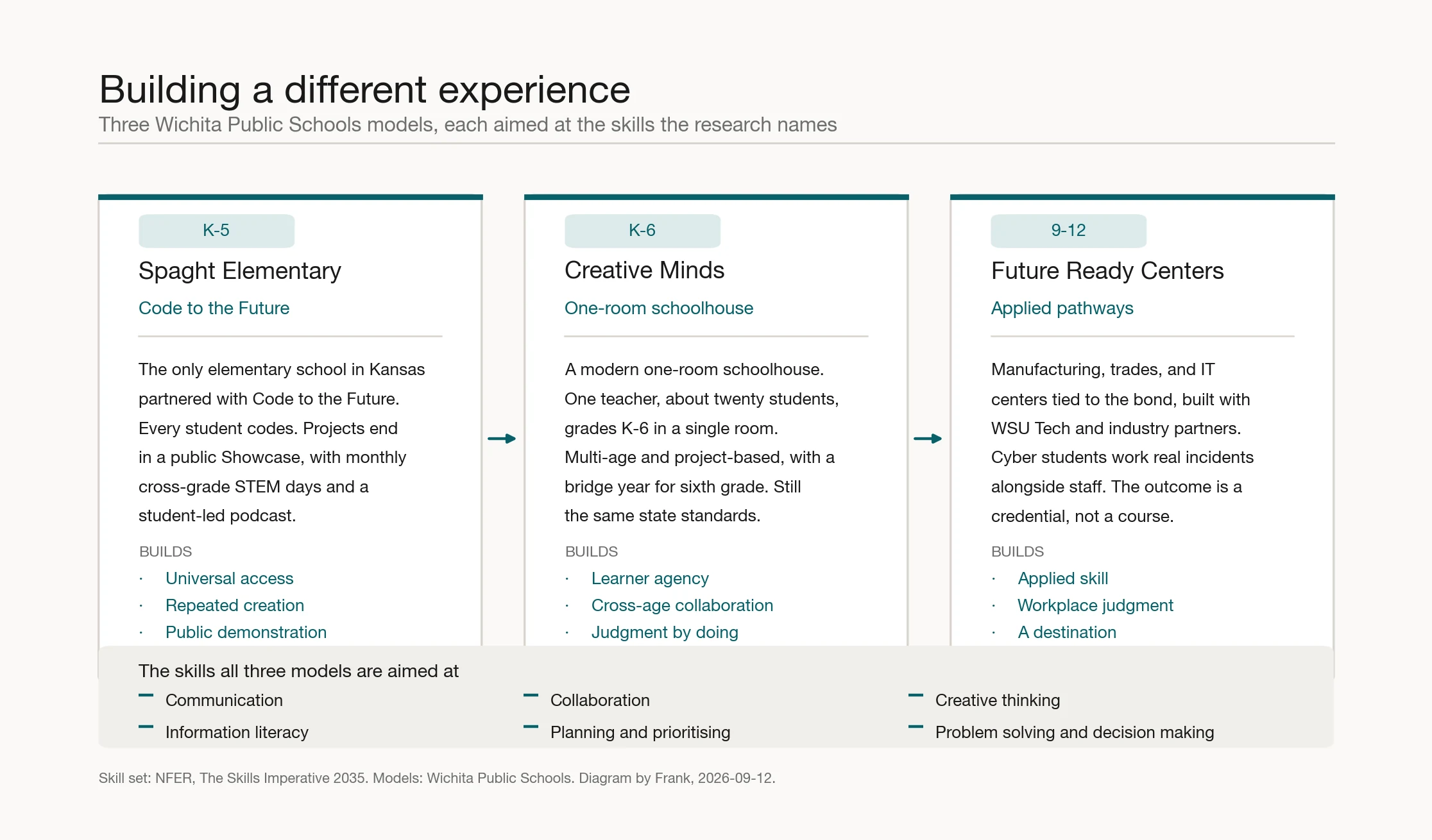
Spaght Elementary runs Code to the Future. It is the only elementary school in Kansas partnered with the program. Every student codes, not the ones who sign up for the club. Projects end in a public Showcase where kids stand next to their work and explain it. There are monthly cross-grade STEM days, interest-based electives for fourth and fifth graders, one-to-one access, and a student-led podcast. Spaght sits in the highest-poverty zip code in the district.
That last detail is the whole point. Immersion, not enrichment. Every kid, not the ones whose parents already know how to ask. Universal access to creating something and then standing behind it in front of an audience.
The collision nobody has priced yet
There is a problem bearing down on this program from Topeka, and I do not think anyone has run the numbers on it.
The Kansas State Board of Education is drafting guidance on student screen time, aiming for consensus by November so it can act before the 2027 Legislature convenes. Board members have discussed banning classroom technology outright through second grade. One member said screens do not belong in kindergarten at all, and that she would like to see a ban run through second grade. The board has also weighed tying compliance to accreditation standards, which is the strongest lever it holds. The commissioner has urged caution, noting that regulation is slow to write and slower to undo.
Separately, the Legislature has already moved. Senate Bill 350 would cap school-owned device use at one hour per day in grades six through eight, and ninety minutes a day in high school. For kindergarten through fifth grade, it would prohibit classroom devices entirely, requiring instruction and testing to be print-based or hands-on. Districts would have to buy more physical textbooks and printed materials with no additional state funding, and per the bill's own fiscal note the state has no cost estimate for rebuilding statewide assessments on paper after more than a decade of testing online. The Kansas Association of School Boards opposes it, arguing screen time policy belongs at the local level.
Now read that against what Spaght is.
Code to the Future is a computer science immersion model. Students write code, run it, watch it break, and fix it. That is not a lesson you deliver in an hour and then put away in a cart. It is a practice, and practice needs a device, unbroken time, and permission to iterate. Spaght is a kindergarten through fifth grade building. A prohibition on classroom devices in those grades would not inconvenience that program. It would end it.
The category error underneath all of this is that screen time treats two completely different activities as one thing. A student scrolling short-form video is consuming. A student debugging the code on a robot so it follows a line is creating. Both register as minutes on a device, and only one of them is the thing we claim we want.
And there is a contradiction here I cannot get past. The same state that is considering a one-hour cap just wrote two market value assets into the diploma, including client-centered projects that address real workplace problems and industry-recognized certifications. You cannot earn a cybersecurity credential on paper, and you cannot hand a client a workbook. The state is asking schools to produce applied, credentialed, device-intensive work while capping the tool that produces it.
The equity consequence runs the wrong direction too. A district serving wealthy families can absorb a device cap, because those students have computers and enrichment at home. The students in Spaght's attendance area do not. Restricting school device time lands hardest on the kids whose only reliable access to a computer is the one the school hands them.
I am not arguing against limits. I am arguing for precision. Media literacy is written into the bill, and it should be. The research is unambiguous that unstructured device and AI use without guidance leaves students worse off, and that structured use with guidance leaves them better off. That is a teaching question, not a stopwatch question.
So measure the minutes if it makes anyone feel better. But write the rule so that a nine-year-old debugging a robot and a nine-year-old watching autoplay are not the same line item. Because if we take the device away to protect the child, and the child who loses access is the one in the poorest zip code in the district, we will have solved the wrong problem in the most expensive way available.
Creative Minds is a modern one-room schoolhouse. One teacher, about twenty students, grades K through 6 in a single room. Multi-age, project-based, hands-on. The pedagogy is Montessori crossed with Reggio Emilia and service learning, built by Dyane Smokorowski and me on an idea the superintendent, Kelly Bielefeld, put in motion.
Rather than describe it, here is what the room actually sounds like when you ask the students themselves how school is going.
We started it at the Learning Lab, a building we did not own, for a specific reason. Sometimes our systems get in the way. If you try to transform an existing school, you end up with something very similar to what we already have today. So we went somewhere the rules did not reach and built the thing we actually wanted to see.
Last year it was one classroom. Then two. This year it is four, including a school-within-a-school at Benton Elementary. The wait list has sat at roughly 200 students with no advertising, just word of mouth and siblings. Retention around 94 percent. Kids stay.
And the parts people assume we abandoned, we did not. Same state standards. Same FastBridge. Same state assessments. The difference is not lower expectations. It is hyper-communication with families, and real projects instead of worksheets. Sixth grade exists as a bridge year because fifth to sixth is the hardest transition in a child's school life, and some kids are not ready to leave the room yet.
I watched a second and third grader design a shovel that plants and fertilizes on its own, then cold-call companies about it with an adult standing nearby. That is a nine-year-old doing exactly what the research says we need: making a claim, gathering evidence, and defending reasoning to a stranger. You cannot put that on a worksheet.
The Future Ready Centers are the secondary end of the same idea. Manufacturing, trades, and information technology pathways, tied to the bond and built with WSU Tech and industry partners rather than in isolation. The cyber students work real incidents alongside district staff, which is another way of saying they get the reps on live problems before anyone hands them a diploma. The outcome is a credential and a destination, not a course code.
The pattern under all three
None of these are technology programs. That is the mistake people make when they look at Spaght or Creative Minds and see devices.
Every one of them is built the same way: a student makes something real for a real audience, and then has to explain it. That is the mechanism. It builds communication because you have to present. Collaboration because the work is too big alone. Creative thinking because the answer did not exist yet. Information literacy because you had to go find out. Planning because you ran out of time. And problem solving because it broke.
Those are the six Essential Employment Skills from the research, showing up as side effects of doing real work instead of as a checklist bolted onto a lesson plan. The longer version of why that works, and why a standalone critical thinking course does not, is in AI can do the grunt work. Wisdom still needs shared experience. Cognition is context-bound. Skills move when the contexts vary, not when we write them on a rubric.
The complication I cannot skip
I am making this argument in the middle of a backlash, and I would rather name it than talk around it.
The screens I want schools to use well are the same screens parents are trying to take away. Forty-two states, plus Washington, D.C. and Puerto Rico, have already enacted legislation on cellphone use in schools. Kansas is one of them. The debate left is not whether to restrict phones. It is how strict to be.
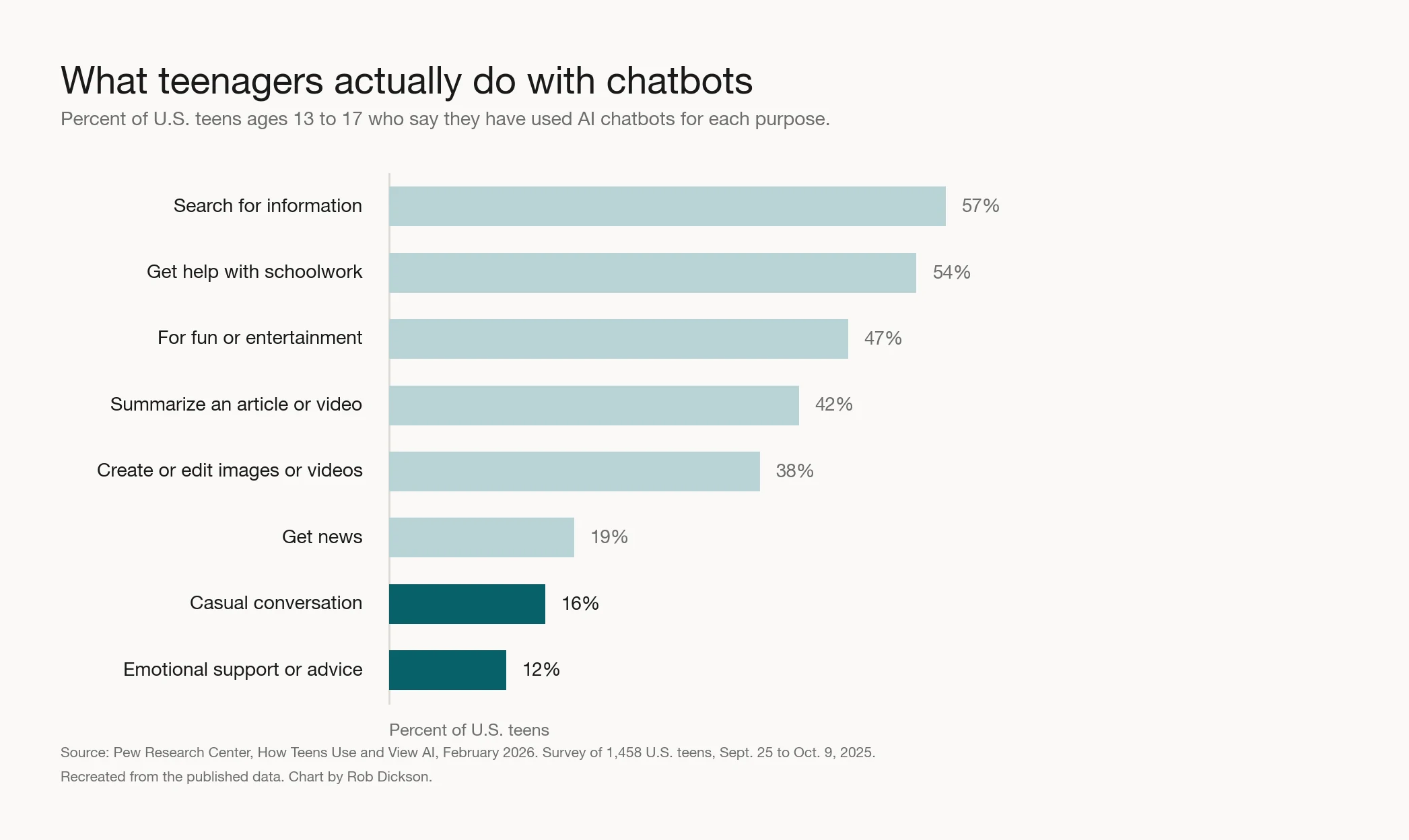
The AI half is harder. Pew surveyed teenagers and found that a majority now use AI chatbots, roughly three in ten daily. Fifty-nine percent say AI cheating happens regularly at their school. Sixteen percent have used a chatbot for casual conversation. Twelve percent have gone to one for emotional support or advice.
So when a district leader stands up and says we need more AI in classrooms, that is what part of the room hears underneath it. Not a skills argument. A screen-time argument, and a story about a kid who got attached to something that cannot care about them.
I understand the instinct. I also think refusing to teach this is its own risk, because the students who get real guidance on AI at school are the ones whose families are not going to buy it for them at home. Opting out of the conversation does not opt a single child out of the technology.
The answer is not fewer screens. It is better reasons to be on them, and honest limits about when to be off. That is a harder sentence to put on a poster, which is probably why we do not say it.
What I would say to a skeptic
These are prototypes, not a finished system, and I will not pretend otherwise. Three of them. Small. Messy in places.
The honest constraints are talent and trust. Creative Minds runs on one teacher per room, and finding people who can run a multi-age project-based classroom is the hard part, not buying equipment. We grew paras who were pre-service teachers into the model, because it is easier to grow a teacher than to unlearn one.
And there is a real question about scale. Not every family wants a one-room schoolhouse. Some need more structure and leave. Creative Minds is not the answer for every child. It is proof that the ceiling is higher than we act like it is, and proof that when you build for judgment and agency on purpose, families will find you without a marketing budget.
That is the argument. Not that everyone should copy Creative Minds. That a district can build genuinely different learning experiences inside the public system, hold them to the same standards, and let the results make the case.
We have been doing it for four years. The research just caught up.
Where the policy actually stands
Microsoft's report also put a number on the state policy picture. Thirty-six states plus Puerto Rico offer official AI guidance for schools. Twenty-six clarify that AI literacy matters. Eleven are working to integrate it into standards. Six have done it. Three have it in graduation requirements.
That is the real shape of the moment. Lots of guidance, very little requirement. Which means districts are largely on their own to decide what this looks like, and the ones that wait will be writing policy after the fact instead of before it.
Kansas already put it in the diploma
Here is the part I would hand to every board member in the state.
Kansas changed the diploma. Beginning with the class of 2028, a student can no longer graduate on coursework alone. They have to earn at least two postsecondary assets, which is the state's term for a market value asset: an experience or credential with value to someone other than the school.
The list runs twenty-four items deep. Some are genuinely market valued. A client-centered project, where a student addresses an authentic workplace problem under an instructor's supervision. A workplace learning experience tied directly to the student's own Individual Plan of Study. A youth apprenticeship connected to a registered program. An industry-recognized certification. Nine or more hours of college credit.
Others are not, and I will say that plainly. Ninety-five percent attendance. Two seasons of a sport. Eagle Scout. A 21 on the ACT. All fine things to do in high school. None of them is an asset an employer bids on, and stacking them in the same list dilutes the term until market value just means did high school things.
The state added coursework too. Half a credit of communications on top of English. A credit of advanced STEM, or a fourth year of math or science. Half a credit of financial literacy. The floor stays at 21 credits, and Wichita requires 23, so we are already two above it.
Kansas lifted the term from PREP-KC, which coined it in 2017 for the Kansas City region. That collaborative set a goal that every student in the metro would graduate with at least one. The state wrote two into the diploma.
This may be the most interesting education policy in the country right now, and it is why I keep returning to the argument I made at length last week in AI can do the grunt work. Wisdom still needs shared experience. Christodoulou's design is knowledge first, then practice across many varied contexts. Most districts build the first half and never build the second. Kansas just made the second half mandatory.
The requirement is only worth what a district puts behind it. If a school counts attendance and a sport toward its two assets, nothing changes and the diploma means exactly what it meant before. If it counts a client project with an outside audience and a real debrief, the diploma starts to certify something a transcript never has.
And the clock is not theoretical. The class of 2028 are juniors right now. The first students bound by this rule are already in our buildings.
What I would watch in Wichita
I run technology for a district of roughly 46,000 students. Here is what I am testing against these findings.
First, does our graduate profile name the skills the research names, or does it name the courses we already offer? If judgment and critical thinking are the outcomes, they need to show up in curriculum, instruction, assessment, and professional development, not just in a vision statement.
Second, does our assessment measure recall or application? The research is unanimous that current tests measure the wrong thing. If we test what a model can already do, we are grading the wrong capacity.
Third, do our teachers have the time and the design support to build authentic work? Skills like judgment and creative problem solving are not delivered by a lesson plan. They are developed through repeated practice on real problems with real feedback.
Fourth, and this is the Microsoft finding I would put first: do we actually know what our students and teachers received? Not what we announced. Not what we posted. Microsoft's data shows a four-fifths versus one-half disagreement between leaders and the people in the room. If we skip that check, we will keep writing guidance nobody reads and calling it training.
Fifth, is our new state technology plan going to be a compliance document or a learning document? Kansas is asking every district to submit an instructional technology plan by the end of this school year, with parent acknowledgement for individual devices starting in 2027-28. That requirement can be met with a filing cabinet, or it can be the moment a district finally writes down what it actually wants students to be able to do.
Sixth, and this is the one I care most about: where do our students practice judgment? Not hear about it, not study it. Practice it. We have three models that do this well and a few thousand students who never touch one. The job now is not inventing the model. It is moving the required experience closer to the simulation and further from the worksheet.
The thing that does not change
Microsoft's education report opens with a line from Mark Sparvell that I keep coming back to. "Schools are places that develop skills, but they're also where society itself is created."
Intelligence is getting cheap. That is a real shift and it deserves a real response. But wisdom, judgment, and the ability to be wrong in public and change your mind are not on a downward cost curve.
The schools that get this decade right will not be the ones that deployed AI fastest. They will be the ones that decided, clearly and in writing, what a human is for. Then they will use every tool available, including AI, to get the student there.
That is the work. It was always the work. AI just made it impossible to avoid.
Sources
From my own library
Microsoft Education, AI in Education: A Microsoft Special Report (2026 global study) https://www.microsoft.com/en-us/education
Microsoft, 2025 Work Trend Index Annual Report: The Year the Frontier Firm Is Born https://www.microsoft.com/en-us/worklab/work-trend-index/2025-the-year-the-frontier-firm-is-born
World Economic Forum, Shaping the Future of Learning: The Role of AI in Education 4.0, April 2024 https://www.weforum.org/publications/shaping-the-future-of-learning-the-role-of-ai-in-education-4-0/
LinkedIn, Workplace Learning Report 2025 https://learning.linkedin.com/resources/workplace-learning-report
Udemy Business, 2026 Global Learning and Skills Trends Report https://business.udemy.com/resources/global-learning-skills-trends-report/
Wichita Public Schools, Spaght Science and Communications Magnet https://spaght.usd259.org/magnet-theme
Wichita Creative Minds https://wichitacreativeminds.org/
Code to the Future https://www.codetothefuture.com/
WSU Tech, HACK and IT FutureReady Center https://wsutech.edu/news/new-hack-and-it-futureready-center-expands-access-to-high-demand-tech-careers/
Entry-level and displacement research
Brynjolfsson, Chandar, and Chen, Canaries in the Coal Mine? Six Facts About the Recent Employment Effects of Artificial Intelligence, Stanford Digital Economy Lab, revised August 2026 https://digitaleconomy.stanford.edu/app/uploads/2026/08/Canaries_August2026.pdf
Stanford Digital Economy Lab summary, No Widespread Displacement, but the AI Employment Gap for Young Workers Has Widened to 19% https://digitaleconomy.stanford.edu/news/canariesaug26/
PwC, 2026 Global AI Jobs Barometer, June 2026 https://www.pwc.com/gx/en/services/ai/ai-jobs-barometer.html
Gartner CHRO survey on entry-level hiring and AI, 2026 https://enterprisedna.co/resources/news/gartner-chro-22-percent-entry-level-hiring-cut-ai-automation-2026/
Oliver Wyman Forum and NYSE CEO survey on junior roles, 2026 https://www.techtarget.com/it-strategy/feature/Survey-finds-CEOs-cutting-junior-roles-to-AI-How-it-impacts-IT
Harvard working paper on AI adoption and junior employment (62M workers, 285K firms) https://papers.ssrn.com/sol3/papers.cfm?abstract_id=5425555
Screen time and chatbot exposure
National Conference of State Legislatures, Enacted State Legislation: Cellphone Use in Schools, updated July 2026 https://www.ncsl.org/education/enacted-state-legislation-cellphone-use-in-schools
Pew Research Center, How Teens Use and View AI, February 2026 https://www.pewresearch.org/wp-content/uploads/sites/20/2026/02/PI_2026.02.24_Teens-and-AI_REPORT.pdf
PISA 2025 and the Anthropic scenarios
OECD, PISA 2025 Results (Volume I): Future-Ready Students, September 2026 https://www.oecd.org/en/publications/2026/09/pisa-2025-results-volume-i_5265bfb1.html
Anthropic, Economic Scenarios for Transformative AI, Korinek et al., September 2026 https://www.anthropic.com/institute/econ-scenarios
Kansas screen time policy
The Lawrence Times, Kansas State Board of Education starts work on technology use policies for public schools, August 2026 https://lawrencekstimes.com/2026/08/14/kr-ksed-tech-policies/
KCUR, Kansas bill would limit students' screen time in class and create extra costs for school districts, February 2026 https://www.kcur.org/2026-02-26/kansas-bill-takes-aim-at-screen-time-in-schools-it-would-create-extra-costs-for-school-districts
Kansas Legislature, Senate Bill 350 (2026) and its fiscal note https://kslegislature.gov/li/b2025_26/measures/sb350/ https://kslegislature.gov/li/b2025_26/measures/documents/fisc_note_sb350_00_0000.pdf
Kansas Association of School Boards, on the student screen time task force recommendations https://kasb.org/48409_2?articleID=15625
Kansas graduation requirements
Kansas State Department of Education, Graduation Requirements, including the Class of 2028 and Beyond fact sheet, updated May 2026 https://www.ksde.gov/student-success/graduation
Wichita Public Schools, Graduation Requirements and Postsecondary Assets https://sowers.usd259.org/academics/graduation-requirements
Real World Learning, Market Value Asset Guidebook and the PREP-KC origin of the term https://realworldlearning.org/wp-content/uploads/sites/11/2024/03/MVA-Guidebook_Version-1_March-2024-1.pdf
External, verified
World Economic Forum, Future of Jobs Report 2025 https://www.weforum.org/publications/the-future-of-jobs-report-2025/
National Foundation for Educational Research, The Skills Imperative 2035, final report, November 2025 https://www.nfer.ac.uk/media/4lrdmrrl/skills_imperative_2035_final_report.pdf
America Succeeds and Lightcast, Durable by Design, 2026 https://americasucceeds.org/resources
U.S. Chamber of Commerce, New Hire Readiness Report 2025 https://www.uschamber.com/workforce/new-report-reveals-students-arent-ready-for-work-business-and-education-join-forces-to-close-the-gap
ACT, Bridging the Skills Gap, May 2026 https://www.act.org/content/dam/act/unsecured/documents/r2600-bridging-the-skills-gap-2026-05.pdf
OECD, PISA 2029 Media and Artificial Intelligence Literacy https://www.oecd.org/en/about/projects/pisa-2029-media-and-artificial-intelligence-literacy.html
European Commission and OECD, AI Literacy Framework https://ailiteracyframework.org/
Learning Policy Institute, Educating in the AI Era: The Urgent Need to Redesign Schools https://learningpolicyinstitute.org/blog/educating-ai-era-urgent-need-redesign-schools
Boston Consulting Group, From Ambition to Action: Redesigning Education for an AI-Driven Economy, April 2026 https://www.bcg.com/publications/2026/ambition-to-action-education-in-the-ai-driven-economy