AI can do the grunt work. Wisdom still needs shared experience.
Daisy Christodoulou's case against transferable skills is right, and it points schools toward internships, simulations, and public showcases instead of a critical thinking course.
Today is Labor Day.
The day we used to honor the job. The shift. The trade. The first rung that taught you the work by doing it.
I have been thinking about the future of that.
AI can already do a lot of the grunt work that used to sit a young person next to someone with judgment.
A line I saved from Dan Koe:
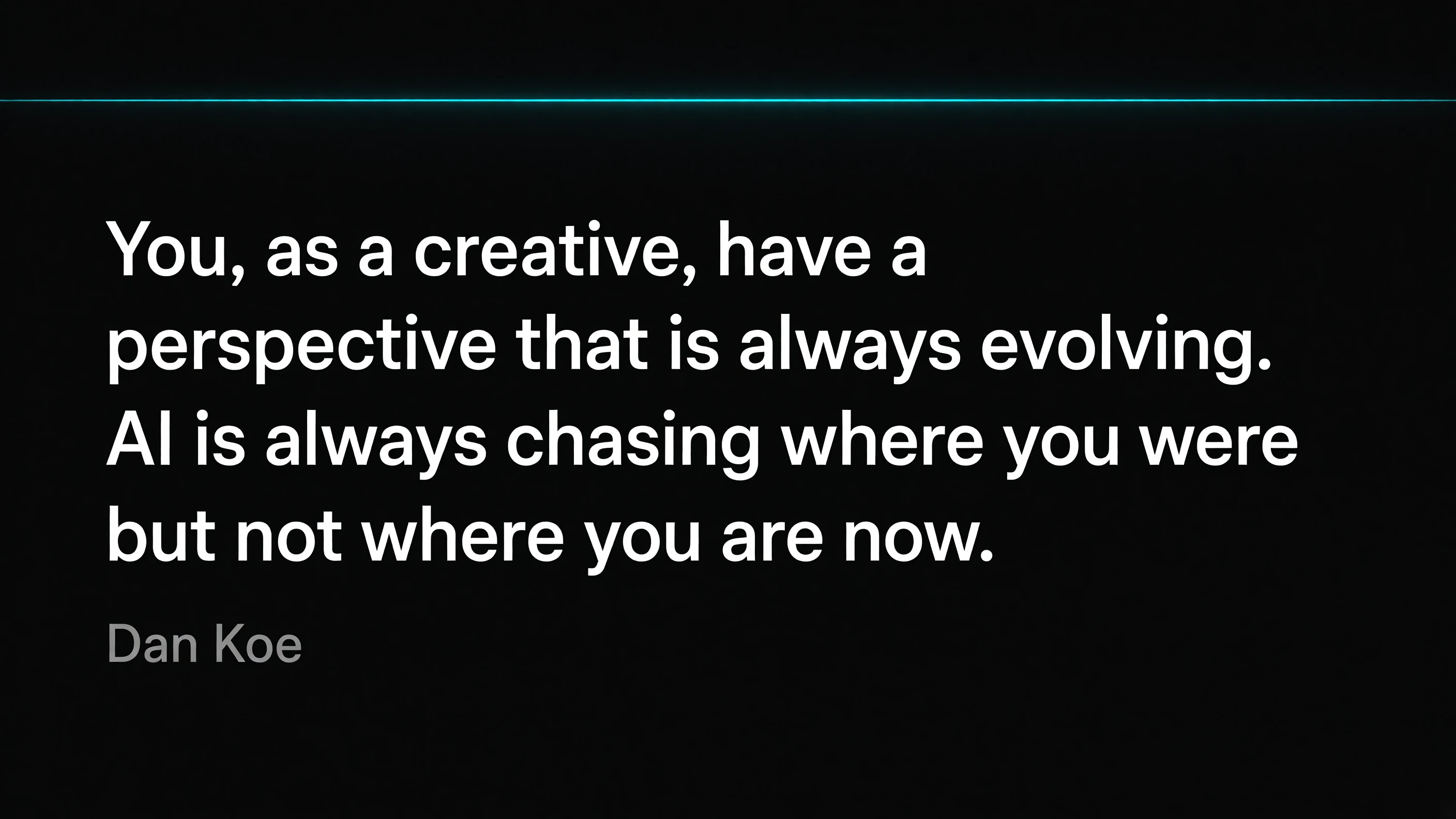
I asked a question out loud at an AI session this summer that I still cannot put down. In a workforce where intelligence is cheap and sitting in everyone's pocket, how do we build wisdom?
Nobody in the room had a clean answer. I did not have one either. What I noticed is how fast we all reached for the same borrowed one. Creativity. Collaboration. Communication. Critical thinking. The poster on the wall.
Then Justin Baeder shared Daisy Christodoulou's new AEI report, The Problem with Transferable Skills, and the poster got much harder to defend.
What Christodoulou actually argued
Her target is narrower than the headline suggests, so it is worth stating carefully. She is not arguing that creativity or collaboration are worthless. She is arguing that they do not exist as free-floating muscles you can train in one place and then use anywhere.
She is also honest about why that belief is popular. Two reasons. We are afraid of the AI-era job market and cannot predict which jobs survive, so generic skills feel like the safe hedge. And we disagree politically about what content students should learn, so "skills" lets everyone skip the fight.
The evidence does not cooperate.
Cognition is context-bound. Far transfer, the kind where something learned in one domain shows up in an unrelated one, is elusive. Near transfer, where it moves to a similar problem, runs on domain-specific knowledge.
Chase and Simon's chess work is the cleanest version of this. Chess experts recall real game positions far better than novices. Scatter the pieces at random on the same board and most of that advantage disappears. What the expert had was not a memory skill. It was chess.
Willingham makes the same point about critical thinking, and it is the one I would put in front of every curriculum team. You cannot look at an issue from multiple perspectives if you do not know the issue. Perspective-taking is not a procedure you run. It requires knowing enough to know that other perspectives exist.
Ericsson's deliberate practice research points the same direction. Getting better is not playing the whole game over and over.
And there is a sequencing finding that should change how we build units. Simon, Anderson, and Reder found that dropping students into a messy real-world project as the opening move can swamp working memory. The better sequence is explicit abstract instruction first, then practice across many varied contexts that make the underlying similarity visible.
Christodoulou's conclusion is blunt. The magic amulet does not exist. There is no generic skill you can hand a student that makes the domain knowledge optional.
The gap AI just opened
Here is my turn, and it is not a rebuttal of her argument. It is what her argument obligates us to build.
The tasks AI already handles well are the tasks that used to train young people. Boilerplate. First drafts. Lookup and summary. Routine analysis. The document review, the model check, the intake form, the grunt work that justified a first job.
That work was never valuable because it was hard. It was valuable because it put a twenty-two year old in a room, for a year, next to people who had judgment. You learned when to escalate. You learned what a client meant instead of what they said. You learned that the number was wrong before anyone told you why.
We are removing the low rungs of the ladder while telling students that a set of generic skills will carry them up.
What they need is wisdom, and wisdom is not a poster. It is domain knowledge plus judgment earned in company. It requires shared experience. Real work, in a real domain, alongside other humans who can tell you when you are wrong and are close enough to bother.
Much of this I believe because of the Air Force. The learning was hands on. On the job. You built the skill and the experience along the way, next to people who already had the work in their hands. It accumulated. It was not a one-off drill you finished and then forgot.
I keep a map for this distinction. The center names three things people smash together: experience, wisdom, and choice.
Living long enough builds patterns, habits, and memories. The map is honest about that. It does not guarantee wisdom.
Experience creates confidence in familiar knowledge. It teaches what worked before. It can trap you in what you already know. Past success becomes a present limit. The orange cluster calls that the trap of the past. Familiar answers feel safer. Old assumptions shape new choices.
Wisdom, on this map, is narrower. It learns from experience without being ruled by it. It knows when the past no longer fits.
Dylan Wiliam posted a line today that people pin on Piaget: "Intelligence is knowing what to do when you don't know what to do." He says that is a paraphrase. He found it on page 165 of John Holt's 1964 How Children Fail. Experience is knowing what to do when you already know. Wisdom is the other case.
View post on X
That is the job of the human in the room. An internship that only repeats last year's move is more experience. An internship where someone can tell you the old move is done is wisdom plus a present choice.
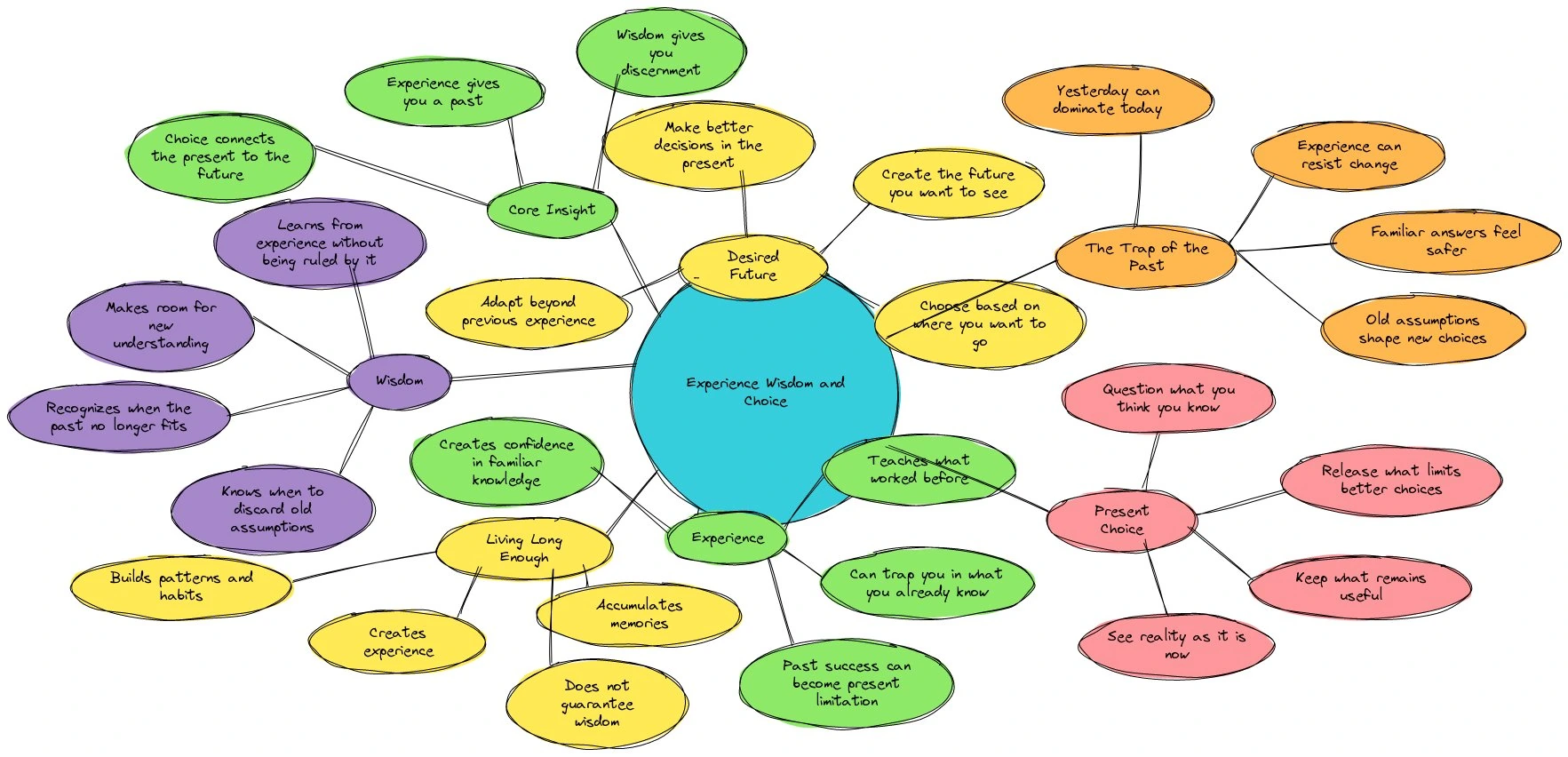
The graphic is unlabeled. I am using it as a thinking tool, not a published instrument.
Christodoulou gives us the design. Knowledge first, then practice across many varied contexts. The second half of that sentence is where shared experience lives, and it is the half schools underbuild. Internships. Apprenticeships. Simulations. Public showcases. Clinical rotations under another name.
None of that is teaching collaboration as a subject. It is the varied context, after the knowledge, with humans in the room.
I want to be careful about one misread, because it will happen. Christodoulou is not anti-making and she is not anti-project. The failure mode she identifies is treating messy real-world work as a substitute for knowledge, or treating critical thinking as a course you can schedule fourth hour. Our Wichita programs are the opposite arrangement. Domain work first, then public, shared practice.
Future Ready Centers
Our Future Ready Centers are pathway places, not a generic high school with a career-themed banner. Advanced Manufacturing. Biomed. HACK and IT. Students go deep in a domain with people who work in it, and the industry sits close enough to the classroom to correct it.
The HACK and IT FutureReady Center opened October 16, 2025 at WSU Tech South. WSU Tech reported more than 380 students enrolled across FutureReady Centers that semester.
This is where internships and industry-adjacent work belong, and where the sequencing matters most. An internship is not a field trip and it is not a substitute for the coursework. It is the varied context that comes after a student knows enough to notice what is happening. Put a student in a biomed lab with no biomed knowledge and you have given them a very expensive afternoon. Put them there in year three and they see the thing the technician is worried about.
Simulations do the same job when the real setting is scarce, dangerous, or licensed. A high-fidelity simulation gives you many varied reps in a compressed window, with a supervisor watching. That is the cheapest wisdom transfer we know how to build.
Creative Minds
Creative Minds is our public K-6 microschool. Multi-age classrooms, Montessori practice, project work, and morning circle. Students make things in front of each other.
Shared experience is not a side effect of the design there. It is the design. Morning circle is the daily practice of speaking to people who will respond, in a group that has to keep working together afterward. Multi-age grouping means an older student explains something to a younger one, which is the oldest and most reliable knowledge check we have.
Spaght and Code to the Future
Samuel E. Spaght Science and Communications Magnet was the first Code to the Future school in Kansas. Every student codes.
The clearest picture of what I am describing is the Showcase of Learning. Students build a LEGO robot, write the code that drives it, and send it down a line they designed. Then they stand next to it while it runs and other people watch.
That is domain-specific computer science plus a public performance with real stakes. The robot either follows the line or it does not, in front of an audience, and the student has to explain the fix. No computational-thinking worksheet does that work.
The test I would use
If you lead a school or a system, here is the test I would run on any program that claims to prepare students for an AI economy.
Name the domain. Not "the 4Cs." The actual body of knowledge the student is building, and where it is taught explicitly before anyone is asked to apply it.
Name the shared practice. Where does this student do the work in front of other people who can see it fail?
Name the internship or the simulation. Which varied contexts come after the knowledge, and who runs them?
Name the human in the room. Wisdom transfers through people. If there is no adult with judgment standing close enough to correct the work, you have a project, not an apprenticeship.
If a program cannot answer those four in plain language, it is not preparing anyone for an AI economy. And do not buy the transferable-skills unit. There is no unit. There is knowledge, and there is practice with other people, and the only shortcut anyone has ever sold you is the amulet.
Take a step. Then look.
Labor Day invites a speech about the future of work. I do not trust a long-range version of that speech.
Dan Koe's line is the honest horizon. AI is chasing where we were. It is not standing where we are. The further out we pretend to see, the more we decorate last year's job with new vocabulary.
The map says the same thing in a different color. Experience will try to run the next choice. Living long enough is not a plan.
So skip the ten-year forecast. Take one step you can watch.
Put a student in a real domain. Teach the knowledge first. Then shared practice, with a human close enough to say the old move is done. Measure whether they can do the work when the prompt is gone. If they cannot, change the step. Do not scale the poster.
That is how I learned it. On the job. One step, then another, with someone watching. Not to prove we predicted the future. To see, this week, whether judgment showed up in the room.