K-12 Esports Is Not One System
A source-backed 51-jurisdiction dashboard separating esports participation, state-association status, leagues, and instructional pathways, with a detailed Wichita Public Schools case study.
Before the dashboard, there was a conversation
My introduction to K-12 esports did not begin with a strategy document, a vendor pitch, or a national participation report. It began in 2018 at Omaha Public Schools with Regina Lupo, a member of my help desk staff. Regina introduced me to her son, Benjamin Lupo, known to millions of people online as DrLupo.
DrLupo showed me that gaming could become more than competition or entertainment. In 2018, he was already using his platform to rally a community around St. Jude Children’s Research Hospital. By the end of 2022, his Build Against Cancer campaigns and related fundraising had helped raise about $13 million for St. Jude. The scale was impressive. The deeper lesson was what made that scale possible: belonging, shared purpose, teamwork, production, storytelling, and a community willing to act together.
That conversation with Regina changed how I understood esports. I began to see a learning environment hiding inside what many school systems still dismissed as kids playing video games. Esports could create a place for students who had not found their place elsewhere. It could connect competition to technology, media production, communication, career exploration, and service.
When I came to Wichita Public Schools in 2019, I carried that lesson with me. Working with Clint Dayhuff, our esports specialist, we began building a district esports program around access and progression, not just isolated teams. The work grew into Gaming Concepts classes, competitive teams across grade levels, a district esports arena, and pathways that connect play with technical and creative skills.

The national dashboard below grew from that local experience. To understand what K-12 esports has become, we have to stop treating every team, league, association, class, and participant count as evidence of the same system. They are different signals. Wichita’s story is one example of what becomes possible when a district designs those signals to work together.
From answering problems to defining them
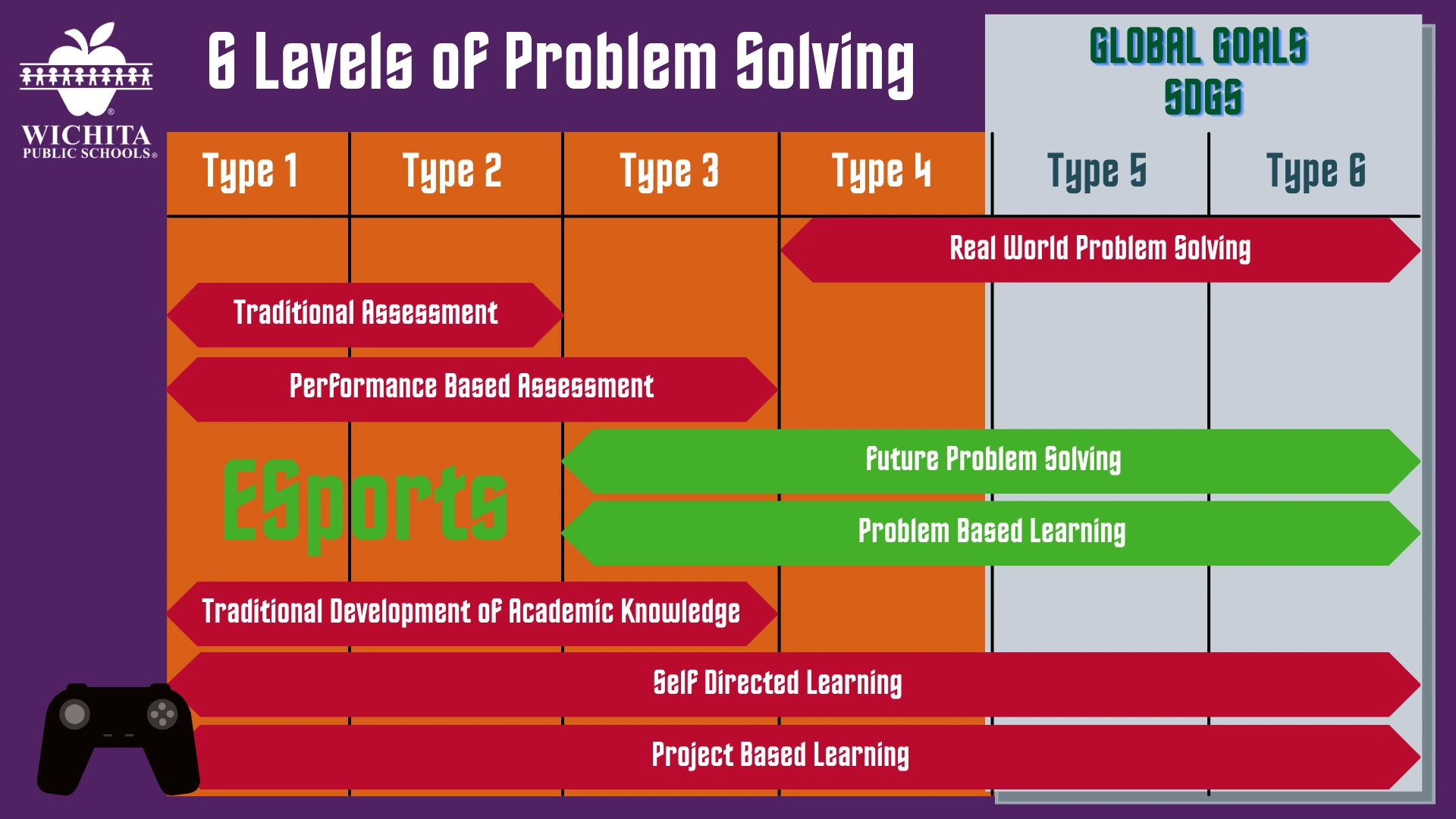
The DISCOVER Problem Continuum classifies six kinds of problems according to what the presenter and solver know about the problem, method, and solution. It is a framework for designing tasks and observing problem solving, not a ranking of student ability.
Types I and II are closed: the problem and one correct solution are known, while Type II leaves the method for the solver to determine. Type III permits a range of methods but retains a known solution. Type IV permits ranges of methods and solutions. Type V defines the problem while its methods and solutions remain unknown. In Type VI, the problem, method, and solution are undefined. C. June Maker and Shirley Schiever developed this six-type continuum at the University of Arizona by expanding earlier work by Getzels and Csikszentmihalyi.
The Wichita graphic maps familiar school practices onto that continuum. That mapping is a local interpretation, not a claim validated by the University of Arizona. Its useful provocation is the widening gap between solving a supplied problem and framing a problem worth solving.
Well-designed esports can function as an adaptive simulation inside that gap. A student acts, receives immediate evidence, revises a strategy, coordinates roles, and tests again under changing conditions. James Paul Gee described how good games lower the cost of failure, provide continuous feedback, vary problems, and challenge routine mastery. Productive-failure research makes the boundary equally important: failure becomes educational when the task is accessible, students can revise, and instruction or consolidation follows.
Transfer is not automatic. Becoming better at one game does not prove broad problem-solving growth. Coaches and teachers have to make the learning visible through reflection, debriefing, varied scenarios, and explicit connections beyond the game. Under those conditions, esports can give students repeated practice with recovery after setbacks, systems thinking, strategy switching, decision-making under change, and collaborative role coordination, forms of practice that conventional first-pass assessment often underemphasizes.
Research boundary. DISCOVER did not study esports, and the continuum does not establish that gameplay causes transferable skills. This section applies the framework as a learning-design lens, supported by separate research on games, feedback, productive failure, and preparation for future learning.
Sources behind this interpretation
- Maker and Bahar, 2025: closed, semi-open, and open DISCOVER tasks
- Bahar and Maker, 2015: six-type matrix and definitions
- Maker, 2005: DISCOVER monograph
- Gee, 2005: learning principles in good games
- Sinha and Kapur, 2021: productive failure meta-analysis
- Schwartz, Bransford, and Sears, 2005: preparation for future learning
Four signals, kept separate.
Explore NFHS survey participation, association status, league operators, and instructional pathways. A missing survey row is shown as NR, not zero.
Tile color shows association status. The number is the 2024-25 NFHS survey participant value; NR means the state was not separately reported in the extracted tables. Neither measure is a census, ranking, or legal conclusion.
The finding
K-12 esports is not one national program. It is at least four overlapping systems: an NFHS survey measure, state-association governance, vendor and nonprofit competition, and school or state instructional pathways. Most public descriptions collapse those systems into a single claim that esports is sanctioned or growing. That shortcut produces confident numbers that do not measure the same thing.
This study keeps the measures separate. A state can have substantial league activity without association sanctioning. A state association can operate championship weeks while labeling esports non-sanctioned. A course can use gaming as a vehicle for programming, media, teamwork, or career exploration without being a formal esports CTE pathway.
What the national number means
The 2024-25 NFHS High School Athletics Participation Survey reports 30,440 esports participants: 25,651 boys and 4,789 girls. The extracted state table contains separate esports rows for 23 member associations. This is association-reported survey data, not a census of every school club, provider league, or student playing competitively.
The same survey lists 2,285 boys reporting-school program slots and 1,275 girls reporting-school program slots. Those values cannot be added into 3,560 unique schools because a school may appear in both tables. Missing state rows are labeled not reported, never zero.
How to read the dashboard
The association filter uses five conservative categories: sanctioned championship, association-operated non-sanctioned, recognized or partnered, third-party only, and not yet verified. Provider availability does not establish sanctioning. The pathway filter separates statewide frameworks, district or school examples, related pathways, and evidence not yet verified.
Every state panel shows the evidence date, direct source when available, and a caveat. Not yet verified means the research pass did not locate current public evidence. It does not mean no esports activity exists.
Where the evidence is strongest
Current official pages confirm sanctioned championship structures in Georgia, Kansas, Kentucky, Mississippi, New Hampshire, New Mexico, Utah, and Virginia. Louisiana is the useful counterexample: LHSAA publishes an esports calendar and championship weeks but places esports under Non-Sanctioned. Texas is the opposite kind of warning. Third-party leagues operate there, but UIL has repeatedly declined sanctioning.
Instructional evidence is thinner and not comparable across states. Texas has an approved half-credit Gaming Concepts: Fundamentals course for grades 9-12. Alabama publishes a Computer Game and Simulation Programming framework. California has aligned curriculum and district-level game-design examples. Utah publishes related digital technology pathways, but the state does not label those pathways as esports courses.
Wichita Public Schools case study
The local case study below shows what a fuller system can look like when access, instruction, competition, production, and progression are designed together. It also shows why the evidence boundary matters. Device counts, school sites, teams, course enrollment, and participant counts are different units. None should be silently substituted for another.
Limits
This is a public-source snapshot verified through July 23, 2026. State structures change, association terminology is inconsistent, and several direct pages block automated retrieval. The dashboard preserves uncertainty instead of converting missing evidence into a negative claim. It is research, not legal advice, a ranking, or a complete census of K-12 esports.
Core sources
Wichita built an esports system, not just teams
Wichita Public Schools began with an access decision. In 2020, the Board authorized up to $544,400 for 320 gaming desktops, entered five high schools in HSEL, and added Gaming Concepts as an elective. That amount was an authorization ceiling, not confirmed actual spending.
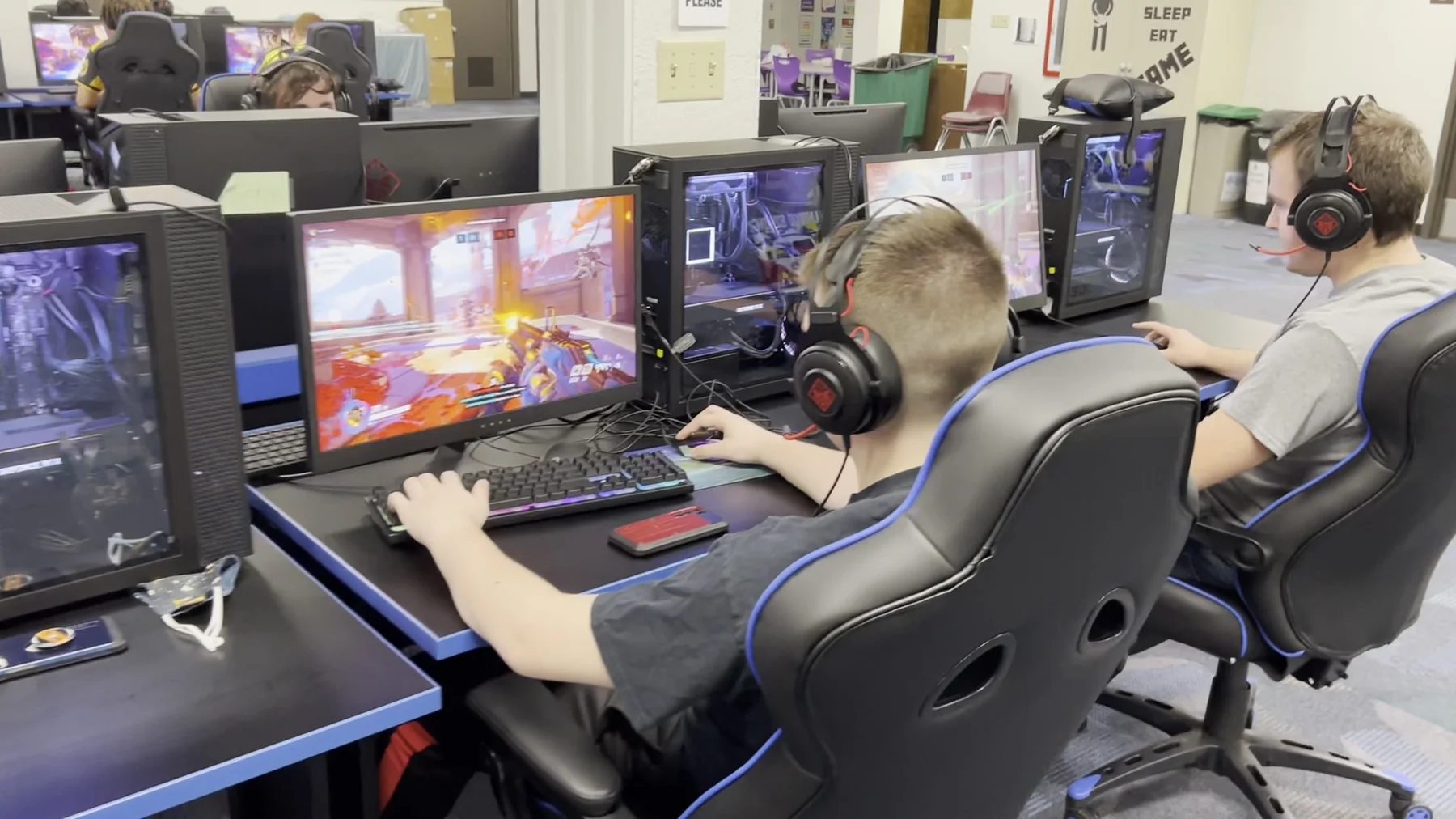
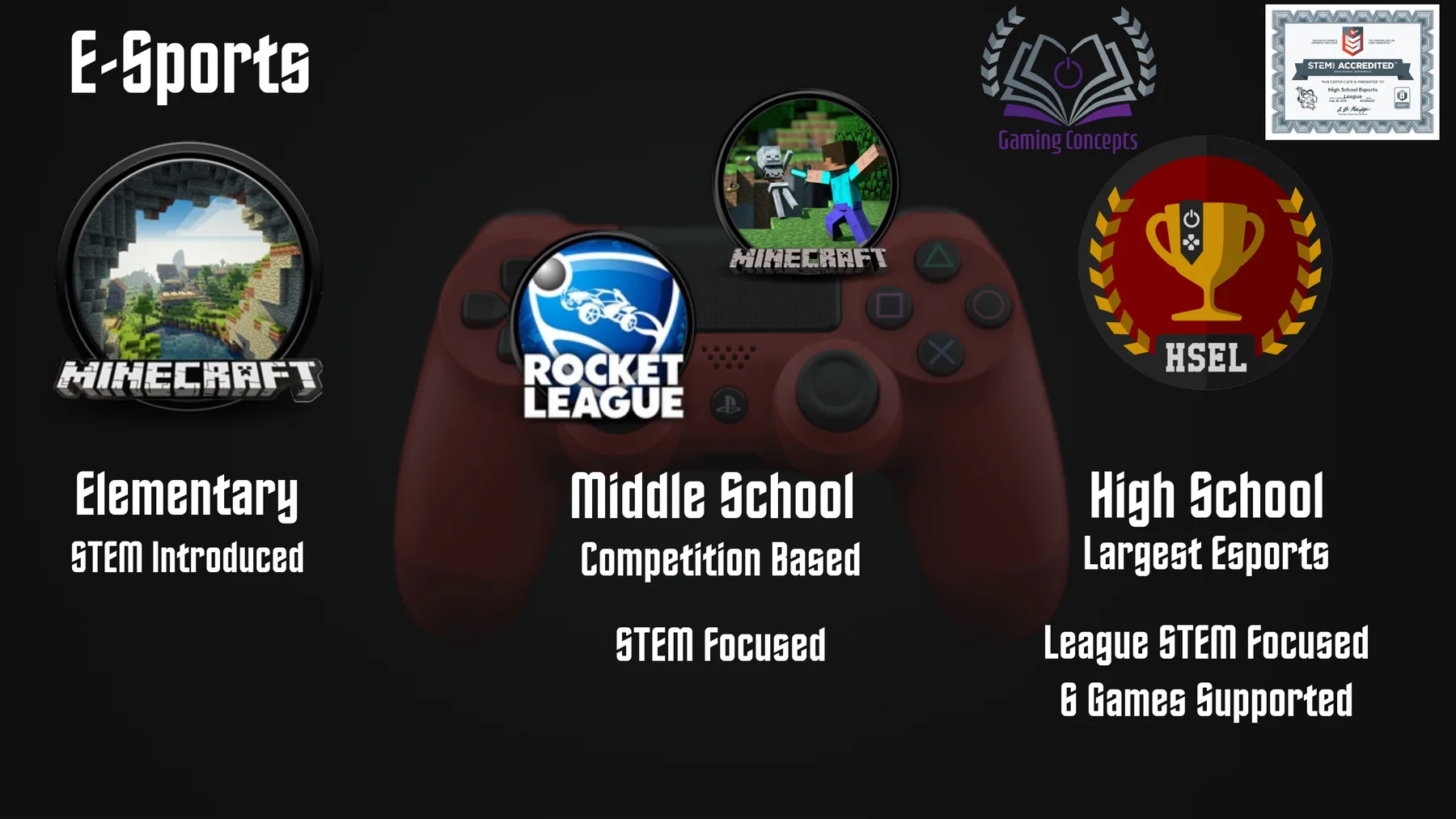
By July 2026, the district described a footprint of nine high schools, 16 middle schools, and four alternative schools. All nine high schools field teams, Gaming Concepts is integrated at most middle and high schools, and the district arena provides a common competition space.
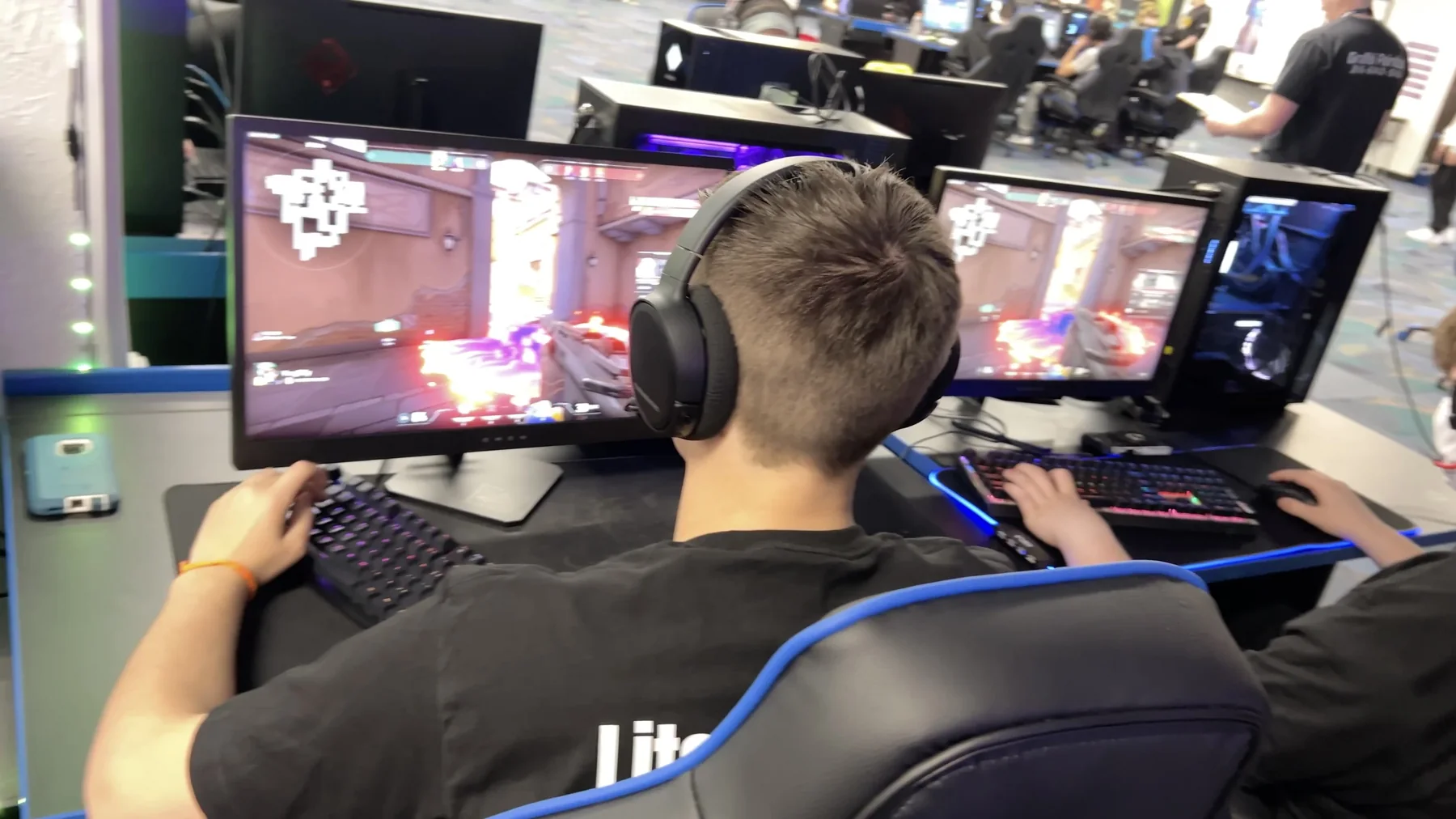
Competition has also matured. Kansas launched a KSHSAA-sanctioned state championship for 2025-26 with PlayVS as administrator. Wichita Northwest reached the Super Smash Bros. Ultimate semifinal on January 31, 2026, losing to eventual runner-up Hugoton. That was a game-title semifinal, not an overall placing or state title.
The instructional story needs precision. Public evidence verifies Gaming Concepts classes and adjacent pathways in media design, programming, networking, cybersecurity, marketing, finance, and entrepreneurship. It does not establish a standalone district esports CTE pathway, formal college articulation, or esports-specific dual credit.
Participation is also incomplete. KSHSAA reported 20 to 25 full-time East High players in spring 2025, while KSN reported around 50 East players per season in 2023. The years and definitions differ, so they are not a trend and cannot be converted into a district total. Wichita does not publicly report a current unduplicated participant count, complete results archive, or current title inventory.
What Wichita’s two studies found
The studies answer different questions. The Wichita State field study explains what participants experienced. The Marzano and Magana report tests whether participation was associated with attendance and behavior differences over five years. Neither study, by itself, proves that esports caused the outcomes.
It Takes a Spark to Ignite a Fire: Developing Efficacy and Connections Through Esports
Method. A qualitative case study at four selected Wichita Public Schools high schools with 44 administrators, team captains, players, and coaches. The team used interviews, focus groups, documents, observations, constant comparative analysis, and triangulation.
Finding. Participants consistently described social benefits, stronger relationships with peers and adults, greater school connection, and opportunities to build confidence. Adult participants perceived esports as a catalyst for academic and behavior improvement, while students described attendance and passing-grade requirements as reasons to stay eligible.
Read this carefully. This is a selected-sample study of participant perceptions. It does not estimate a causal effect on attendance, grades, behavior, or districtwide outcomes.
A Study of the Relationship Between Participation in Gaming Concepts and Esports and Student Attendance and Incidents of Misbehavior
Method. The study compared grades 6 through 12 participation in Gaming Concepts, esports, or both with nonparticipation across five school years, from 2020-21 through 2024-25. Analyses included annual group comparisons, standardized effect sizes, and a multilevel attendance model accounting for school-level differences.
Finding. Participation was associated with higher attendance in every year studied. The multilevel model estimated 2.2 additional days for Gaming Concepts only, 5.2 for esports only, and 7.4 additional days per year for students in both. The report also estimated 10 to 50 percent fewer behavior incidents, depending on the group and year.
Read this carefully. The PlayVS-commissioned report explicitly says the findings are descriptive. It does not establish causation. Selection bias was not addressed, combined-program groups were small, repeated comparisons increase false-positive risk, and behavior counts were highly skewed.