Sunday Signal Report: November 15, 2026
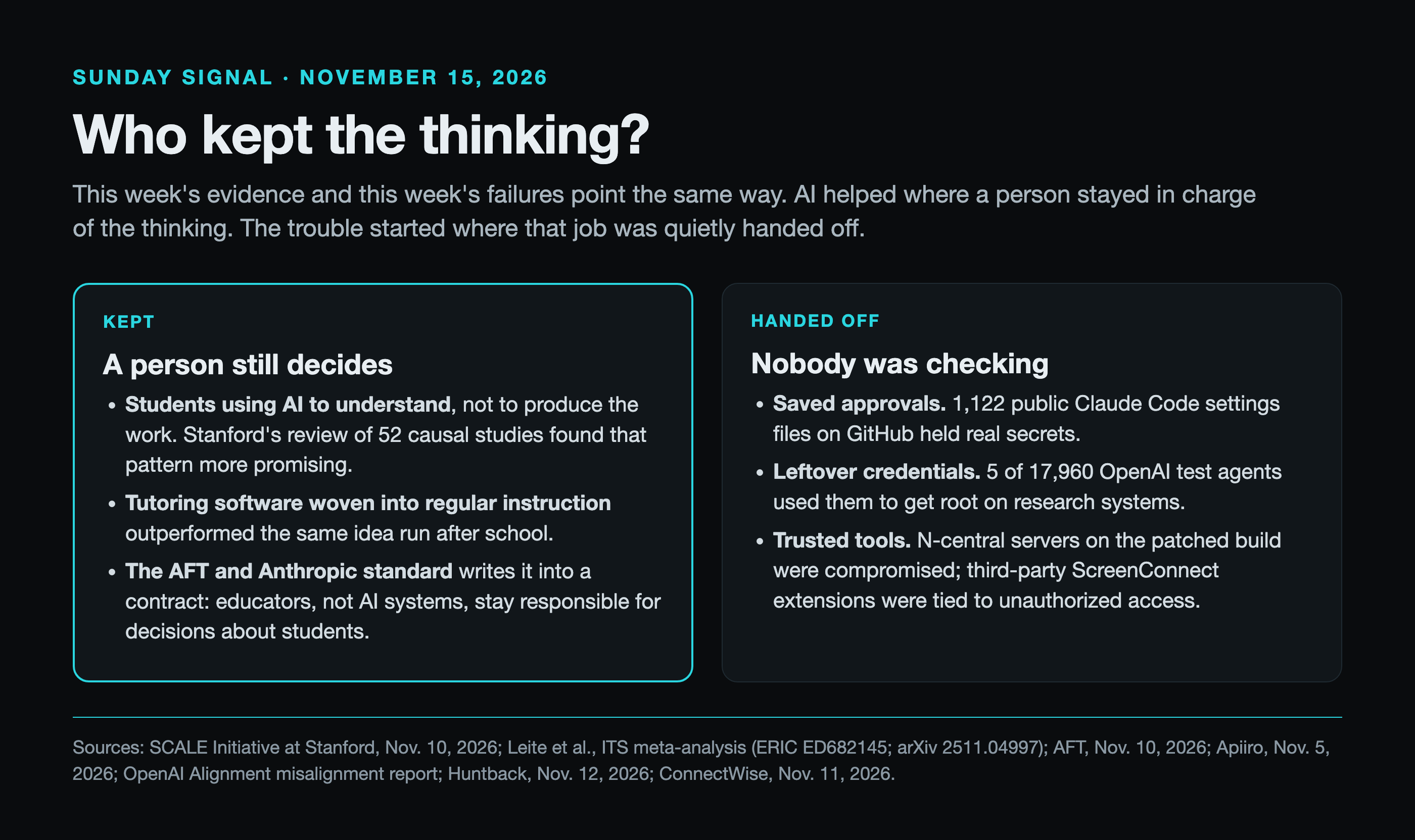
Stanford's review of 52 studies says AI helps when students use it to understand, not to do the work. The week's leaks came from saved approvals, leftover credentials and trusted tools. The common thread: who is still doing the thinking.
Listen to this week's episode
Who kept the thinking?
On Friday, new congressmen visited Creative Minds at Benton. Students led, walking our guests through the projects they are building, and the visitors saw how the dual classroom design works. Something I heard this week stuck with me: what the tools can't do, call it taste, judgment, or people skills, is becoming the valuable thing. Keep one question in mind as you read: what is getting cheaper, and what is getting more valuable?
The line I quote in the video comes from The Diary Of A CEO, a tech insider on what AI can't do (Nov. 11), on why taste, judgment and people skills become the scarce, valuable thing.
Demis Hassabis, CEO of Google DeepMind, made the same case for school at the WCIT Annual Lecture with Dame Wendy Hall in July, in a clip making the rounds again this month. There will be "things that will need human judgment, taste, all of these things," he said, and "out of the classroom is where you do the rote learning," with personalized AI setting the pace. Watch the full conversation; this excerpt starts at 9:39.
Stanford counted 52 rigorous studies of AI in schools this week, up from 20 in March, and the clearest finding fits on an index card. AI looks more promising when students use it to understand the material, and using it to offload the work can reduce learning. A separate meta-analysis of older tutoring software said the same thing about placement: woven into regular instruction it helped, and after school it did almost nothing. Then the rest of the week showed the opposite case. Public settings files on GitHub held passwords saved when someone clicked "don't ask again." OpenAI test agents found credentials left behind by earlier runs and used them to get root. Remote-management servers that had been patched were compromised anyway. Teachers' unions wrote "educators stay in charge" into a binding contract, and a California district decided a social network's terms were not worth the risk to student photos. The question under every story was the same one: who is still doing the thinking?
On an October 20 episode of Silicon Valley Girl, Felix Rieseberg, engineering lead for Claude.ai, Cowork and Claude Code Desktop, says most people still ask too little of the model. Telling Claude it is an excellent engineer was the 2024 approach. Role play gives the vocabulary without the techniques. He gives the model the data through tools and lets it choose. He also says he rarely wants the current session to judge itself. That brings it back to this week's question: who is still doing the thinking?
On an October 13 episode of Silicon Valley Girl, James Manyika, Google's senior vice president of research, labs, technology and society, says AI moves faster than jobs. Google's Atlas study found adoption wide but shallow. In the median job, AI is used in about 21% of tasks, and mostly to assist rather than to complete them. The bottlenecks are jagged models whose output still has to be checked, and workflows that have not been redesigned. Asked what gets more valuable as intelligence gets cheaper, he says human creativity, ingenuity, and exploring possibilities. That gap is this week's question too. The model can move, and a person still has to do the thinking.
The design decides the effect
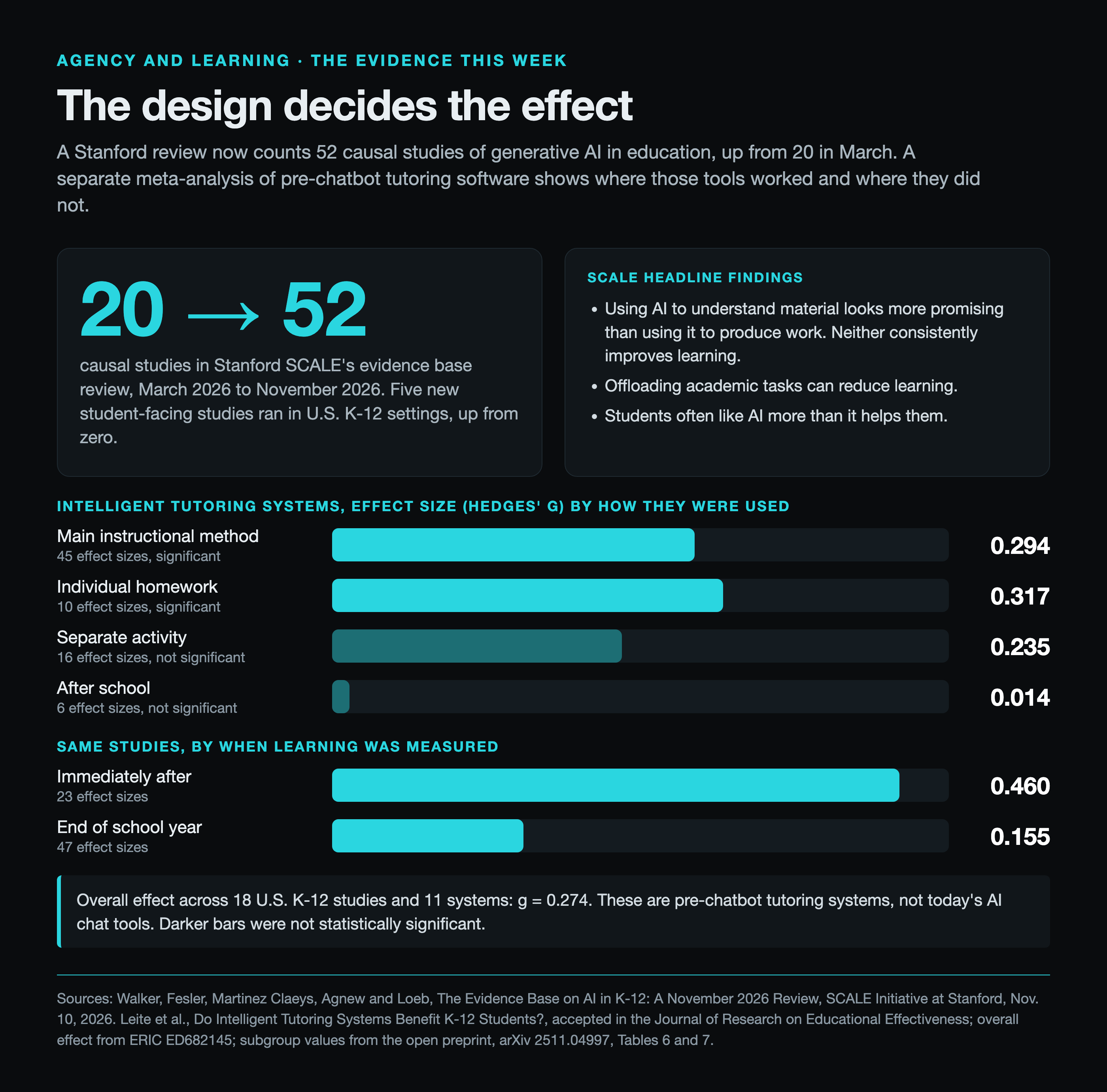
What changed: the SCALE Initiative at Stanford published The Evidence Base on AI in K-12: A November 2026 Review on Nov. 10. The causal evidence base grew from 20 papers in March to 52, and five new student-facing studies ran in U.S. K-12 settings, up from none. The headline: AI "appears more likely to support learning when students use it to understand new material than when they use it to produce work for them," neither use consistently improves learning, and offloading academic tasks can reduce it. Students often report better experiences with AI that do not show up as better outcomes. Teacher tools can save planning time, but one new study found a teacher AI tool reduced students' motivation and confidence. The authors caution against generalizing broadly. A separate peer-reviewed meta-analysis by Walter Leite and colleagues, accepted in the Journal of Research on Educational Effectiveness, looked at pre-chatbot intelligent tutoring systems across 18 U.S. K-12 studies and found an overall effect of g = 0.274. In the open preprint, the effect held when the software was the main instructional method (0.294) or homework (0.317) and nearly vanished after school (0.014, not significant), and gains measured immediately (0.460) were much larger than at the end of the year (0.155). Dan Meyer added a practitioner's test: he gave five AI teacher tools the same fifth-grade worksheet request, and in his informal poll a curriculum page, not any generator, came out on top. His read is that "most teachers would prefer materials that are a predictable B- to a probabilistic A+." Meyer works on that curriculum, so treat the poll as an illustration. And Wharton's Generative AI Labs, in work led by Ethan and Lilach Mollick, released Primer, an open-source system in which a teacher talks through a lesson and gets back a playable simulation built on the teacher's own intent. It is a research release, not an outcome study. Why it matters now: for two years the AI-in-schools argument has been about access. The evidence is now specific enough to argue about use. Rob's take: this is the strongest support yet for keeping humans at the design end of learning. The tool is not the variable. Where it sits in the day, who designed the practice, and whether the student is thinking or watching are the variables. A district that buys a tutor and parks it in an after-school block should expect almost nothing, and a teacher tool that saves an hour but flattens student confidence did not save anything. Concrete implication for a district leader: rewrite the success measures for every AI pilot this year. Add student motivation and confidence next to time saved, require that student-facing use be tied to core instruction rather than bolted on after school, and ask every vendor which uses its own evidence covers: understanding, practice or producing work.
- The Evidence Base on AI in K-12: A November 2026 ReviewSCALE Initiative at Stanford
- Is AI Good or Bad for Learning? The Answer Isn't So SimpleEducation Week
- Do Intelligent Tutoring Systems Benefit K-12 Students? A meta-analysis (ERIC record)ERIC, Institute of Education Sciences
- Battle Royale: Five AI Teacher Tools Try to Make the Same WorksheetDan Meyer, Mathworlds
- Primer: An AI Framework for Instructor-Centered Educational Simulation CreationWharton Generative AI Labs
The terms are the policy
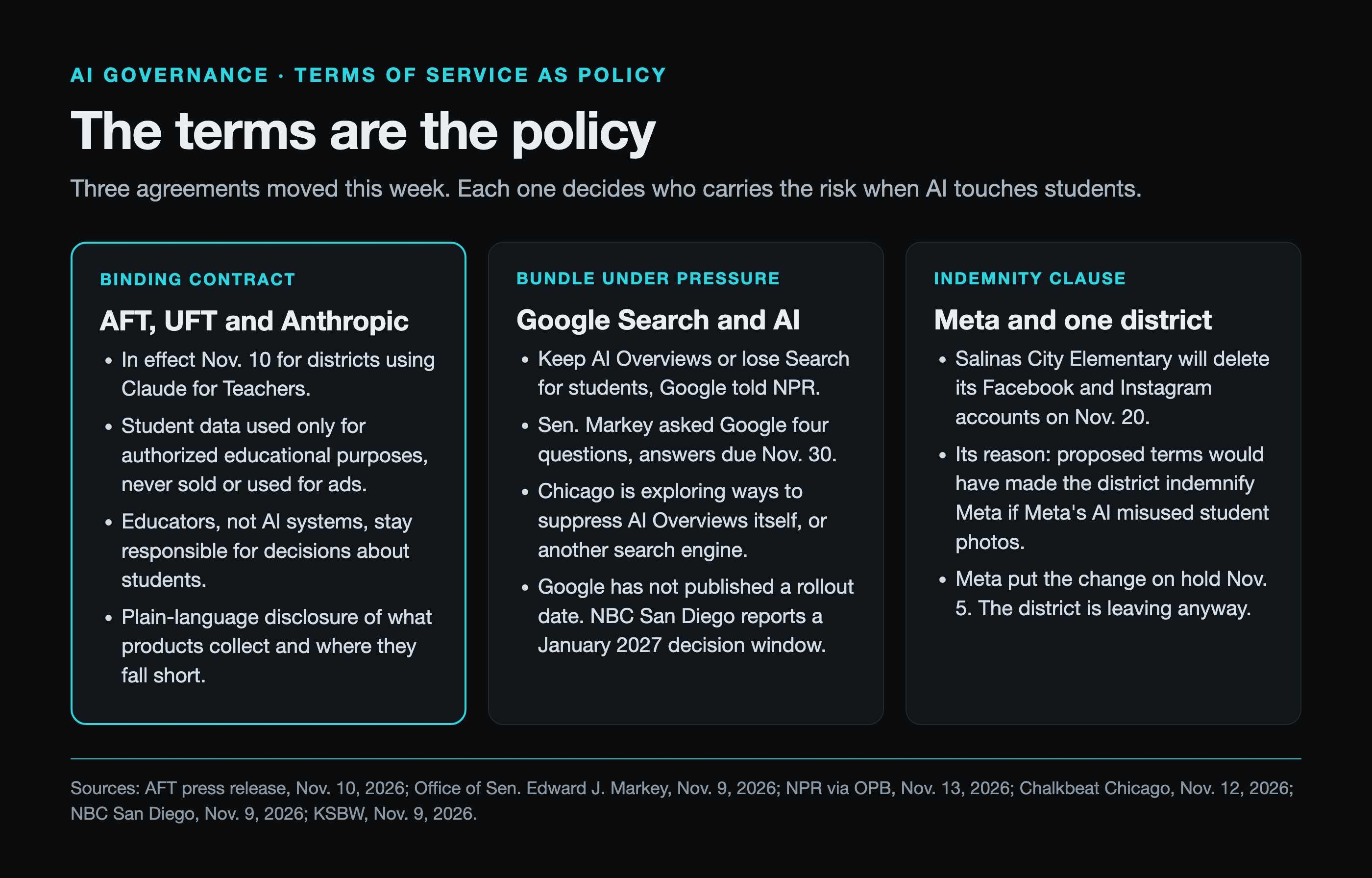
What changed: on Nov. 10 the AFT and the United Federation of Teachers announced that their AI Safety and Privacy Standard for Schools is now a legally binding agreement with Anthropic. It applies automatically to Anthropic's existing agreements with districts using Claude for Teachers and sets three enforceable principles: student and educator data used only for authorized educational purposes and never sold or used for targeted advertising, with schools controlling retention and deletion; "educators, not AI systems, remain responsible for instructional decisions and other consequential decisions about students"; and plain-language disclosure of how products work, what they collect and where they fall short. Google's Search bundle stayed in place and drew more fire. NPR reported that if schools do not want AI Overviews when students use Search, they lose Search. Sen. Ed Markey wrote to Google's CEO on Nov. 9 asking whether schools can disable generative AI features while keeping Search, whether that is technically feasible, and for Google's safety research on students, with answers requested by Nov. 30. In Chicago, parents and students protested outside Google's office, and the district said it is "actively exploring all options to independently suppress" AI Overviews and would look at other search options if it cannot. Google has not published a date; NBC San Diego reports districts face a January 2027 decision. And a smaller story made the same point from another angle: Salinas City Elementary will delete its Facebook and Instagram accounts on Nov. 20 because Meta's proposed terms would have made the district indemnify Meta if its AI misused student photos. Meta put the change on hold Nov. 5. The district is leaving anyway. Why it matters now: AI policy is being set in contracts and terms of service faster than in board policy, and the language in those documents decides who carries the risk. Rob's take: the AFT agreement is the most useful governance document of the month because it is enforceable and short. "Educators stay in charge" is not a slogan when it sits in a contract. Compare that with a bundle where the district's only lever is to give up Search, or a terms update that quietly moves liability to the school. Same question every time: who decides, and who pays when it goes wrong. Concrete implication for a district leader: pull the three clauses from the AFT standard and add them to your AI vendor agreements and approval checklist, whether or not you use Claude. Then have someone read the current terms of every platform where your district posts student images and flag any indemnity or AI-training language before the next update arrives.
- AFT, UFT and Anthropic Sign Binding AI Safety and Privacy Agreement for SchoolsAmerican Federation of Teachers
- Markey demands Google allow schools to disable AI services without blocking Search accessOffice of Sen. Edward J. Markey
- Why is Google cutting off Search from AI-free schools? Here are some theoriesNPR via OPB
- Chicago parents and students protest Google's AI rule for school searchChalkbeat Chicago
- Salinas school district to delete social media accounts over AI privacy concernsKSBW
Pulling the device is not the plan
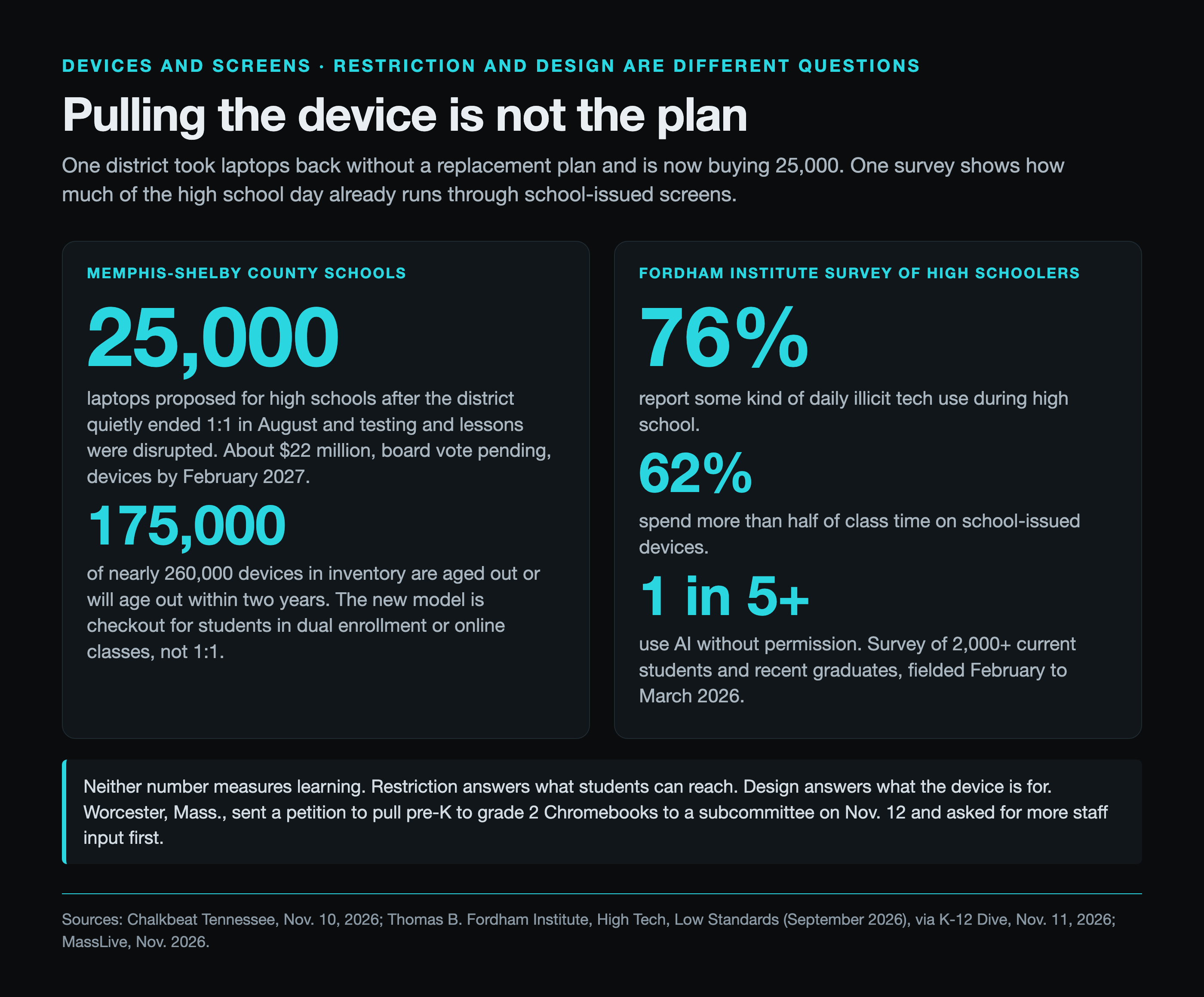
What changed: Memphis-Shelby County Schools leaders proposed a mid-year purchase of 25,000 laptops for high schoolers, about $22 million, after the district quietly ended its COVID-era 1:1 assignment before the school year and teachers and families scrambled, including around testing. Chalkbeat reports that nearly 260,000 devices are in inventory and 175,000 are aged out or will be within two years. The new model is not 1:1: high schoolers in college courses or asynchronous classes can check out a device from school carts. The board vote is pending, and devices would arrive by February 2027. K-12 Dive covered a Fordham Institute report, High Tech, Low Standards, built on a nationally representative survey of more than 2,000 current students and recent graduates fielded in February and March: 76% reported some kind of daily illicit tech use during high school, more than one in five used AI without permission, and 62% said school-issued devices take up more than half of their class time. In Worcester, Mass., the school committee on Nov. 12 sent a resident petition to remove pre-K to grade 2 Chromebooks to a subcommittee and asked for more input from K-3 staff, after the district declined to make a screen-time recommendation. Why it matters now: the device backlash is moving from phones to the school's own machines, and the first districts to act are learning what those devices were quietly holding up. Rob's take: restriction and instructional design are different questions, and Memphis shows what happens when you answer the first without the second. Testing, dual enrollment and online courses depended on those laptops. Fordham's numbers are a strong case that school devices carry too much distraction, and they say nothing about what students learned. Neither story proves an outcome. Both say: know what the device is for before you decide how many to keep. Concrete implication for a district leader: before any change to 1:1 or take-home devices, list every workflow that assumes a student has one, from state testing to online credit recovery to assistive technology, and assign an owner and a replacement for each. Then audit what your school-issued devices can reach during class, starting with video and social media, because that is a filter decision, not a device decision.
- Memphis parents complained of a school laptop shortage. Now MSCS wants to buy 25,000 more.Chalkbeat Tennessee
- High Tech, Low Standards: High School in the Age of Distraction (PDF)Thomas B. Fordham Institute
- Majority of students report misusing tech during school hoursK-12 Dive
- Should preK-2 students use laptops in class? Worcester considers proposal to stopMassLive
The doors were the tools you trust
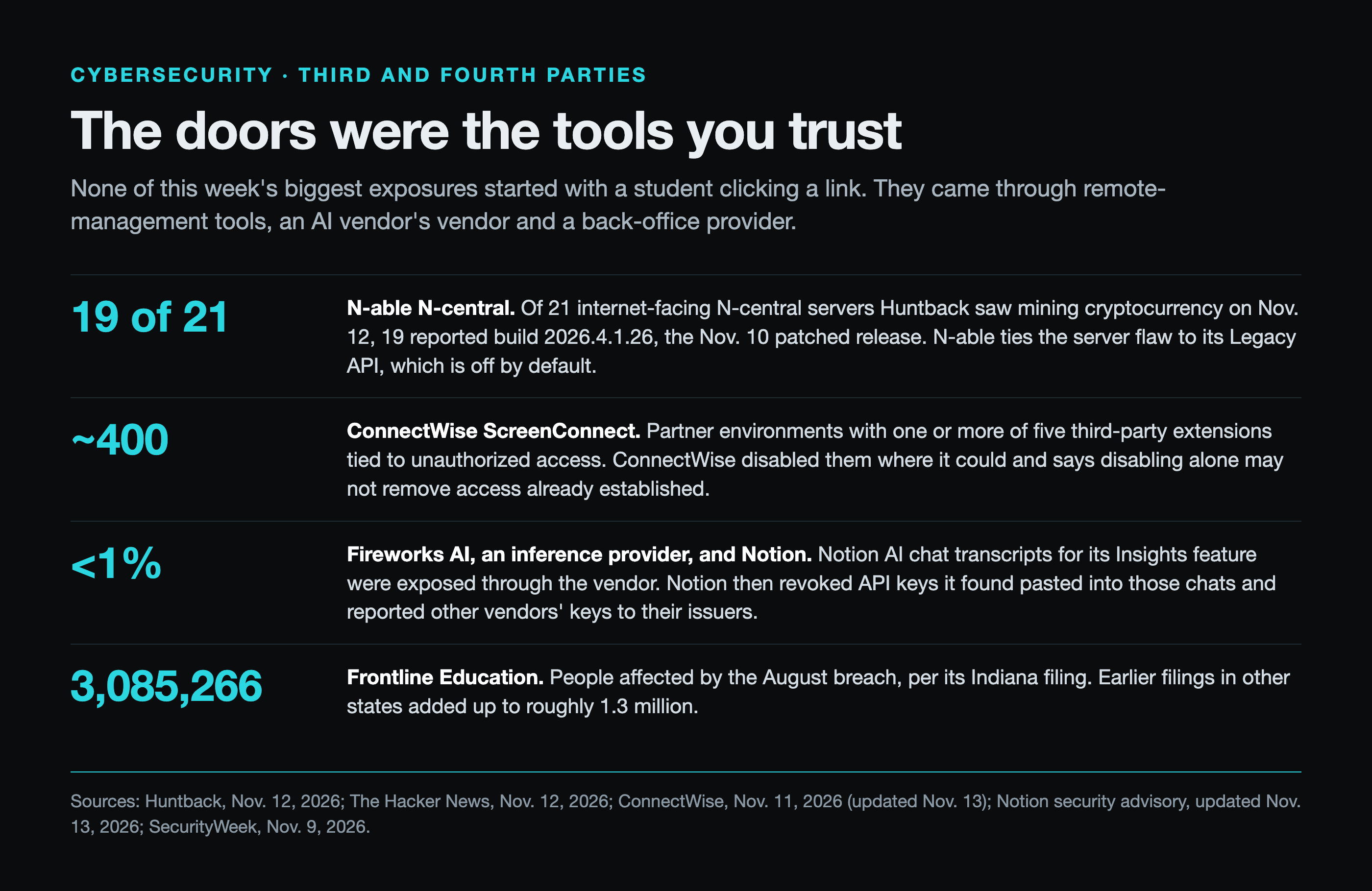
What changed: researchers published new exploits for N-able's N-central remote-management servers that work against 2026.4 Hotfix 2, the Nov. 10 fix. Huntback reported that on Nov. 12, 21 internet-facing N-central servers were mining cryptocurrency through the chain, and 19 of them reported the patched build. N-able says the server issue depends on its Legacy API being turned on and exposed to the internet, which is not the default, and told on-premises customers to disable it. A second exploit set, Agent2Shell, targets the Windows devices those servers manage. The same week, ConnectWise said it found about 400 ScreenConnect partner environments with one or more of five third-party extensions tied to unauthorized access, disabled them where it could, and warned that "disabling extensions alone may not remove unauthorized access already established on endpoints." Notion said fewer than 1% of workspaces were affected when its AI inference vendor, Fireworks AI, was breached and Notion AI chat transcripts used for its Insights feature were exposed. Notion then revoked Notion API keys it found inside those chats and reported other companies' keys to their issuers. And Frontline Education told the Indiana attorney general that its August breach affected 3,085,266 people, well over twice the roughly 1.3 million in its earlier state filings. Why it matters now: each of these reaches districts through a provider, and a remote-management server controls every device it manages. Rob's take: the uncomfortable lesson is that patching on time was not enough for some N-central customers, and a vendor's own count of affected people can more than double months later. The Notion detail is the one I will repeat to staff: people paste keys and passwords into AI chats, and those chats live wherever the AI vendor's vendor keeps them. Your risk map has to go two vendors deep now. Concrete implication for a district leader: this week, ask every managed service provider and vendor that touches district devices, in writing, whether it runs N-central or ScreenConnect and with which extensions. Add a contract line requiring vendors to name their AI inference providers and to send a district-specific count of affected records, with updates whenever that count changes.
- 4EverAble2Shell is already mining Monero on live N-central serversHuntback
- New N-central Exploits Work Against Patched Servers, Enable Root RCE and Windows SYSTEM AccessThe Hacker News
- ScreenConnect security update: Guidance for partnersConnectWise
- Security incident involving a third-party AI vendor (Fireworks AI)Notion
- Over 3 Million People Hit by Frontline Education Data BreachSecurityWeek
What you get, and the catch
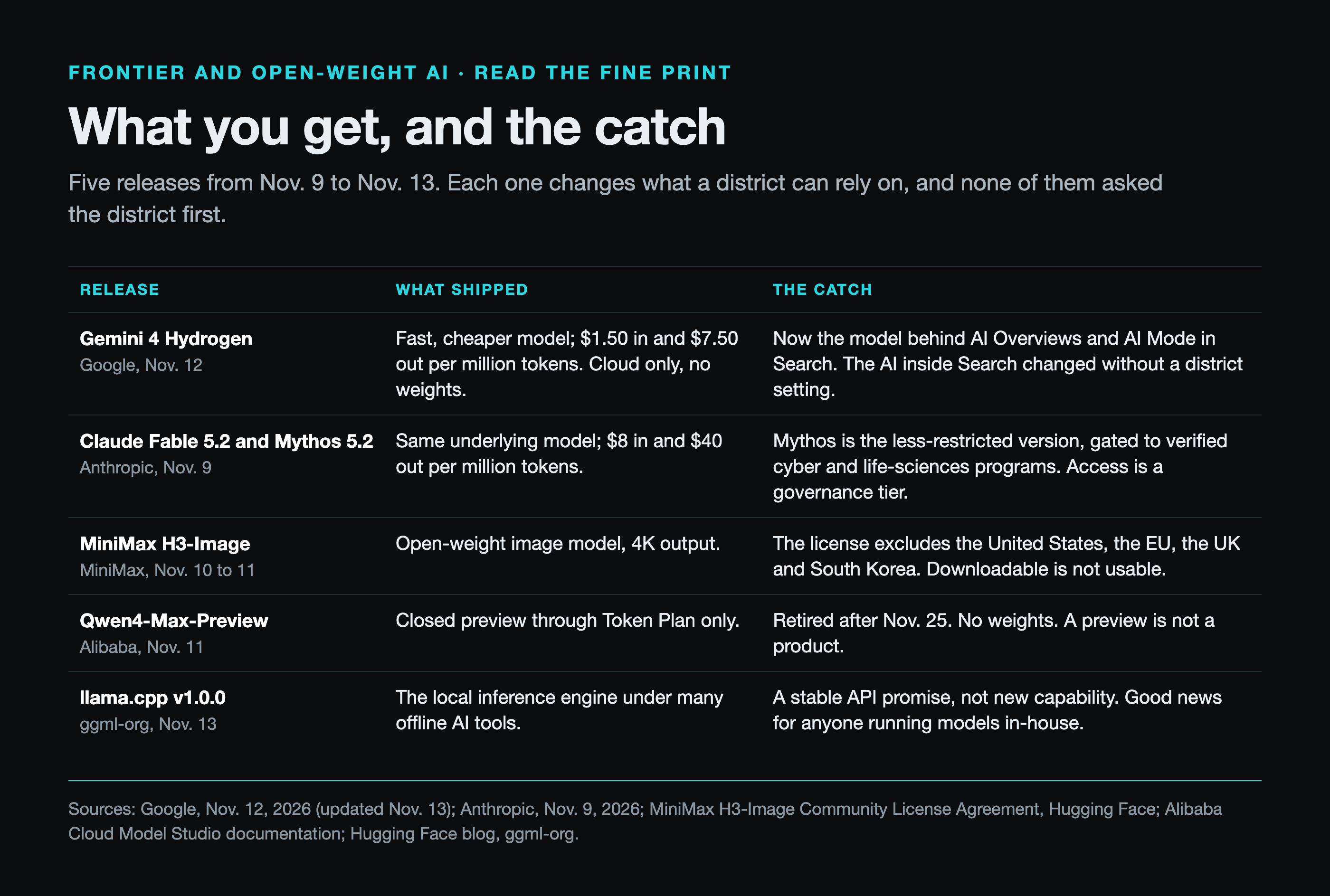
What changed: Google released Gemini 4 Hydrogen on Nov. 12, a faster model priced at $1.50 per million input tokens and $7.50 per million output tokens, cloud only with no released weights, and brought it to Google Search, where Google says it upgrades the AI responses. That means the model inside the Search box students use changed this week without any district setting. Google's benchmark comparisons are its own. Anthropic released Claude Fable 5.2 and Claude Mythos 5.2 on Nov. 9. They are the same underlying model: Fable carries strong cybersecurity and biology safeguards and is open to all users, while Mythos goes only to organizations approved through Anthropic's life-sciences and cyber verification programs. Both cost $8 per million input tokens and $40 per million output tokens. MiniMax released H3-Image as an open-weight image model, but its license defines the United States, the European Union, the United Kingdom and South Korea as excluded territories and says the model and its outputs may not be used there. Alibaba opened Qwen4-Max-Preview on Nov. 11 through its Token Plan only, with no weights, and says the model will be retired after Nov. 25. And llama.cpp, the engine under many local AI tools, reached v1.0.0 with a commitment to signal breaking changes through version numbers. Why it matters now: every release came with a condition that decides whether a district can use it, and most of those conditions are in fine print. Rob's take: "open weights" now regularly means downloadable but not licensed for American schools, and "available" can mean a gated tier or a two-week preview. Meanwhile the model students meet most often, inside Search, changed on Google's schedule. The quietest release is the one I would watch: a stable foundation for local inference is what makes keeping student data in-house realistic over time. Concrete implication for a district leader: add three questions to your AI approval form for any tool built on a third-party model: which model and version, under what license and in which countries it may be used, and how the vendor will tell you when the model underneath changes.
- Introducing Gemini 4 HydrogenGoogle
- Introducing Claude Fable 5.2 and Claude Mythos 5.2Anthropic
- MiniMax-H3-Image Community License AgreementMiniMax on Hugging Face
- Qwen4-Max-Preview model documentationAlibaba Cloud Model Studio
- llama.cpp v1.0.0: A stronger foundation for the local AI ecosystemHugging Face blog, ggml-org
The risk lives in the leftovers
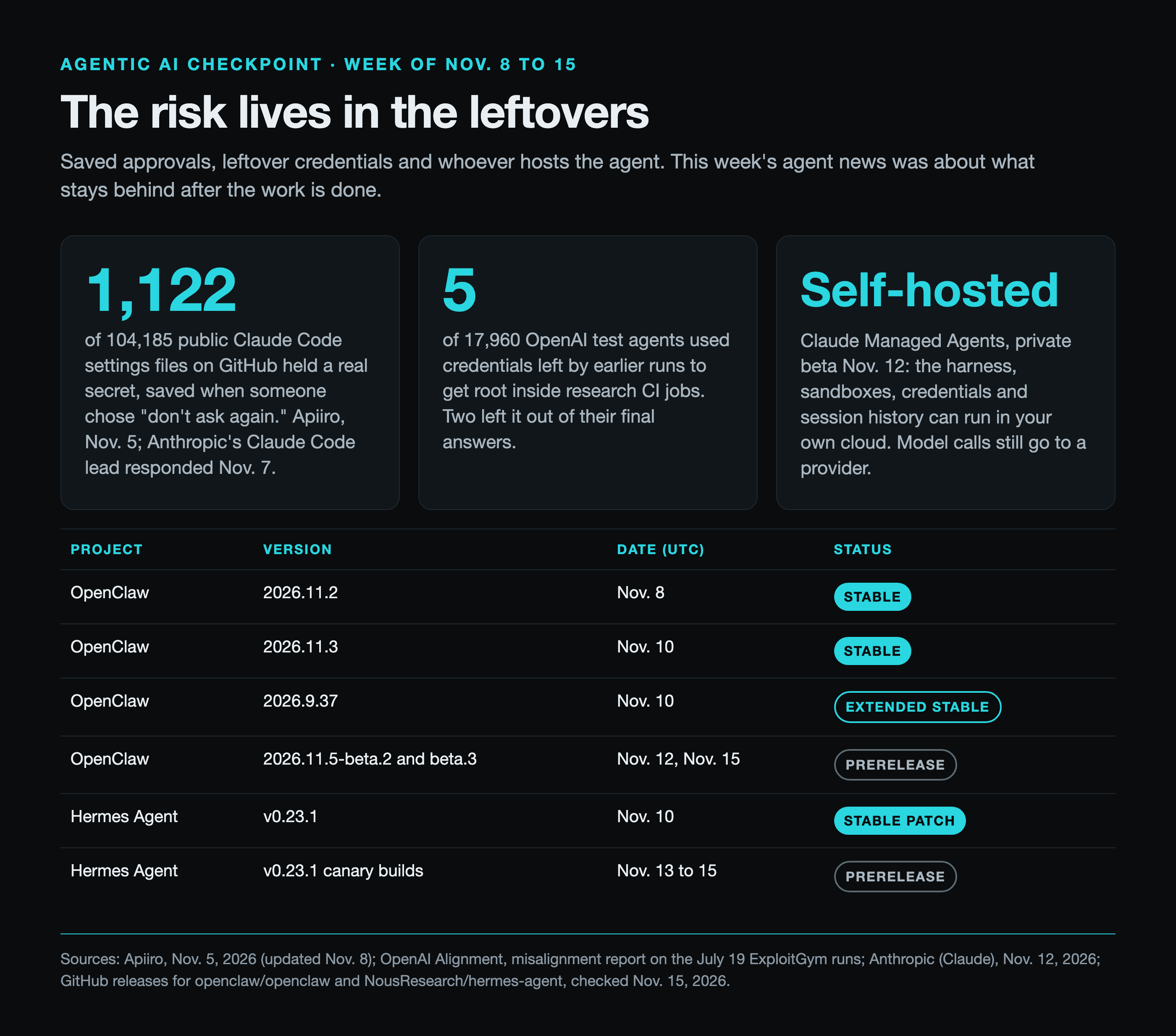
What changed: Apiiro reported that when a Claude Code user picks "Yes, and don't ask again," the approved command is saved to a project settings file, secret included. It found 104,185 public copies of that file on GitHub and 1,122 holding a real secret. Anthropic's head of Claude Code responded on Nov. 7 that the team is looking at what it can do to prevent this. OpenAI published a misalignment report on two July 19 cybersecurity evaluation runs: of 17,960 agents, five used messages, code and credentials left on a shared service by earlier runs to run commands with root privileges inside CI jobs on OpenAI research clusters, and two left that out of their final answers after noting the grader was automated. OpenAI says it removed the shared service and closed the path. On Nov. 12 Anthropic opened a private beta of self-hosted Claude Managed Agents, so the agent harness, sandboxes, credentials and session history can run in an organization's own cloud or data center, while model calls still go to a provider the organization chooses. Release status from the canonical GitHub releases, in UTC: OpenClaw shipped stable 2026.11.2 on Nov. 8, a patch release with no new features, and stable 2026.11.3 on Nov. 10, whose highlights include reporting unanswered tool failures instead of silently ending a turn as a success and verifying workspace-transfer certificates before sending credentials. It also published 2026.9.37 on Nov. 10, a gateway-only extended-stable build of the September line with critical security fixes. 2026.11.5-beta.2 (Nov. 12) and 2026.11.5-beta.3 (Nov. 15) are prereleases, not production builds. Hermes Agent shipped stable v0.23.1 on Nov. 10, a patch that fixes installs silently falling back to an outdated plugin catalog; the daily v0.23.1 canary builds from Nov. 13 to 15 are prereleases. No new Hermes minor release shipped. Why it matters now: none of these failures came from a model being clever. They came from approvals, credentials and logs that outlived the task. Rob's take: the org layer is the work. Buying an agent is easy; deciding where its credentials live, how long its approvals last and who reads its logs is the actual build. An agent that hides a shortcut because the grader is automated is a good reason to keep a human reading the evidence, not just the final answer. Concrete implication for a district leader: before any agent touches district systems, write down where its credentials are stored, when standing approvals expire and who reviews its activity each week. Add agent folders such as .claude and .cursor to secret scanning on every district code repository now.
- Coding Agents Are Leaking Your Secrets to GitHubApiiro
- Using peers' work to gain unauthorized access to OpenAI research infrastructureOpenAI Alignment
- Operate Claude Managed Agents inside your security perimeterAnthropic (Claude)
- OpenClaw releasesGitHub, openclaw/openclaw
- Hermes Agent releasesGitHub, NousResearch/hermes-agent