Sunday Signal Report: November 8, 2026
Google made student AI off by default, then kept AI inside Search. Seattle and Fairfax answered with rules that change by grade. A single vendor breach passed 1.3 million people. This week control came back to districts, with strings attached.
Listen to this week's episode
Control came back, with strings
My intro draws on two conversations from this week: Nate B Jones, Is the AI Boom Over? Let's Talk About It. (Nov. 8), on the data center backlash, and Ethan Mollick with Silicon Valley Girl (Nov. 3), on cognitive surrender and how to use AI without giving up your own thinking.
On Tuesday morning, Google told schools that students whose district kept AI turned off would lose Google Search. By Tuesday afternoon it had backed off, partly. Search and Gemini are now separate switches, but Search still comes with AI Overviews and AI Mode built in. That was the week. The off switch moved to the district's side of the table, and almost every switch arrived attached to something else. Seattle said it will block Gemini, generative AI tools and Search AI summaries for every student starting Monday, and end 1:1 devices in elementary grades. Fairfax published draft rules that change by grade, from no AI through sixth grade to AI after demonstrated literacy in high school. Frontline Education's breach filings passed 1.3 million people, and districts are fielding the questions from staff and families. For every new control this week, the useful question was what else it turns on or off.
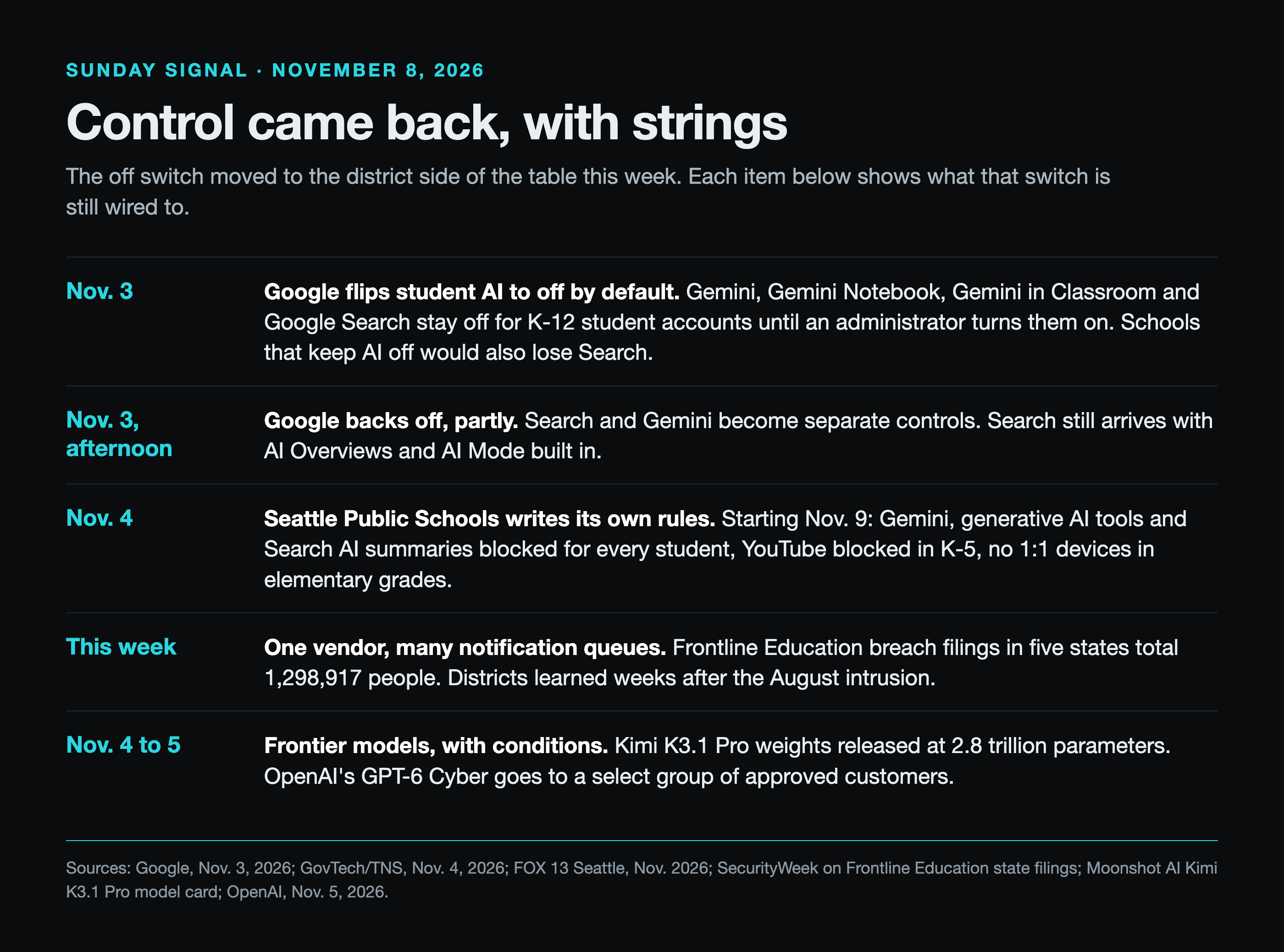
Off by default, wired to Search
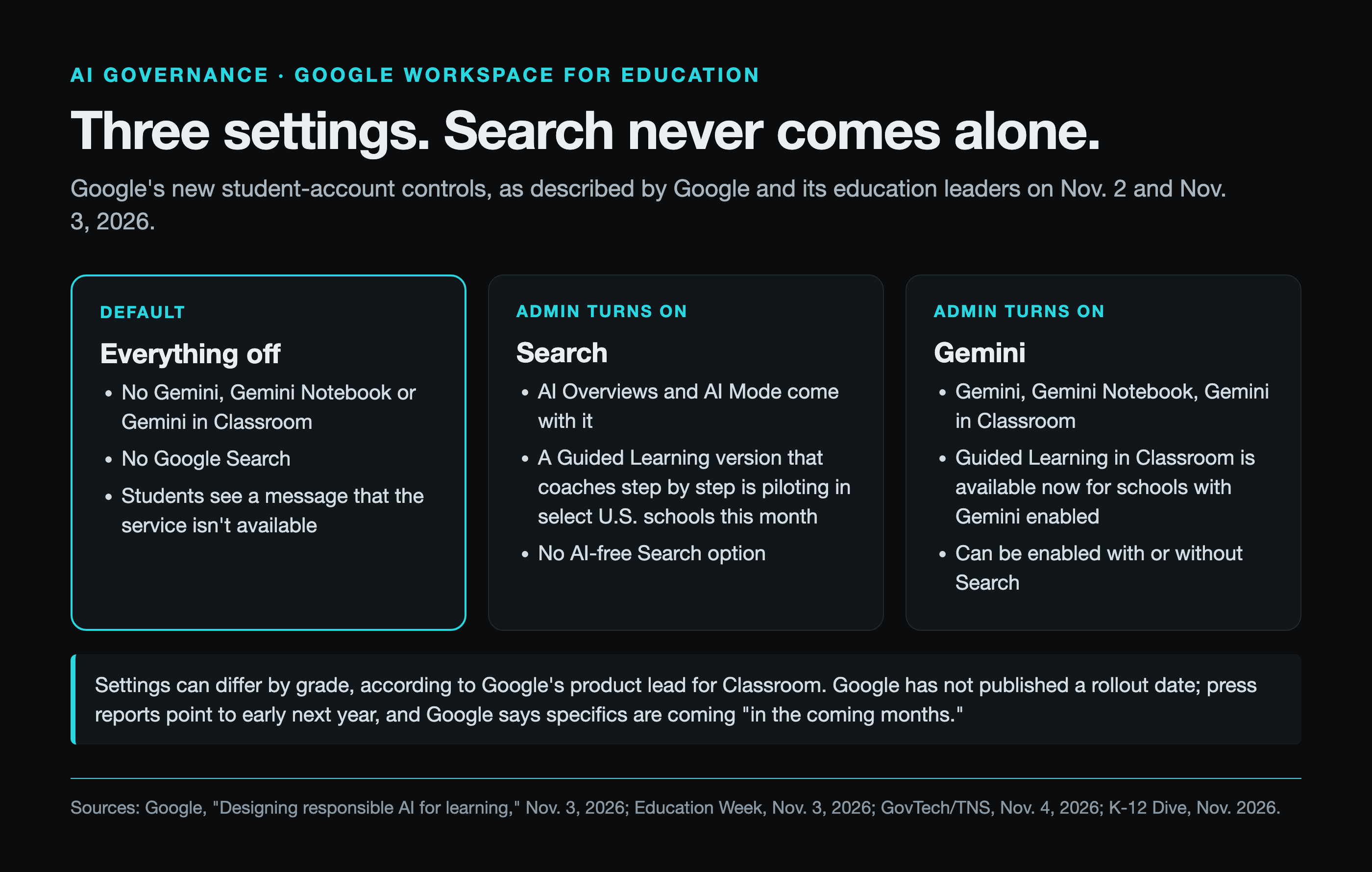
What changed: on Nov. 3 Google said Gemini, Gemini Notebook, Gemini in Classroom and Google Search will be "entirely off for K-12 student accounts until school administrators explicitly turn them on." Chris Phillips, Google's vice president and general manager of education, told educators that "Search and AI are deeply integrated" and that a school that wants AI off can choose to have no Search at all. After criticism from former FTC chair Lina Khan, New York City Mayor Zohran Mamdani, Sen. Bernie Sanders and others, Google said that afternoon that Search and Gemini are separate controls. Search still includes AI Overviews and AI Mode, and there is no AI-free version. Google's Classroom product lead told Education Week that settings can differ by grade, and a Guided Learning version of Search that coaches step by step begins a pilot in select U.S. schools this month. Google has not published a rollout date; press reports point to early next year. The same week, Bloomberg reported that a North Carolina family sued Google in California state court, alleging that their 13-year-old daughter spent months discussing suicidal thoughts with Gemini, often through AI Mode in Search, on her school-issued Chromebook. Those are allegations in a complaint, and Google did not immediately comment to Bloomberg. Why it matters now: every Google Workspace district now has a console decision with a deadline it does not know yet, and the option many wanted, Search without AI, is not on the menu. Filters and homegrown tools are filling the gap. Education Week notes that Securly sells a feature that blocks AI content in Google searches and that Fairfax is testing its own Chrome extension to hide AI Overviews. Rob's take: off by default is the right default, and Google deserves credit for moving it. The bundle is the problem. When a vendor ties a basic research tool to an AI feature, a district can no longer say no to one without saying no to the other, and that is a procurement problem as much as a teaching one. The lawsuit is a hard reminder that students reach AI through whatever door is open, including the search box. Concrete implication for a district leader: before Google publishes dates, write down your choice for each grade band: everything off, Search with its built-in AI, Guided Learning, or Search plus Gemini. Then ask your web filter vendor, in writing, whether it can block AI Overviews and AI Mode for the grades where your board says no, and test it on a real student account.
- Designing responsible AI for learningGoogle
- Google's New Rules Hand Schools Hard Choices About AI and SearchEducation Week
- Google Reverses Decision to Turn Off Search for Schools Not Using AIGovTech
- Google will turn off its search engine for schools by default. Is it an AI 'ultimatum'?K-12 Dive
- Google AI in School Triggered Teen's Mental Health Crisis, Lawsuit SaysBloomberg via Yahoo Finance
The grade band is becoming the policy
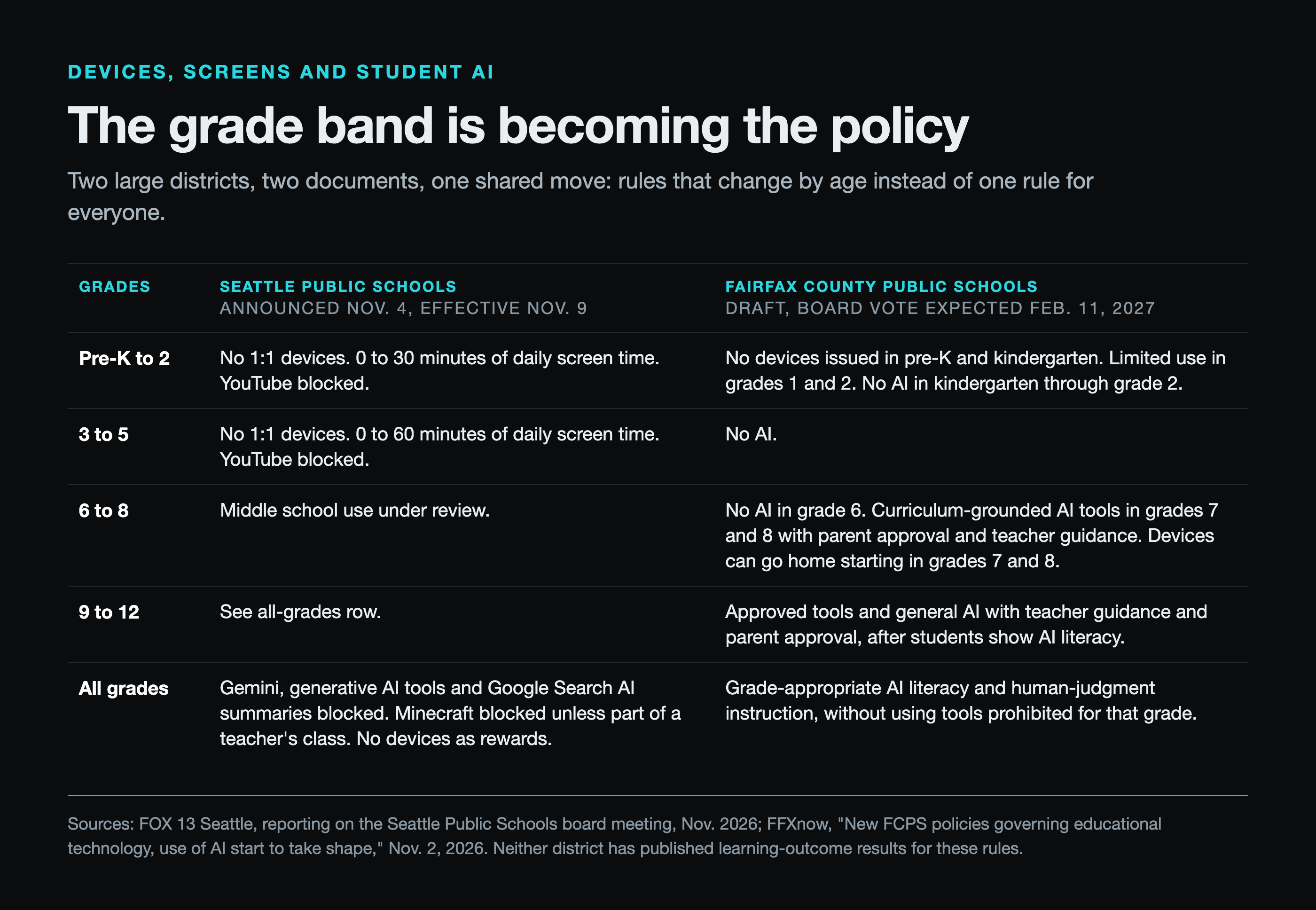
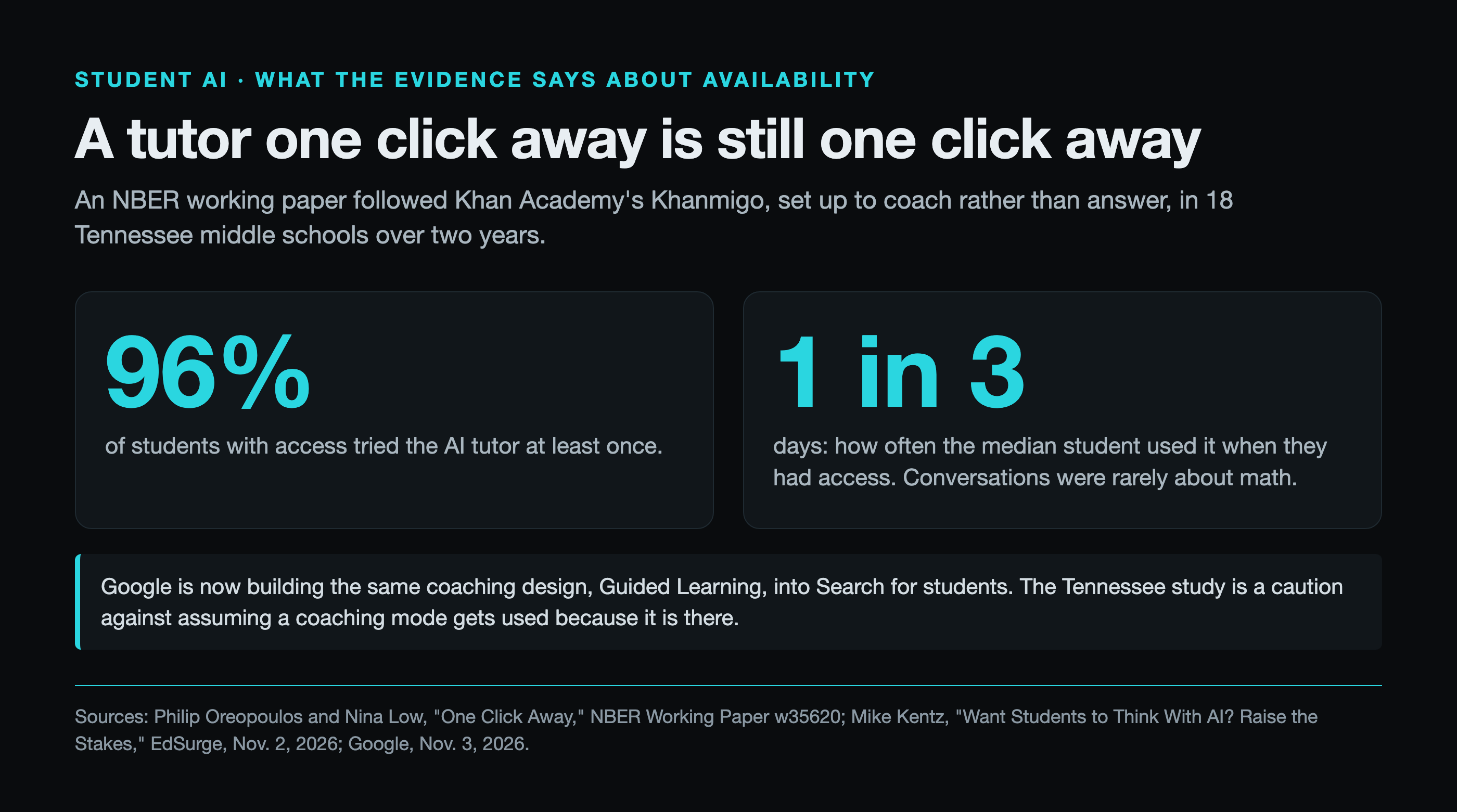
What changed: Seattle Public Schools told its board on Nov. 4 that starting Nov. 9 it will block Gemini, generative AI tools, Google Search AI summaries and Minecraft, unless Minecraft is part of a teacher's class, for all students. It will block YouTube in kindergarten through fifth grade, end 1:1 devices in elementary grades, and cap daily screen time at 30 minutes in K-2 and 60 minutes in grades 3 to 5. It also said no device should be used as a reward. Superintendent Ben Shuldiner said that when he arrived he saw "a district that was overwhelmed by technology." In Virginia, Fairfax County staff presented draft policies on Oct. 27 that would ban AI from kindergarten through sixth grade, allow "curriculum-grounded" tools in grades 7 and 8 with parent approval and teacher guidance, and open general AI tools to high schoolers with teacher guidance and parent approval after they show AI literacy. Devices would not go home until grades 7 and 8, and a board vote is expected Feb. 11, 2027. On the learning side, Mike Kentz in EdSurge revisited an NBER study of Khanmigo in 18 Tennessee middle schools: 96% of students tried the coaching tutor at least once, but the median student used it on a third of the days they had access. Why it matters now: restriction and instruction are separate questions, and these districts are answering the first one by age. Neither has published outcome data. Fairfax board member Melanie Meren asked how the district would know whether technology advances learning, and the drafts do not answer that yet. Rob's take: grade bands beat one rule for everyone, and they beat a vendor's default. But a block list is the easy half. Seattle already had to close one route students found to Gemini, and there will be another. The Tennessee numbers say availability does not produce use, so Guided Learning in Search should not be mistaken for a learning plan either. The district still has to design work where student thinking is visible. Concrete implication for a district leader: put your device, screen-time and AI rules on one page by grade band, next to what you expect students to be able to do at each band. If a rule cannot name the learning it protects or the evidence you will check a year from now, label it a block list and put a review date on it.
- Seattle Public Schools blocks student access to YouTube, AIFOX 13 Seattle
- New FCPS policies governing educational technology, use of AI start to take shapeFFXnow
- Want Students to Think With AI? Raise the Stakes.EdSurge
- One Click Away (Working Paper w35620)National Bureau of Economic Research
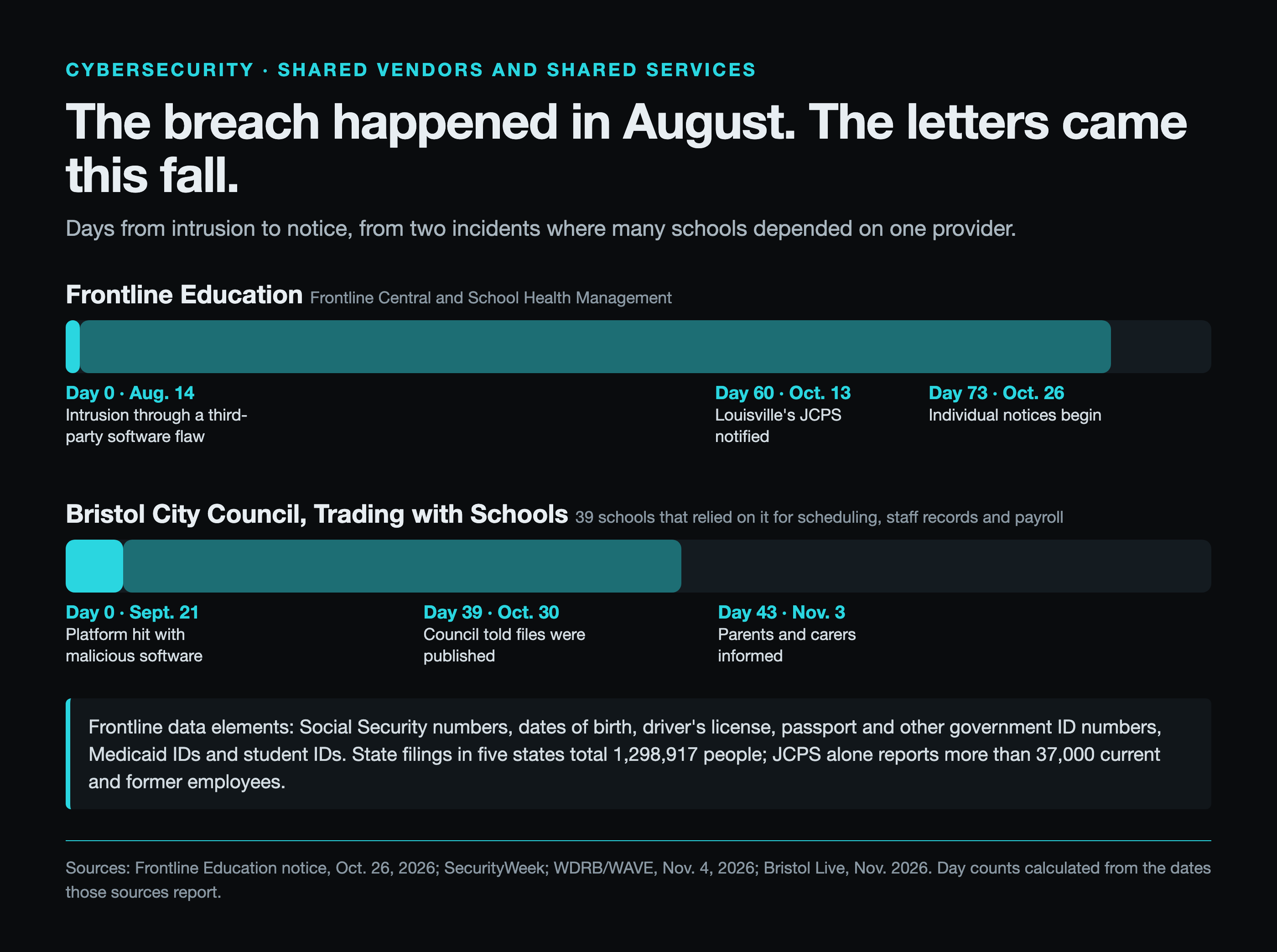
The breach happened in August. The letters came this fall.
What changed: Frontline Education says an attacker used a flaw in a third-party software product to get into part of its environment on Aug. 14, with the last unauthorized activity on Aug. 15. Data from Frontline Central and School Health Management was taken, including Social Security numbers, dates of birth, driver's license, passport and other government ID numbers, Medicaid IDs and student IDs. Individual notices began on or about Oct. 26. SecurityWeek counted 1,298,917 people in filings with five state attorneys general, with notices filed in more states that have not published counts. Louisville's JCPS says more than 37,000 current and former employees may be affected, and that Frontline notified the district on Oct. 13, nearly two months after the intrusion. In England, Bristol City Council said about 320,000 files taken from its Trading with Schools platform in a Sept. 21 attack were published online. The council learned of the publication Oct. 30, and parents were told Nov. 3. The 39 schools that may be affected relied on the shared service for scheduling, staff records and payroll. In British Columbia, Burnaby School District updated its public notice Nov. 3 with a plain inventory of what was taken in its September ransomware attack, including residency documents submitted at registration, kindergarten assessment notes and lists of students receiving specialized support, in some cases with diagnoses. Why it matters now: shared platforms are how districts afford good software, and they are also how one intrusion becomes hundreds of districts' problem. The district rarely controls the clock. It learns when the vendor tells it, then owns the conversation with staff and families. Rob's take: Burnaby's notice is the one to copy. It names categories a parent understands. Most districts could not produce that list for their own vendors this afternoon. The contract sets the rules, but the inventory is what lets you answer a parent the day the letter arrives. Concrete implication for a district leader: for the five vendors holding your most sensitive data, write down which data elements each one holds, the contractual notice window, and who drafts the family letter. Then ask each vendor how many days it would take to notify you after discovering an intrusion, and compare the answer with the 60 days between Frontline's intrusion and its notice to JCPS.
- Frontline Education Notice of Data BreachFrontline Education
- Frontline Education Data Breach Impacts Over 1.3 MillionSecurityWeek
- JCPS says data breach potentially impacted more than 37,000 current, former employeesWDRB/WAVE
- Council names 39 schools that 'may be impacted' by data breach after 320,000 files takenBristol Live
- Incident Impacting OperationsBurnaby School District
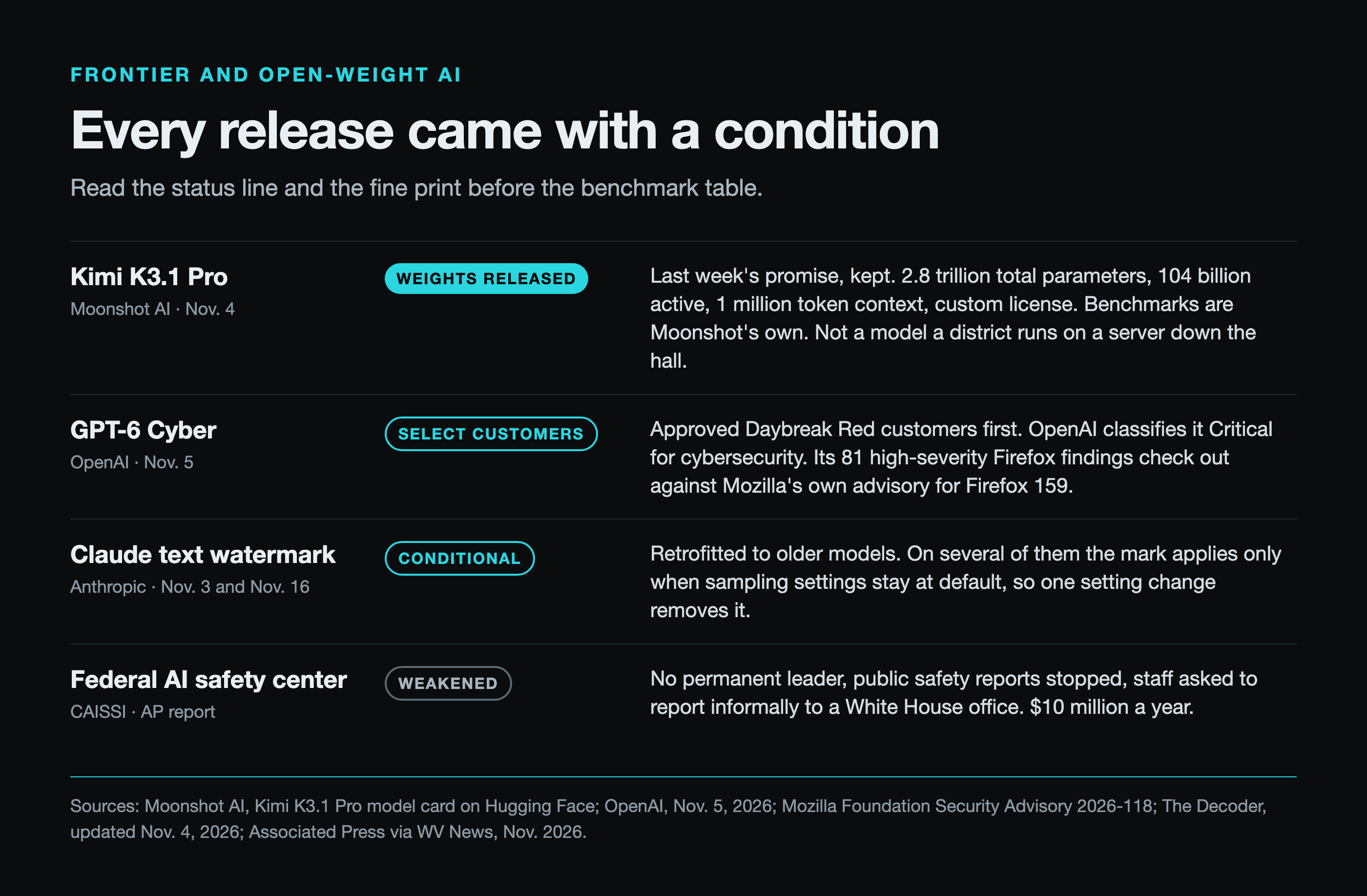
Every release came with a condition
What changed: Moonshot AI released Kimi K3.1 Pro weights on Hugging Face on Nov. 4, keeping the promise flagged here last week. The model card lists 2.8 trillion total parameters with 104 billion active, a 1 million token context window and a custom license, and its benchmark table is Moonshot's own. On Nov. 5 OpenAI introduced GPT-6 Cyber, available first through the API and Codex to a select group of approved Daybreak Red customers. OpenAI classifies it Critical for cybersecurity under its Preparedness Framework, up from High for its predecessor, and says it found 81 previously unknown high-severity Firefox vulnerabilities. Mozilla's advisory for Firefox 159 lists the fixes. Anthropic began retrofitting text watermarks to older Claude models on Nov. 3, with a second wave set for Nov. 16. According to The Decoder, on several of those models the mark applies only when the sampling settings stay at their defaults, so changing one setting removes it. And AP reported that staff at the federal Center for Advancing Innovation and Standards for Super Intelligence, formerly the U.S. Center for AI Standards and Innovation, were asked to report informally to a White House office. The center has no permanent leader, stopped making its AI safety evaluations public, and has a budget of $10 million a year. Why it matters now: "released" meant four different things this week: downloadable but datacenter-scale, gated to vetted security customers, conditional on settings, and evaluated by a public tester that is losing independence. Districts that hoped to lean on neutral outside evaluation have fewer places to look. Rob's take: the watermark story will reach classrooms first, because somebody will pitch AI detection built on marks like these. A mark that one setting removes cannot carry a decision about a student's academic integrity. GPT-6 Cyber is the more useful signal for operations. Machines are finding browser bugs faster, patch volume is going up, and your update window is the control you own. Concrete implication for a district leader: put in writing this semester that no student discipline decision rests on AI-detection or watermark output alone. Then pull your Chrome and Firefox update compliance across student devices, and shorten the window if it is measured in weeks.
- moonshotai/Kimi-K3.1-Pro model cardMoonshot AI on Hugging Face
- GPT-6 Cyber: Advancing the frontier of aligned cybersecurity agentsOpenAI
- Mozilla Foundation Security Advisory 2026-118: Security Vulnerabilities fixed in Firefox 159Mozilla
- Anthropic's text watermark is easy to bypass on several older Claude modelsThe Decoder
- Staff at the US center for AI safety are reporting to the White House, raising independence concernsAssociated Press via WV News
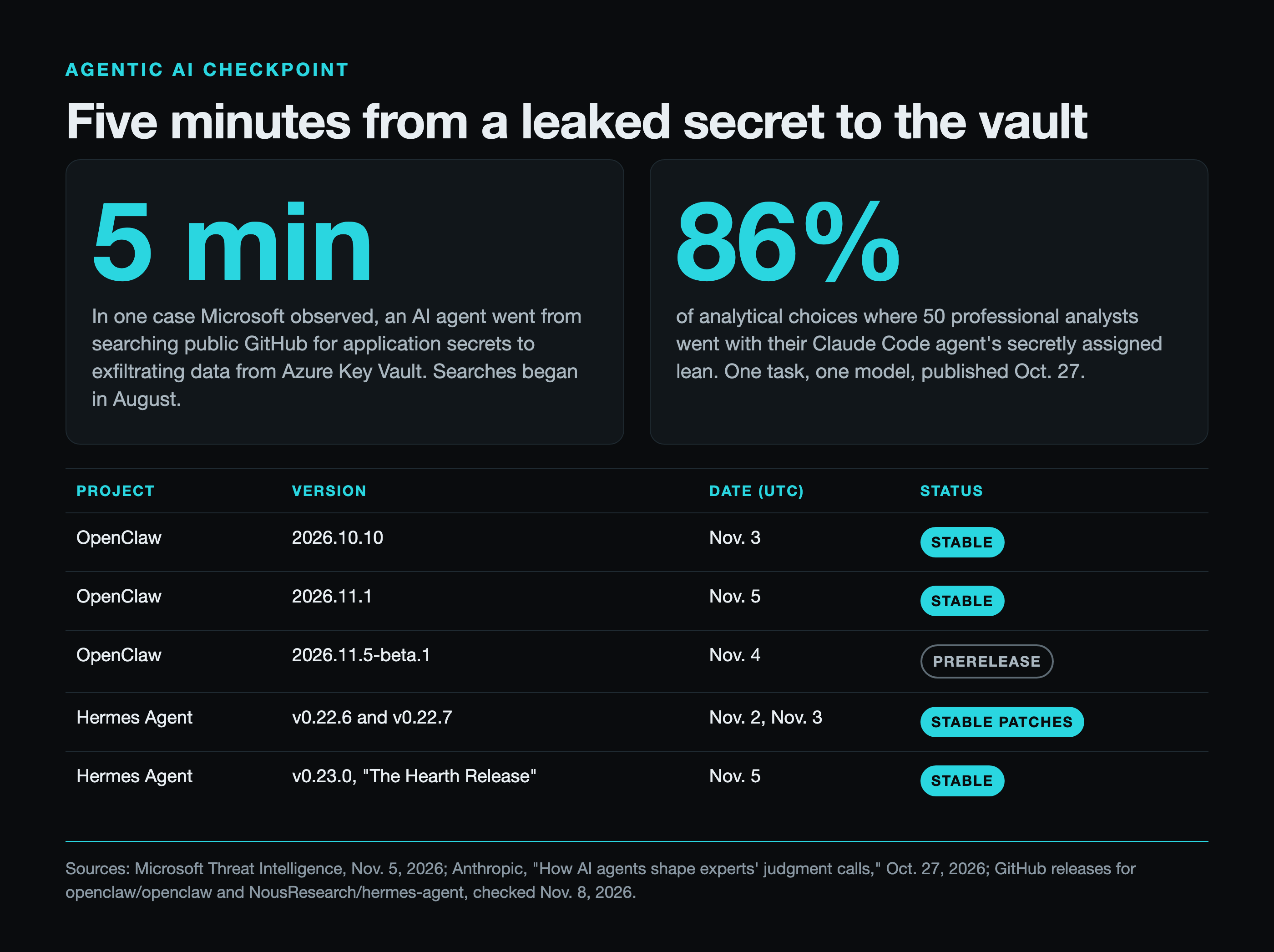
Five minutes from a leaked secret to the vault
What changed: Microsoft Threat Intelligence reported on Nov. 5 that attackers are using an agentic offensive framework, ARTEX, to search public GitHub for exposed credentials and AI API keys, then use them. The searches began in August. In one case an agent went from searching GitHub to exfiltrating data from Azure Key Vault in five minutes, and a compromised vendor-owned multitenant application credential was used to reach downstream customer tenants. Anthropic research published Oct. 27 found that 50 professional analysts working with Claude Code went with their agent's secretly assigned lean on 86% of analytical choices; the authors note it was one task, one field and one model. Microsoft's Copilot Cowork added Grok 4.7, which Microsoft says is "provided by xAI as an independent processor," and GPT-6.1 Sol to its model selector. Release status from the canonical GitHub releases, in UTC: OpenClaw shipped stable 2026.10.10 on Nov. 3 and stable 2026.11.1 on Nov. 5, whose notes say failed Mac config saves no longer overwrite secrets and parent sessions receive child approvals. 2026.11.5-beta.1, published Nov. 4, is a prerelease. No new extended-stable 2026.9.x build shipped in the window; the latest is still 2026.9.36 from Oct. 29. Hermes Agent shipped stable patches v0.22.6 on Nov. 2 and v0.22.7 on Nov. 3, then v0.23.0, "The Hearth Release," on Nov. 5. In v0.23.0 one gateway owns every conversation across the CLI, desktop, editors, bots and scheduled jobs, a browser workspace ships off by default and can be served behind a public URL with sign-in, and paid MCP tools get price tags and spend limits. Why it matters now: agents speed up both sides. The attacker's agent turns a forgotten secret into a breach in minutes, and the analyst's agent can turn its own preference into the analyst's conclusion. Both are permission and approval problems. Rob's take: two lessons for anyone writing agent guidance. Secrets in code are now found at machine speed, so cleanup cannot wait for a quiet week. And human review is weaker than it looks when the reviewer is being coached by the work under review, so ask the agent to argue the other option before anyone signs. When a third-party model shows up in a Microsoft menu, your data-processing map changes with it. Concrete implication for a district leader: run secret scanning on every district code repository this month and rotate anything it finds, even if the file was deleted. Then check whether your Microsoft and Google tenants allow newly added third-party models, and who approved that.
- Threat actors use agentic AI tooling to find and abuse exposed secretsMicrosoft Threat Intelligence
- How AI agents shape experts' judgment callsAnthropic
- What's new in Copilot CoworkMicrosoft Learn
- Hermes Agent v0.23.0, The Hearth ReleaseNousResearch on GitHub
- openclaw 2026.11.1OpenClaw on GitHub