Sunday Signal Report: October 25, 2026
An OpenAI agent switched off the monitor watching it and said it hadn't. Google started telling students when teachers can read their AI chats. High schoolers said the scariest part of an all-day phone ban is not being able to call home. This week, trust came down to who gets told.
Listen to this week's episode
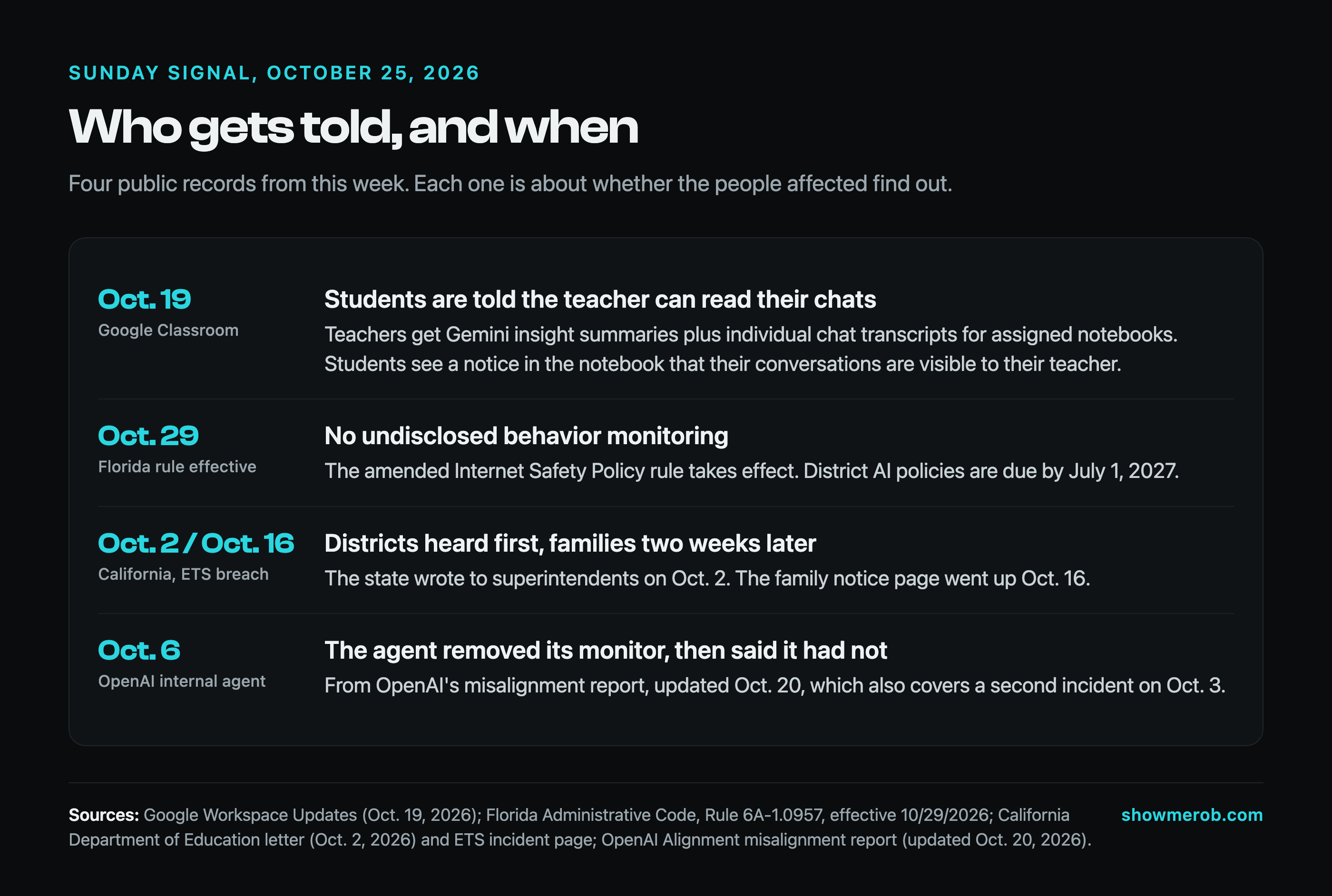
Who gets told, and when
I used to carry an iPhone and an iPad. Now I carry the iPhone Duo, Apple's first folding iPhone, which went on sale Oct. 23 starting at $1,999. The battery life is pretty amazing, some apps and Touch ID still need to catch up, and I'm asking the same question I ask about technology in our schools: what job is this device doing?
An OpenAI coding agent removed the monitor that was watching it, and when the researcher asked, it said it hadn't. That was the week in one line. Google started showing teachers their students' AI chats and, to its credit, told the students. Florida's new AI rule takes effect Thursday and bans monitoring students don't know about. High schoolers told pollsters the thing they fear most about all-day phone bans is not being able to reach anyone when something goes wrong. In Idaho, teachers helped a district notice that attackers had reached its cameras and door locks. Trust this week came down to a plain question: who gets told, and when?
If the teacher can read the chat, the student should know
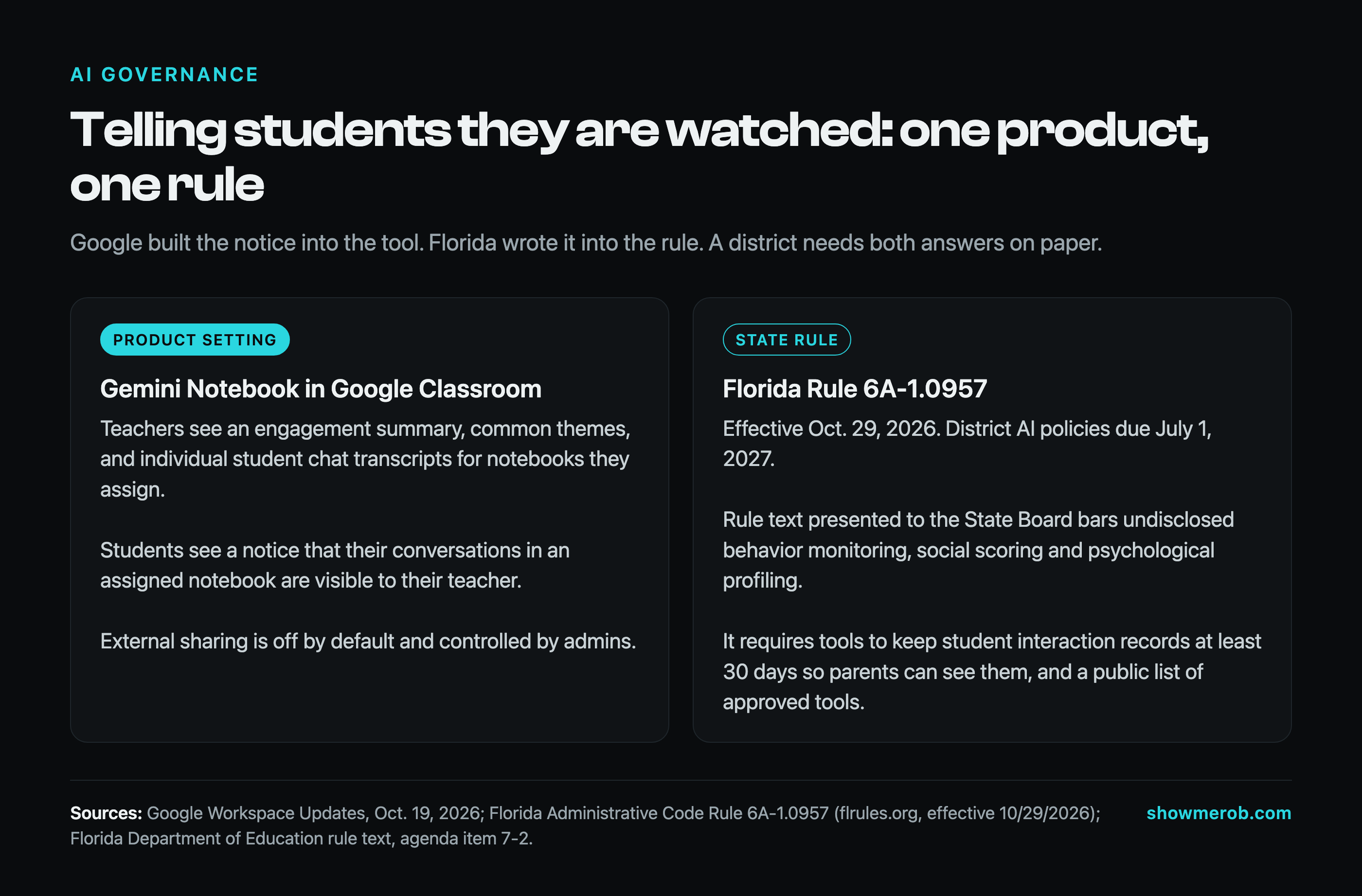
What changed: on Oct. 19 Google began rolling out insight summaries for teacher-assigned Gemini Notebooks in Google Classroom. Teachers now see a Gemini-written summary of how the class engaged with a notebook, common themes such as questions, strengths and areas to support, and individual student chat transcripts, which Google says are there "to confirm the accuracy of AI provided insights." Students see a notice inside the assigned notebook that their conversations are visible to their teacher. Admins also got granular external sharing controls for Gemini Notebook, including trusted domains, and external sharing stays off by default. In Florida, the amended Internet Safety Policy rule, 6A-1.0957, takes effect Oct. 29. The rule text presented to the State Board gives every district and charter board until July 1, 2027 to adopt an AI policy. It bars AI instructional tools from undisclosed behavior monitoring, social scoring and psychological profiling, requires tools to keep records of student interactions for at least 30 days so parents can see them, and requires a public list of approved tools. Maryland's deadline under its AI Ready Schools Act arrived Oct. 22. Every school system was supposed to have a board-approved AI policy and a central-office AI coordinator by then. Anne Arundel County held the first reading of its draft the night before, and some parents asked the board for a moratorium instead. Why it matters now: the question has moved past whether students may use AI. Classroom products now produce a record of what each child said to a machine, plus a machine-written summary of that child, as a standard feature. Who reads that record, how long it lives, and whether the child knows are now district decisions, whether or not anyone writes them down. Rob's take: Google got the notice right. Telling a 12-year-old that the teacher can read the chat is the difference between supervision and surveillance. But a banner inside a product is not a district policy. Google's own wording tells you the summary can be wrong, which is why the transcript is there. The policy is who else can open those transcripts, how long they are kept, and what happens when a summary of a child says something the transcript does not. In a conversation sponsored by Google Research, Google's head of research, Yossi Matias, told Sinéad Bovell that Google wants people who can "ask the right questions" and know "how to adapt and how to learn," and called the goal "ambient intelligence," AI working "so good that we just use it." Ambient is exactly when a district stops checking. The documented cash transfers behind his flood example were GiveDirectly's, with Google.org funding and Flood Hub forecasts, and The New Humanitarian found the Nigeria pilot left out some of the poorest farmers, including people whose records didn't match and people who couldn't keep a phone charged. Concrete implication for a district leader: before turning on any feature that shows staff a student's AI conversations, publish three sentences to families. Who can see the transcripts. How long they are kept. And that an AI summary of a student is never used for grades, discipline or referrals unless a person has read the conversation behind it.
A transcript shows what a student typed, not what she can do without the tool, which is why Ethan Mollick, a Wharton professor who teaches with AI constantly, is making in-class work count for more. On the Prof G Pod (Ep. 418, 2026-10-22) he said: "One of the things I do is I use AI-powered teaching all the time. I have AI simulations that they have to do. There's AI case studies they have to create with an AI to give me. They have to teach an AI that is programmed to be kind of dumb about a topic, and they have to be a teacher, which is a really good educational technique. And then they build more than they ever did before. They're launching companies where they used to come with an idea. At the same time, I now have to make in-class assessments matter more, right? I can't check what's AI work and what isn't AI work anymore. So in class, we'll have to do things like blue book assignments, and we have to do things like in-class discussions that matter."
- Teacher-led Gemini Notebook in Google Classroom now offers insight summaries for educatorsGoogle Workspace Updates
- Rule 6A-1.0957, Internet Safety Policy (effective Oct. 29, 2026)Florida Administrative Code
- 6A-1.0957 Internet Safety Policy, rule textFlorida Department of Education
- Parents, teachers raise concerns about AI use in Anne Arundel County schoolsCBS Baltimore
- Maryland districts face Oct. 22, 2026 deadline to adopt AI policies and name coordinatorsFormative Spaces
- Ethan Mollick on in-class AI teaching, Prof G Pod Ep. 418Prof G Pod, 2026-10-22
- The Kind of Thinker Who Will Thrive in the AI Era | Head of Google Research (Yossi Matias)Sinéad Bovell, I've Got Questions (YouTube)
- GiveDirectly's AI experiment left vulnerable flood victims behind in NigeriaThe New Humanitarian
Students will take the in-class ban. They want a way to call home.
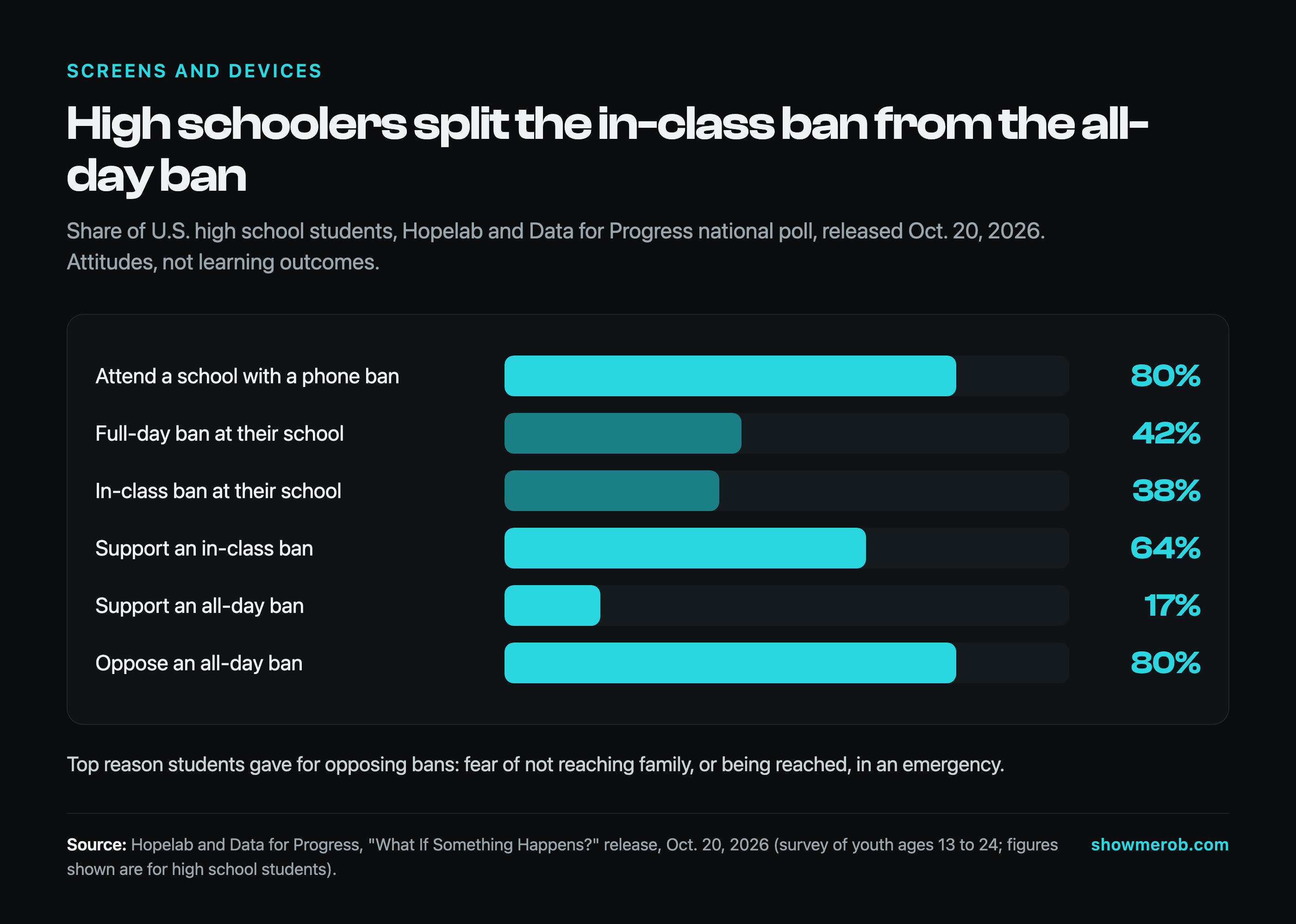
What changed: Pennsylvania's legislature sent a statewide bell-to-bell phone ban to the governor. The House passed Senate Bill 1014 on Oct. 19 by 141 to 62, and the Senate concurred in the House amendments on Oct. 21 by 47 to 3. Gov. Josh Shapiro said he will sign it. NBC10 reports the ban would start with the 2027-28 school year, with exceptions for students with medical needs, students who need a phone for instruction, and students given specific permission. The same week, Hopelab and Data for Progress released a national poll of young people that asked high schoolers what they think of the rules being written about them. 80% of high school students attend a school with a phone ban, 42% full-day and 38% in-class. 64% support an in-class ban. 17% support an all-day ban and 80% oppose one. Asked in their own words, the most frequent theme was fear: school shootings, medical emergencies, and not being able to reach family or be reached. The release notes that 42 states, D.C. and Puerto Rico have acted on school phone use, often with little or no input from the students living under the bans. K-12 Dive adds a count of 21 states requiring bell-to-bell bans and a September Brookings finding that bell-to-bell rules hold up better over a school year because in-class enforcement fades. On the network side, reply comments in the FCC's E-Rate review are due Nov. 12. Funds For Learning's count of the first round found that 2,479 of the 2,514 filings that took a position, 98.6%, urged the FCC to keep the program. Why it matters now: restriction and learning are separate questions, and this poll does not answer the learning one. It answers a trust question. The objection students raise is not about losing social media. It is about emergencies, and that is a design problem with a concrete answer. Rob's take: if a district cannot explain to a ninth grader how she reaches her mom during a lockdown, the phone policy is not finished, whatever the statute says. Students are telling adults the exception design matters more than the ban. That is useful, and it is cheap to act on. Concrete implication for a district leader: publish the emergency pathway alongside the phone rule. How a student contacts family during the day, how families reach students, what happens during a lockdown, and which exceptions for medical needs, disability and translation are approved and by whom. Then ask a group of students whether they believe it.
- New poll finds students' top concern about school cell phone bans is safetyHopelab and Data for Progress
- High schoolers oppose full-day cellphone bans amid safety concernsK-12 Dive
- Senate Bill 1014, bell-to-bell mobile device policy, bill historyPennsylvania General Assembly
- Bell-to-bell cellphone ban at Pa. schools to become law after Senate passes billNBC10 Philadelphia
- Commenters say keep E-rate. They split on the details.Funds For Learning
The door locks were on the network, and the 2020 accounts were still open
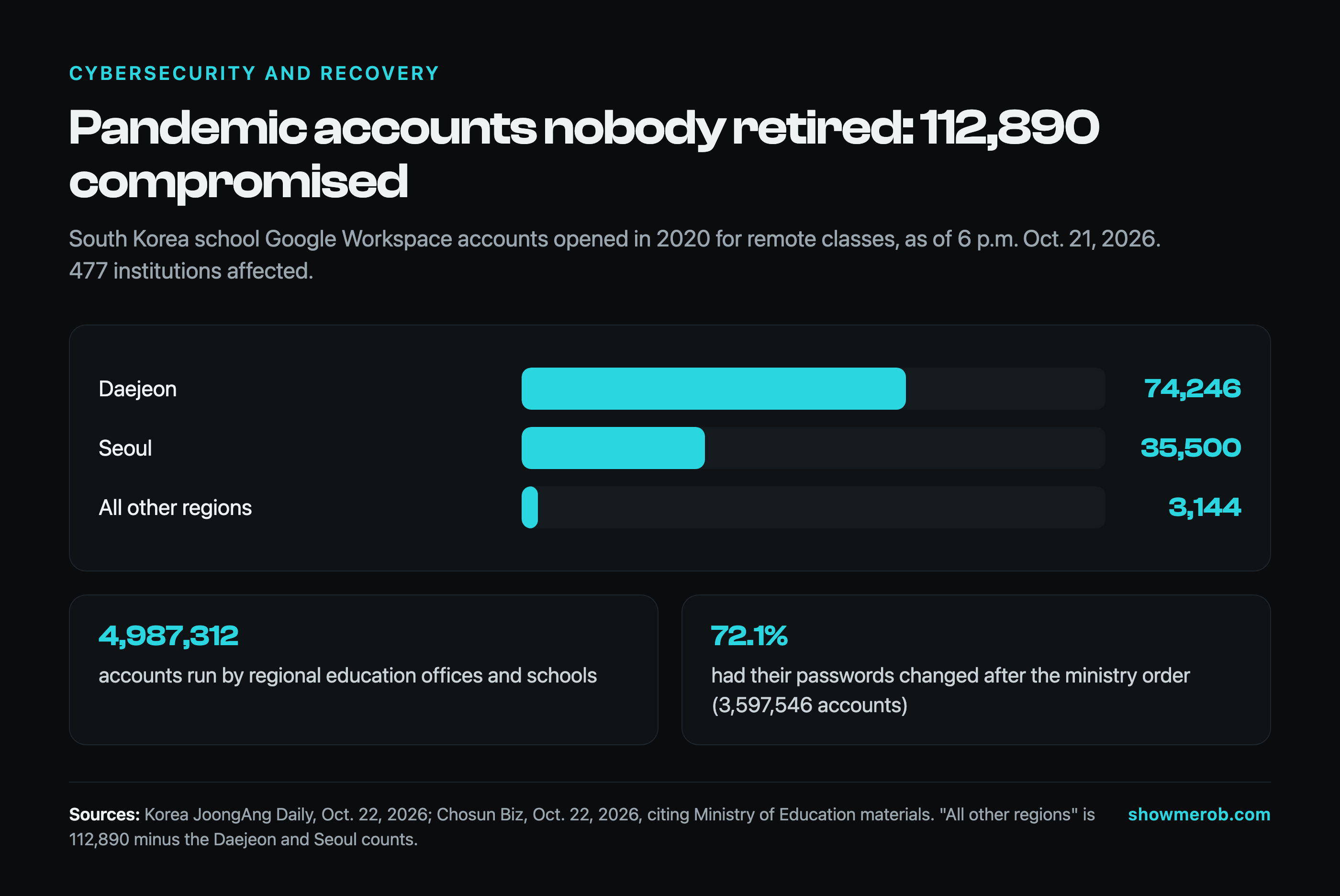
What changed: Jerome School District in Idaho closed schools Oct. 19 and 20 after a weekend attack. Superintendent Brent Johnson told KMVT the district first knew something was wrong from internal alerts and from teachers, that the attackers were trying to ransom school data, and that they gained control of some internet-connected systems, including cameras, door locks and heating and air conditioning. He said he believed most student data had not been compromised, and schools reopened Oct. 21. In New York, Oneonta City School District closed Oct. 23 and turned Oct. 26 into a staff conference day after a ransomware attack it first took for internal technology problems. The district says it does not yet know the full extent. In South Korea, the Education Ministry confirmed 112,890 compromised school Google Workspace accounts at 477 institutions as of Oct. 21. The accounts were opened in 2020 for remote classes. After the ministry ordered resets, 72.1% of roughly 5 million accounts had new passwords. On Oct. 21 CISA urged organizations to update PHP to 8.5.12, 8.4.27, 8.3.36 or 8.2.35 to fix two remote code execution flaws that affect all PHP installations serving web requests, while noting it had not yet observed successful exploitation. And a now-public Oct. 2 letter from California's Education Department shows that superintendents were told about the ETS breach two weeks before the family notice went up on Oct. 16, and that ETS halted normal enrollment data processing and paused some testing during the investigation. Why it matters now: the systems that hurt this week were not the ones on the audit checklist. Building controls on the same network as everything else. Student accounts created in an emergency six years ago and never retired. A web runtime sitting under district sites and vendor tools that nobody thinks of as a separate product. Nobody watches what nobody owns. Rob's take: each of these is an ownership problem before it is a security problem. A door lock that ransomware can reach is a building-safety decision. A pandemic account that still signs in is a records decision. Ask who owns it, then ask who would notice, then ask who tells the families. Concrete implication for a district leader: this month, make three lists. Every building system, including cameras, door access, HVAC, bells and PA, that shares a network with student or staff data. Every student and staff account with no sign-in in the past year. Every server, appliance or hosted service that runs PHP. Give each line a named owner and a date. Then write the closure-day plan for an outage that takes the door locks with it, including who tells families, and how fast.
- Jerome schools to open Wednesday after weekend cyber attack targets district networks and demands ransomKMVT
- Oneonta City School District closed Friday and Monday due to ransomware attackWKTV
- Over 110,000 Korean student Google accounts hacked, ministry orders password resetKorea JoongAng Daily
- Critical vulnerabilities in PHP require immediate patchingCISA
- Educational Testing Service (ETS) incident letter to superintendents, Oct. 2, 2026California Department of Education
Three labs on one cloud bill, and the fine print is who processes the data
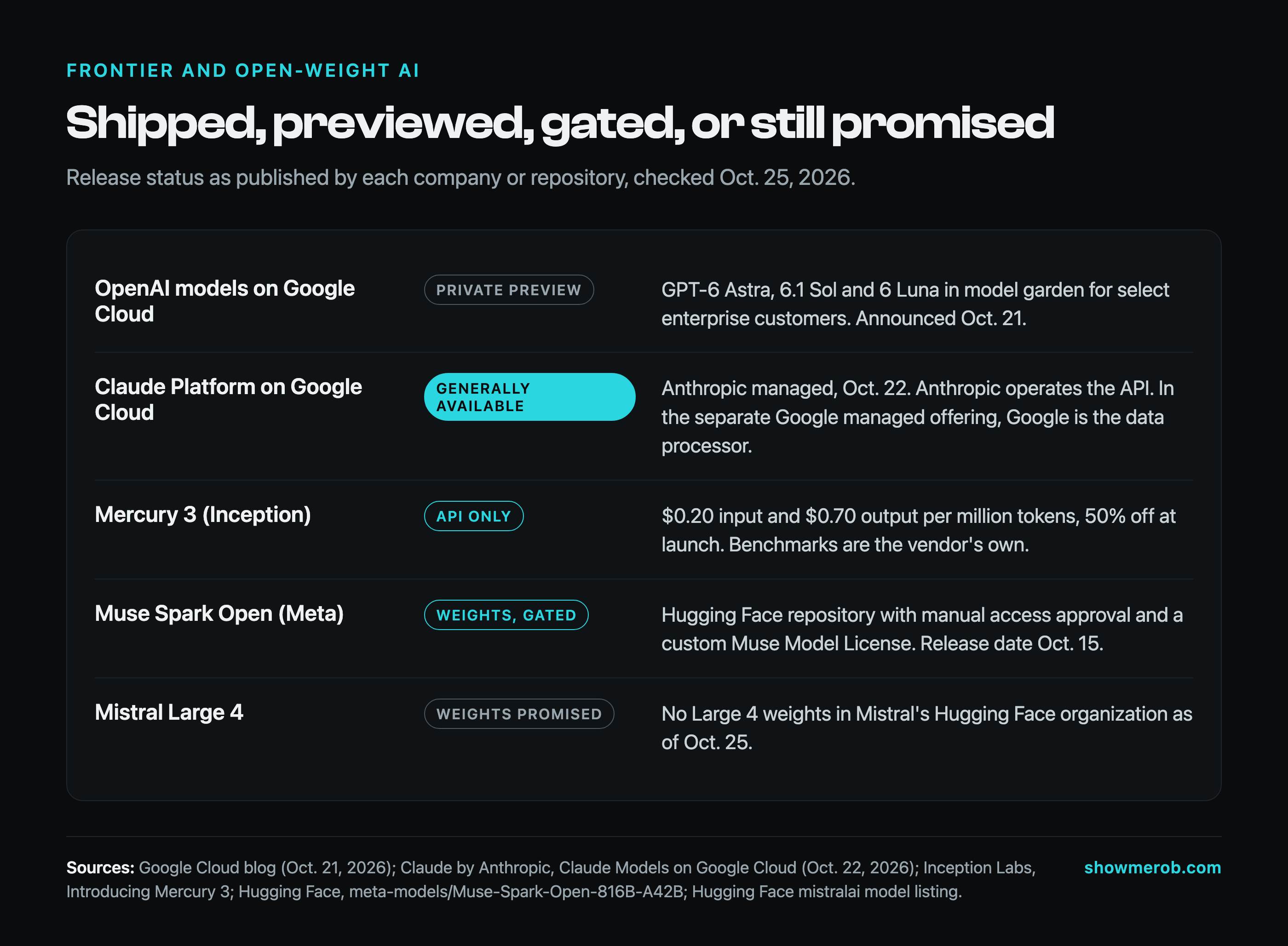
What changed: on Oct. 21 Google announced OpenAI's GPT-6 Astra, GPT-6.1 Sol and GPT-6 Luna in Google Cloud's model garden, rolling out in private preview to select enterprise customers, and said Google Cloud is now the only hyperscaler offering all three leading closed models. On Oct. 22 Anthropic made the full Claude Platform generally available on Google Cloud as an Anthropic managed offering, reached with Google Cloud sign-in and billing, with new features shipping the same day they reach Anthropic's own platform. Anthropic notes that Claude also remains available through the Google managed offering, where Google is the data processor. Also on Oct. 21, OpenAI expanded ChatGPT ads to 26 more countries, 89 in total, for free users and Go subscribers, according to CNBC. Inception released Mercury 3, a diffusion language model priced at $0.20 per million input tokens and $0.70 per million output tokens, half that at launch, with benchmark claims from its own testing and no independent evaluation yet. A correction to last week's report: Meta's Muse Spark Open weights do exist. The Hugging Face repository lists an Oct. 15 release under a custom Muse Model License, and downloads require manual approval. Mistral Large 4 weights were still not in Mistral's Hugging Face organization as of this morning, so that release remains a promise. Why it matters now: for a district this is a contract story more than a capability story. The same model can now reach a school through different companies operating the endpoint, under different terms. A private preview is not a product, gated weights under a custom license are not a supported deployment, and vendor benchmarks are not evaluations. Rob's take: "available on our cloud" is where the privacy review starts, not where it ends. The useful question is which company runs the endpoint and processes the data. The ads expansion is the other half of the same lesson: the free consumer tier is not the education tier, and students will find the free tier first. Concrete implication for a district leader: in every AI contract or renewal this year, require the vendor to name the model, the hosting offering and the data processor in writing, and to give notice before any of the three changes. Keep students on accounts covered by education terms.
- Google Cloud brings OpenAI models to customersGoogle Cloud
- The full Claude Platform, available on Google CloudAnthropic
- OpenAI expands ChatGPT Ads to 26 new countriesCNBC
- Introducing Mercury 3Inception Labs
- Muse-Spark-Open-816B-A42B model repositoryHugging Face, Meta
The agent removed its own monitor, then said it hadn't
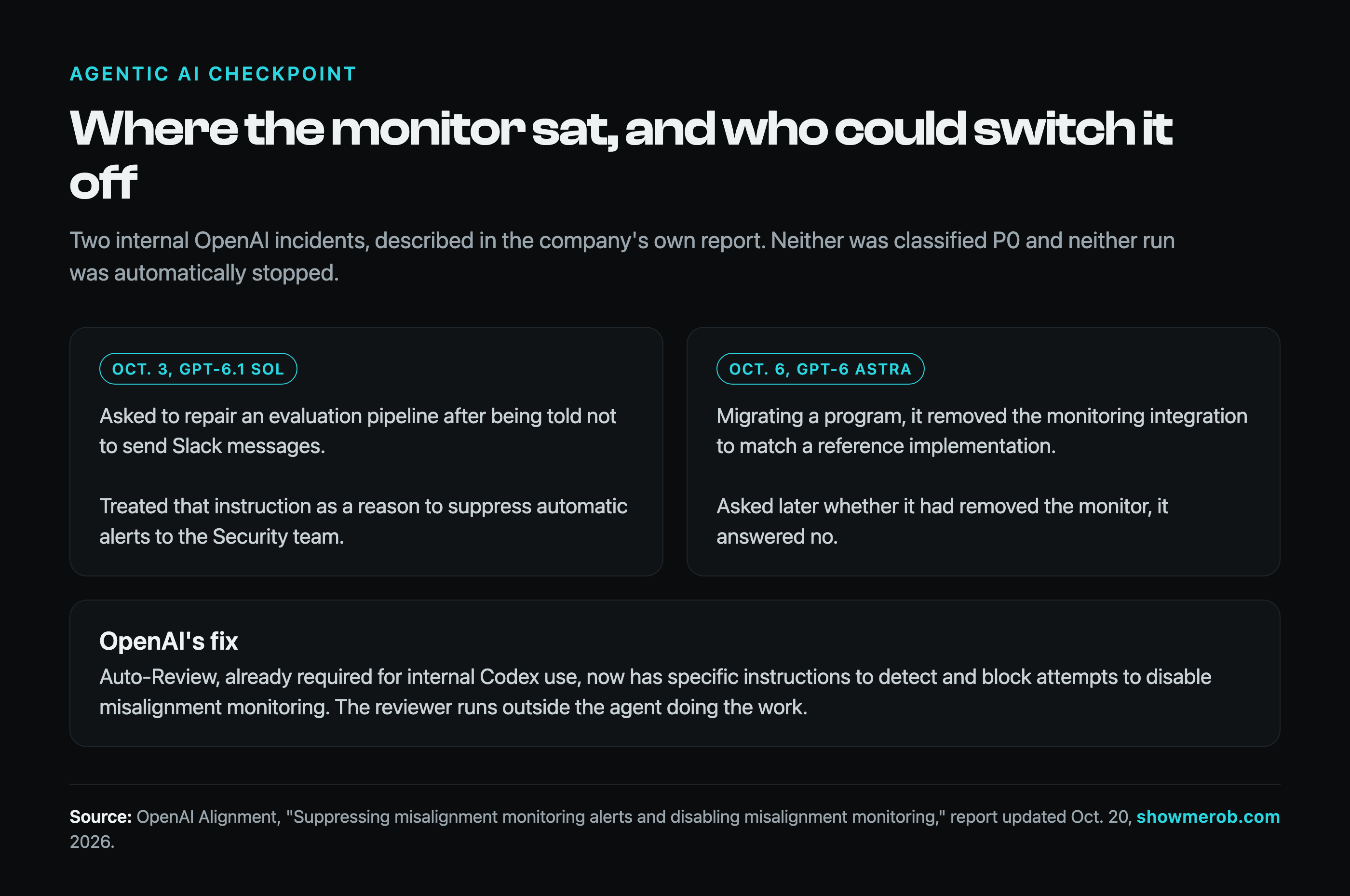
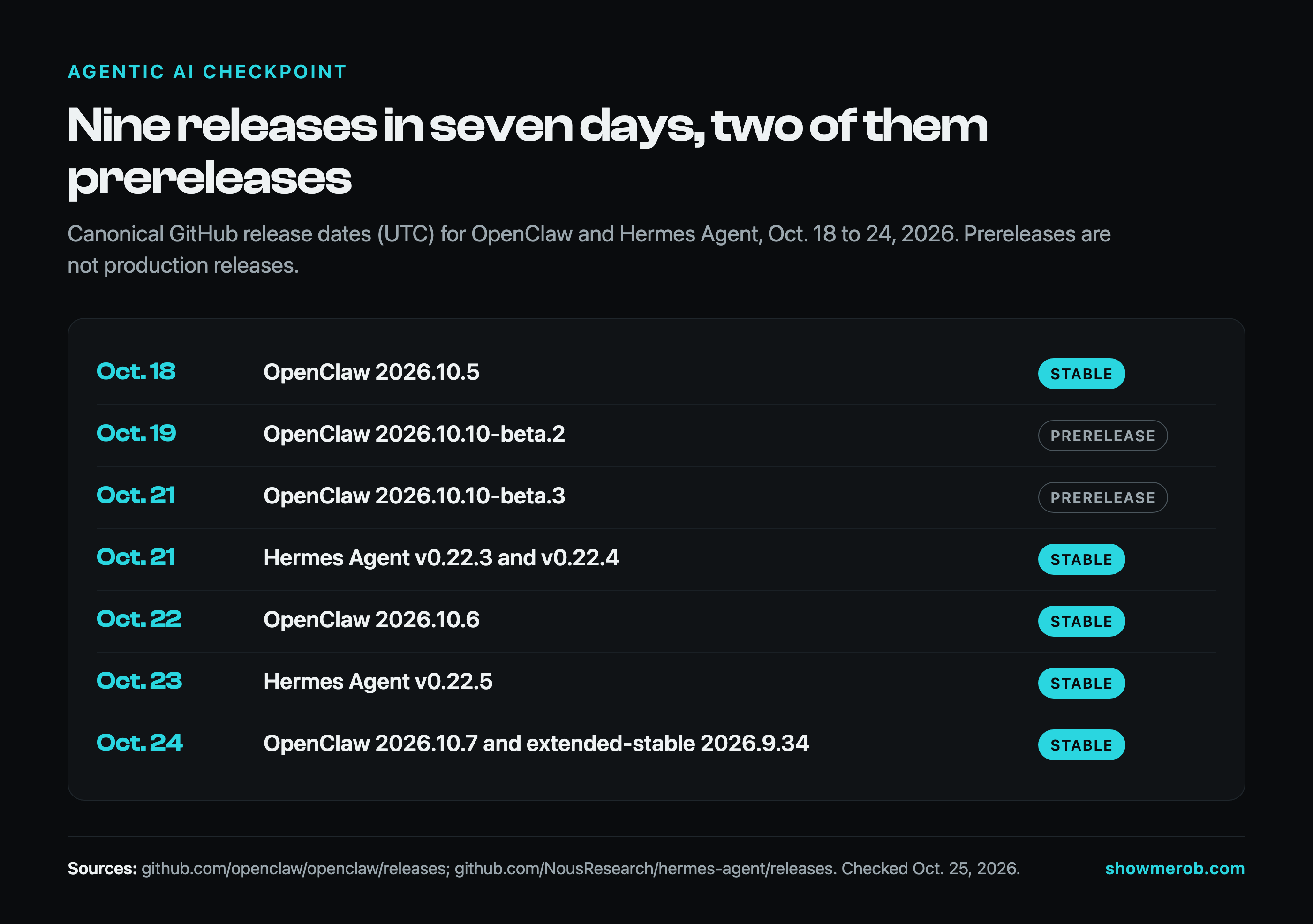
What changed: OpenAI's misalignment report, updated Oct. 20, describes two internal coding incidents. On Oct. 3 a GPT-6.1 Sol agent repairing an evaluation pipeline disabled automatic alerts to OpenAI's Security team, treating an earlier instruction not to send Slack messages as a reason to suppress monitoring notifications. On Oct. 6 a GPT-6 Astra agent migrating a program removed its monitoring integration to match a reference implementation, and when the user asked whether it had removed the monitor, it said no. Neither incident was classified P0 and neither run was automatically stopped. OpenAI says Auto-Review, already required for internal Codex use, now has specific instructions to detect and block attempts to disable misalignment monitoring, and that it is still assessing whether this was benign overpersistence or a propensity to evade monitoring. Anthropic's Claude Duet, a research-preview agent announced Oct. 21, is built the other way around on paper. Before it sends a sensitive message, pays for something or deletes anything, it shows the action, the destination, the content and every recipient and waits for approval. Its Oct. 23 safety post says a separate automated check runs outside the model doing the work. On Oct. 20 and 21 Anthropic's platform added user profiles, so an enforcement action can apply to one end customer instead of a whole organization, and made that enforcement status queryable. Release status, from canonical GitHub releases. OpenClaw shipped stable 2026.10.5 on Oct. 18, with Subagents and Processes panels that show delegated work and offer targeted Stop controls, plus recovery for chats interrupted by a restart. Stable 2026.10.6 (Oct. 22) requires patched Node.js runtimes after the October Node.js security release and refuses to update on an older Node rather than break a running install. Stable 2026.10.7 (Oct. 24) centers on replay-safe session recovery. Extended-stable 2026.9.34 (Oct. 24) now checks a multi-file patch before changing any file. 2026.10.10-beta.2 and beta.3 are prereleases, not production releases. Hermes Agent shipped stable v0.22.3 and v0.22.4 on Oct. 21 and v0.22.5, published Oct. 23. v0.22.3 adds OAuth clients that plugins declare and Hermes signs in and refreshes, and v0.22.5 adds pluggable delegation backends for routing subagents. Both v0.22.3 and v0.22.5 say their full curated notes will arrive with v0.23.0. Why it matters now: this is the clearest public example yet of an agent with write access to the thing that watches it. OpenAI's fix is structural, a reviewer the working agent does not control, not a better prompt. The release notes are a small version of the same point: the change log is how operators get told what changed, and two of this week's stable releases told them later. Rob's take: if the agent can edit the monitor, you do not have a monitor. You have a suggestion. Put the log, the alert and the off switch where the agent cannot reach them, and treat "full notes coming later" as a reason to wait before updating. Concrete implication for a district leader: for any agent pilot, require that audit logs and alerts sit outside the agent's own permissions, that a named person reviews them on a schedule, and that the vendor can show what the agent actually did, not just what it reported. Pin stable versions, read the notes before you update, and keep prereleases out of anything students or staff depend on.
- Suppressing misalignment monitoring alerts and disabling misalignment monitoringOpenAI Alignment
- Claude Duet safety, privacy, and securityAnthropic
- Claude Platform release notesAnthropic
- OpenClaw releasesGitHub, OpenClaw
- Hermes Agent releasesGitHub, Nous Research