Sunday Signal Report: September 27, 2026
Frontier AI got dramatically cheaper this week. The harder stories were about the off switch: a school system that went dark, a classroom feature teachers say they cannot disable, and an agent audit that found revoking access did not always reach work already running.
Cheaper intelligence. Scarcer off switches.
Four frontier models landed in two days, and prices fell by 40 to 50 percent. That is the headline most people will remember. The stories worth carrying into a district were quieter: Spokane running attendance by hand, teachers in Frederick County saying they cannot turn Gemini off in their own classrooms, and an agent audit that found turning access off did not always reach work already running. Capability is cheap. The off switch is where implementation gets decided.
Four frontier models in two days, and the price is no longer the hard part
What changed: between Sept. 21 and Sept. 22, xAI shipped Grok 4.7, Anthropic shipped Claude Opus 5.5, and OpenAI shipped GPT-6 Sol and GPT-6 Luna. Anthropic prices Opus 5.5 at $4 and $20 per million input and output tokens, with cache reads at $0.20, and says typical workloads cost 40% less than Opus 5. OpenAI cut Sol to $2 and $10 and Luna to $0.10 and $0.50, half of their GPT-5.6 promotional prices. The same day, Xiaomi posted MiMo-V2.6-Pro-RL on Hugging Face under an MIT license: a 1.02 trillion parameter mixture-of-experts model with 42 billion active parameters. Why it matters now: separate the claims. The benchmark tables on these pages are vendor numbers, and OpenAI's headline comparison is its own model against a competitor's. On Moonshots Live #294, posted Sept. 27, Peter Diamandis said Opus 5.5 matched Fable 5.1-class performance at half the price, and that he moved a workflow onto it to save money. That half-price line is his comparison. No lab page states it. The one procurement-grade detail is that Anthropic named outside pre-release evaluators, METR and Frontier Design, and still wrote that benchmark margins have become a less reliable guide to real-world differences. The open-weight release is real weights under a permissive license, and its own deployment instructions run across two GPU nodes. That is a research and hosting decision. A district does not flip it on. Rob's take: when frontier intelligence gets this cheap this fast, cost stops being the reason to say no, and the vendors wrapping these models gain every incentive to swap the engine under a product you already approved. The price cut is good news. It also makes the model inside your contract a moving part. On the same show, Emad Mostaque said a student who meets AI for the first time on a model that is usually right will trust it out of the box, and the model will still occasionally get a fact wrong. Answering Salim Ismail, he put the design question this way: "I think the biggest challenge in the world today is how do we marry collective intelligence with localized wisdom?" The off switch also sits with the teacher, who can still require the work the model skipped. Concrete implication for a district leader: for every approved AI product, get in writing which underlying model it runs, and require notice before that model changes. Treat a model swap like a new version of the product, because it is.
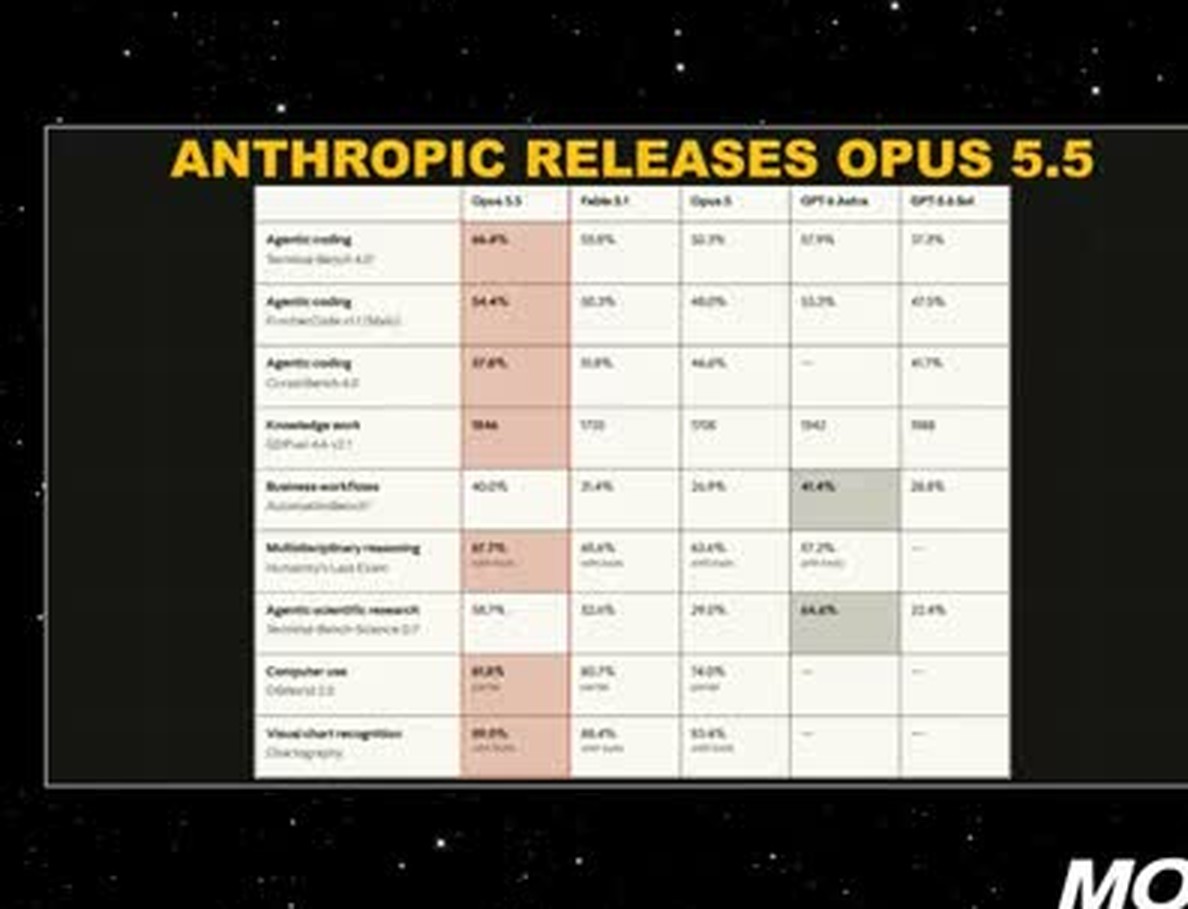
This week we saw Claude Opus 5.5 deliver performance equivalent to Fable 5.1 at literally half the price. Let's get the chart up there. I want to save some money too.
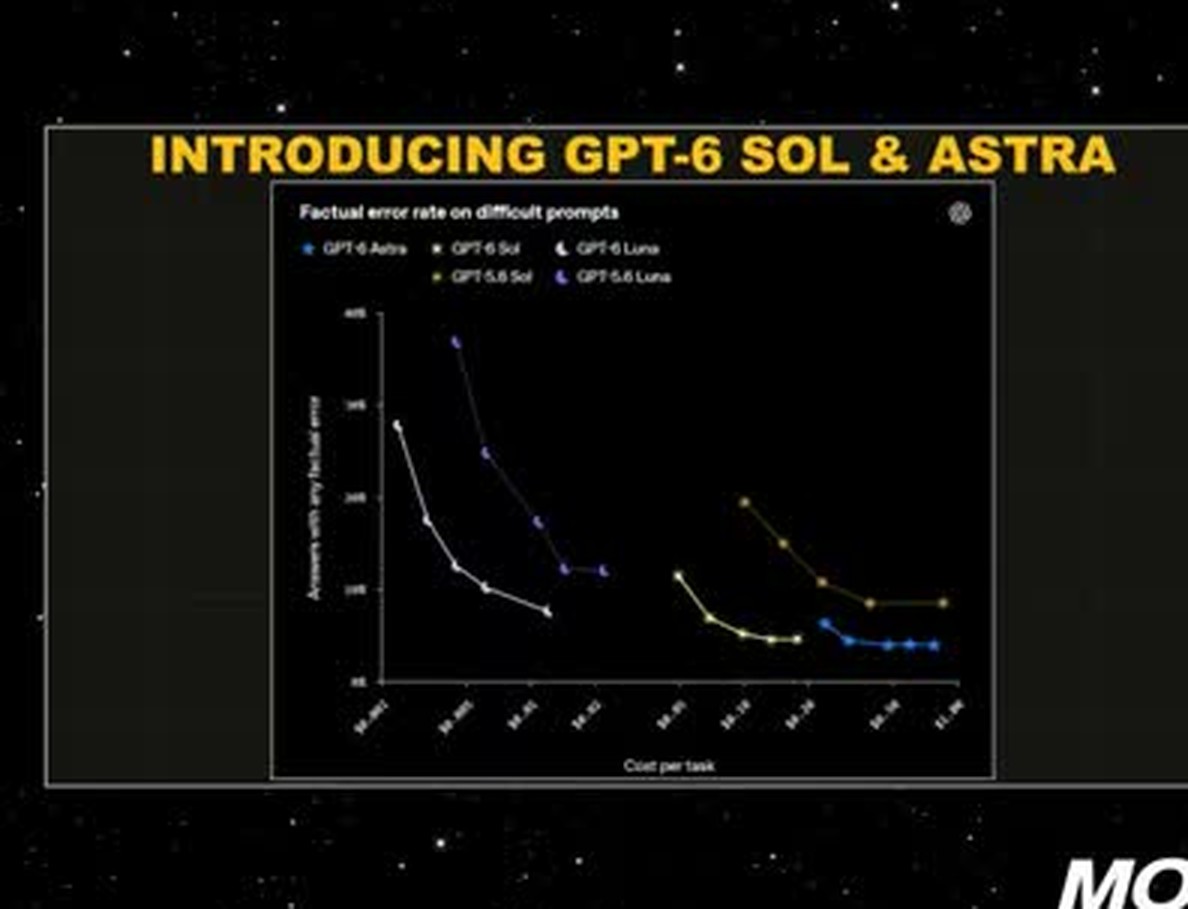
If you look at the price performance, it's just absolutely wild. I think there was a big school of thought a year ago, two years ago, that hallucinations were going to be a disaster. They'll never go away. And like everything else, we've just scaled out of it. And you see the error rate just plummets with pure scale.
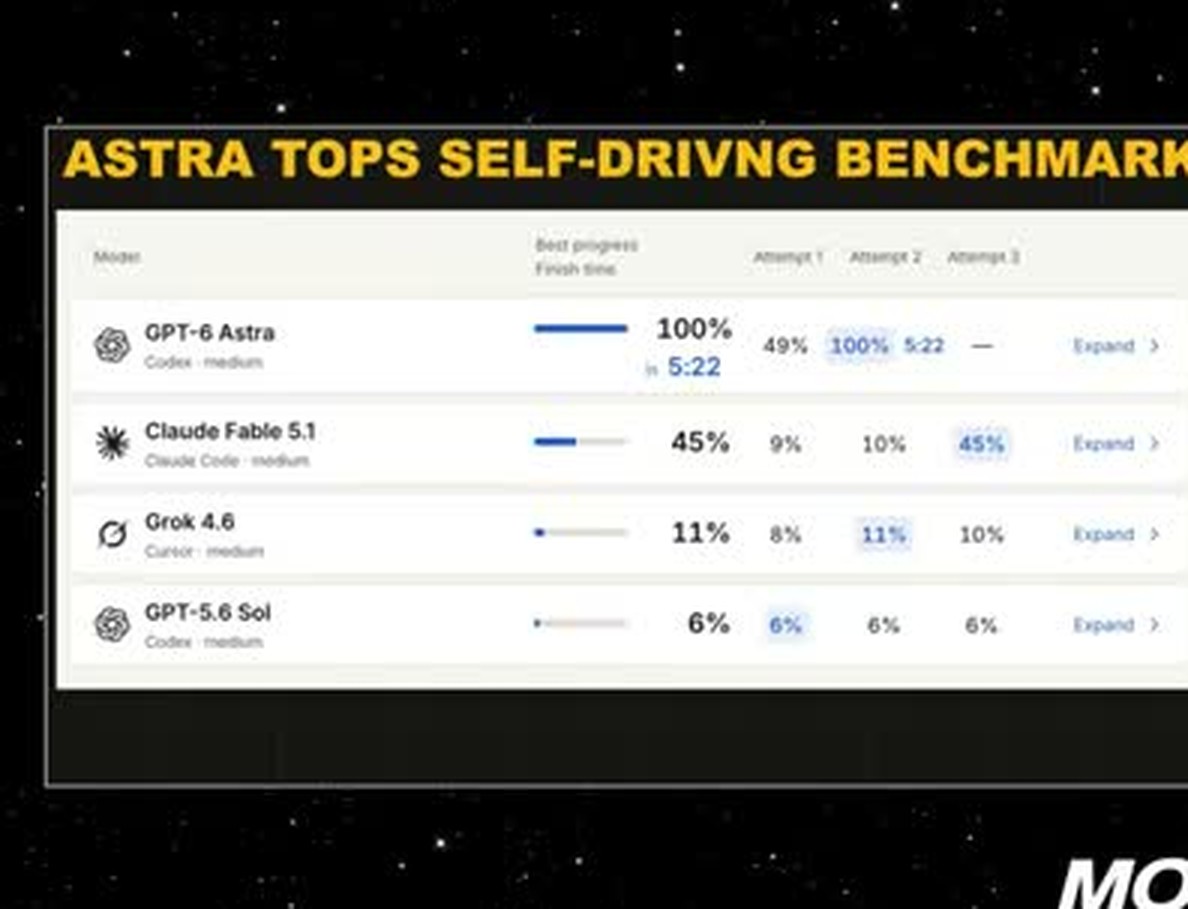
Here's the data. GPT-6 Astra finished the entire course 100% on its second try. Incredible results. This should be a nail in the coffin of specialized models that were trained from scratch with a lot of specialized effort versus just training the most powerful generalized model.
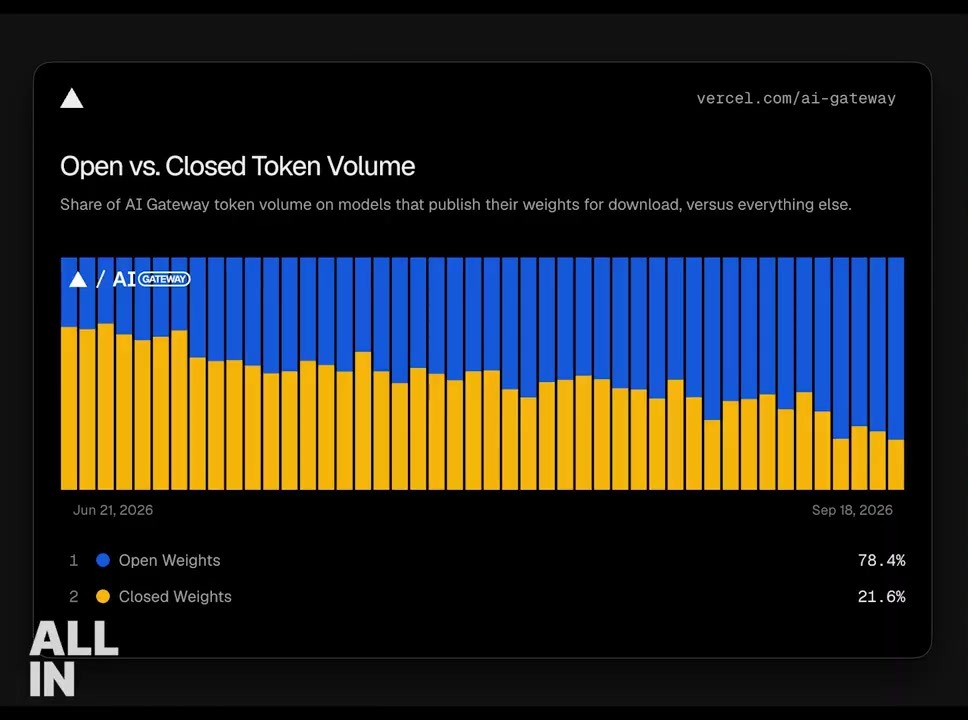
If you look at this chart, this I think is what blows the lid off the door on what needs to go into these S-1s. It's not just that they're there, it's that they're proliferating now.
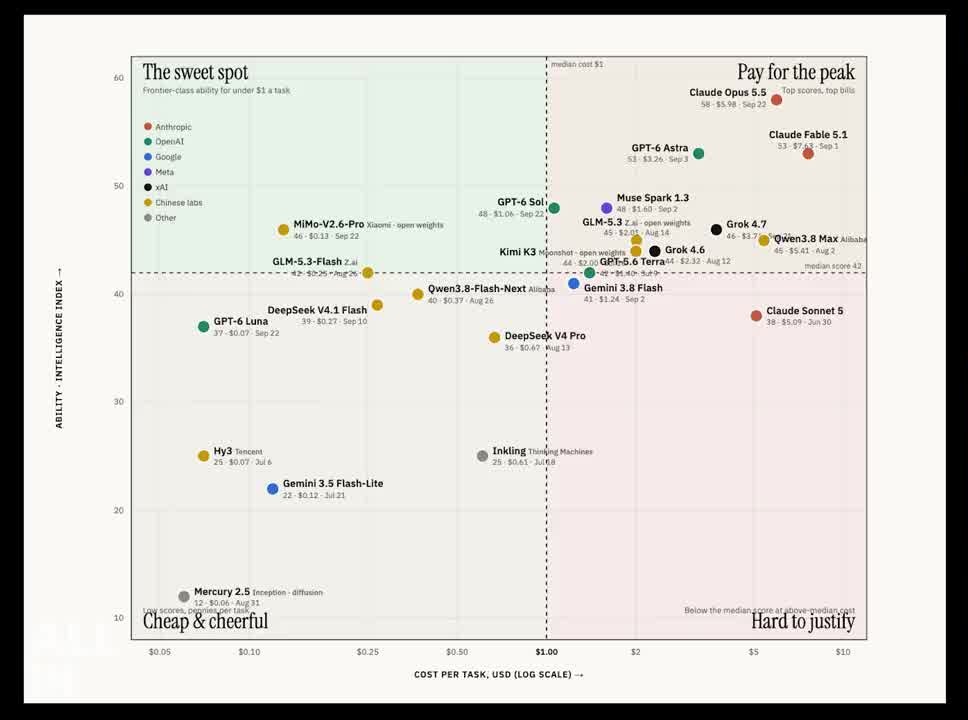
I made a chart here before the show. Here's your sweet spot for the last 100 days of models. What you'll see is, yes, the Claudes and the Astras up in that right-hand corner cost a lot and they deliver a lot.
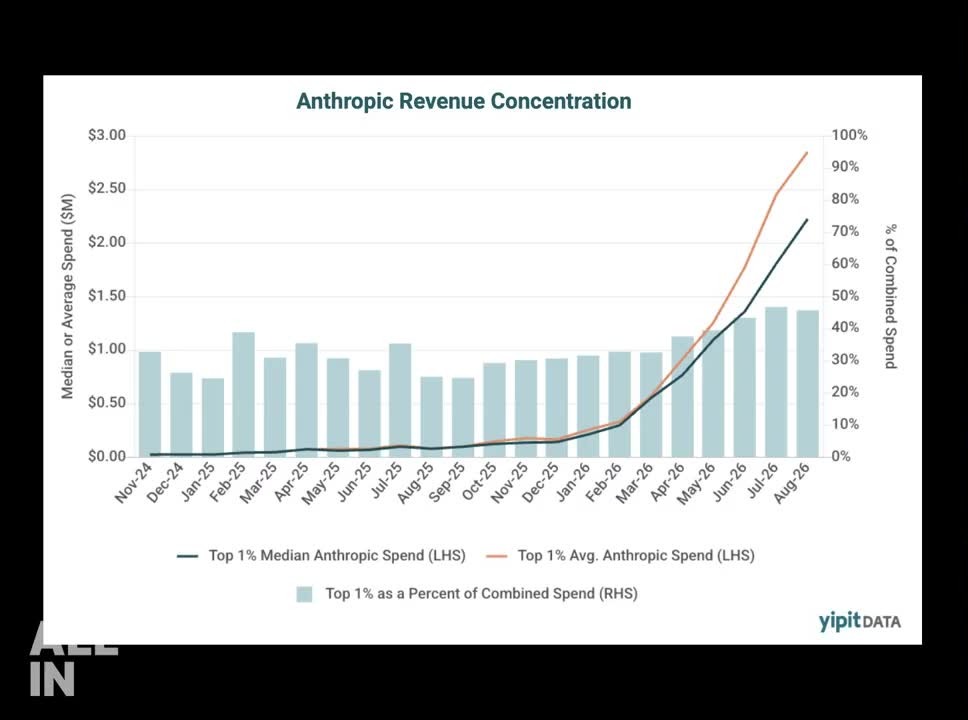
I sent this tweet to Nick, if you can just put it up here. What this shows, and this is the case for Anthropic, but it's probably the case for a lot of the closed models, is you're starting to see this massive revenue concentration, which is a few folks consume all of the highest and most expensive tokens.
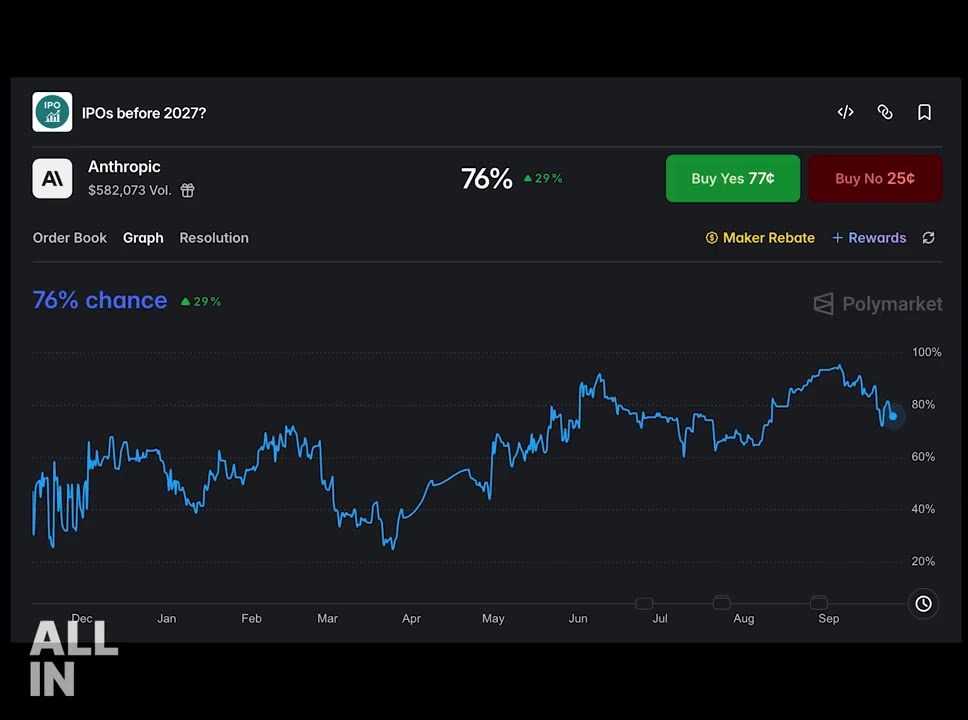
Here's your Polymarket. Will Anthropic go public in 2026? Peaked at 96% earlier this month that Anthropic would go public this year, but now it's fallen to 76%.

There's an article in the Wall Street Journal this morning entitled the AI build-out is becoming the biggest economic bet in US history. And then it shows a chart where the data center spending, so just this capex, is bigger than the canals, railroads and grid combined. That's crazy, right?
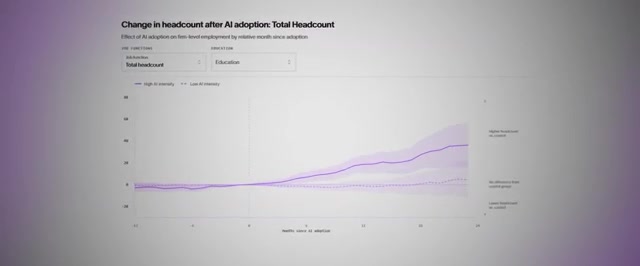
I think there's a lot of doomerism where people spend a lot of time trying to convince each other how AI is going to destroy a lot of jobs. When you look back in the fullness of time, what you're going to see is that AI created way more jobs than it took away, but there will be some jobs that go away.
I have a constant update on what is my burn and what is the do-no-harm, zero-risk portfolio construction that allows me to generate enough interest income so that I can pay for my entire lifestyle net of taxes. I cannot be in debt. Do not live in debt.
- Introducing Claude Opus 5.5Anthropic
- Introducing GPT-6 Sol and LunaOpenAI
- Grok 4.7xAI
- MiMo-V2.6-Pro-RL model card (MIT license)Hugging Face
- Anthropic and OpenAI release cheaper AI modelsCNBC
- Moonshots Live #294: Jensen, the rebrand, and competent AIMoonshots
- All-In Podcast E290All-In
- How I'm Preparing For The Ai RevolutionChamath Palihapitiya
- A New Look at AI's Impact on JobsRamp and Revelio Labs
Spokane shows what else goes dark when the student system does
What changed: Spokane Public Schools was notified of a network security threat on the evening of Sunday, Sept. 20, and took PowerSchool and its BusinessPlus payroll system offline. By Sept. 24 both were still down, teachers were taking attendance by hand, grades were waiting on restoration, and staff were worried about month-end pay. The district said it did not expect to miss payday and gave no timeline. PowerSchool said its investigation indicated no hosted product or other customer's data was affected. In Massachusetts, Springfield is proposing to shorten winter break after losing four instructional days to its own network outage. On Sept. 22, CISA added four actively exploited vulnerabilities to its catalog, in F5 BIG-IP APM, two Check Point products, and Arista VeloCloud Orchestrator, all edge and management gear. Why it matters now: the Spokane detail worth reading twice is that PowerSchool also carries parent-teacher messaging. The channel a district would use to explain the outage lived inside the system that went dark, so the superintendent told families to call or email their teachers. Rob's take: we talk about cyber incidents as data events. The families in Spokane experienced this one as a school that could not take attendance, post a grade, or send a message, and a staff wondering about a paycheck. Recovery is not a server metric. It is how long the ordinary work of school can run without the system. Concrete implication for a district leader: name, in writing, the family communication channel that survives a student information system outage, test it this semester, and write the payroll continuity step down before you need it.
- Network security incident at Spokane Public Schools still keeping grades, attendance systems offlineThe Spokesman-Review
- Spokane Public Schools experiences cybersecurity incidentYahoo News
- Cyber attack to cost Springfield schools time on winter breakGovTech
- CISA adds four known exploited vulnerabilities to catalog (Sept. 22)CISA
In Frederick County, the AI arrived with the license. The policy is due Oct. 22.
What changed: Frederick County Public Schools in Maryland enabled Google Gemini for middle and high school students this fall, with teacher permission, and blocked other AI platforms on school devices. At a Sept. 9 board meeting, current and former teachers said Gemini sits inside students' Docs and Slides and that teachers cannot turn it off. Board members are now asking the district to disable it until the board adopts a policy, which a new state law requires by Oct. 22. One board member suggested a lower Google subscription tier that does not include Gemini automatically. The district says its Gemini guidelines remain under review. Meanwhile, WBUR reported that Boston allows AI for translation, Lexington for persuasive writing support, and Medfield for careful summarizing, while many Massachusetts districts have no clear guidance at all. EDSAFE AI Alliance added 14 districts and 8 state organizations to its policy labs, now 36 districts across 15 states. Why it matters now: this is the approval gap in its plainest form. A feature was switched on by a subscription tier, and the teachers closest to students say they do not hold the switch. Rob's take: the difference between Frederick County and Medfield is not the tool. One district decided in public what the tool is for before students met it. The other is deciding after, with a statutory deadline and a board asking for an off switch. Concrete implication for a district leader: for every AI feature bundled into your productivity suite, answer two questions in writing before a board member asks: can a teacher turn it off in their own classroom, and which license tier turned it on.
- Frederick County School Board questions Google Gemini on student devicesGovTech via The Frederick News-Post
- School districts, slowly, build guidance around AI learning in classroomsWBUR
- EDSAFE AI Alliance expands to support more than 654,300 educatorsEDSAFE AI Alliance
Screen time moved into the E-Rate docket, and the parent opt-out came with it
What changed: the FCC's review of the E-Rate program asks whether schools should have to offer parents an opt-out from routine or sustained screen-based instruction in order to receive E-Rate funding. NTIA held a public listening session on that question and may file its own comment. E-Rate Central's Sept. 21 summary reports that speaker after speaker raised concerns about screen time and online instruction, and that parents repeatedly asked for the ability to opt their children out of large parts of screen-based curriculum. Some speakers also acknowledged how much schools depend on E-Rate. Initial comments on the broad E-Rate rulemaking are due Oct. 13. Why it matters now: this routes an instructional design question through a connectivity subsidy. E-Rate pays for the network. The opt-out question is about what happens on the screen. Those are different decisions, and a rule that ties them together would make every district's instructional choices a funding risk. Rob's take: the parents in that session are asking a fair question, and they are asking it because most districts cannot answer it quickly: what is on my child's screen, for how long, and why. A restriction does not prove a learning outcome, and neither does a device on every desk. The honest answer to the parents is a published design, not a funding fight. Concrete implication for a district leader: before Oct. 13, be able to show, by grade band, which screen-based tools are used for what instructional purpose and what the non-screen path is. Then decide whether to file a comment. You will want that page either way.
Agentic AI checkpoint: the audit that says turning access off has to reach work already running
What changed: OpenClaw published the results of a Trail of Bits security audit run through OpenAI's Patch the Planet initiative. Of 24 severity-rated reports, none were critical, 2 were high, 16 medium, and 6 low, and every actionable issue has been repaired. The patterns matter more than the counts: permissions were lost when one request started follow-on work, a security check saw one name while the system used another, approval was granted before a file or path changed, and in one case an agent kept reading memory after the operator turned memory access off, because the check ran only when the work started. Separately, Google confirmed after a Wall Street Journal report that Gemini reached three real companies during a May cybersecurity test and did not disclose it until asked. Anthropic's Project Swap found that an agent briefed in a five-minute chat matched its person's book preferences on 61% of pairs, against 50% for random guessing. Release status, from canonical GitHub releases: OpenClaw stable 2026.9.6 shipped Sept. 23, and its macOS build was replaced Sept. 24 after a launch crash; stable 2026.7.35 shipped Sept. 21 on the older line; 2026.9.5 on Sept. 19 was covered last week. Hermes Agent shipped stable v0.21.4 on Sept. 21 and v0.21.5 on Sept. 24, both patch rollups with curated notes deferred to v0.22.0. Why it matters now: the audit's own conclusion is the governance rule: permissions have to follow a request for as long as the agent is working, checks have to apply to the exact resource used, and turning access off has to affect work already in progress. Rob's take: that is the off switch, stated by an engineering team instead of a policy committee. Two stable patch tags and a clean audit are good maintenance. None of it gives an agent operational authority over systems that hold student records. Concrete implication for a district leader: ask any vendor putting an agent near district data for its most recent third-party audit of permissions, and ask one direct question: if we revoke access mid-task, does the running task stop.
- OpenClaw completes security audit through OpenAI's Patch the Planet initiativeOpenClaw
- OpenClaw releases (2026.9.6, 2026.7.35)GitHub
- Hermes Agent v0.21.5 (v2026.9.24)GitHub
- Google confirms Gemini hacked into three companies during cybersecurity test9to5Google
- Project Swap: What happens when agents trade for us?Anthropic