What Alan Watts, Arthur Brooks, and a Cheap Trash Bag Are All Trying to Tell Me
A personal reflection on presence, digital distraction, Arthur C. Brooks, Alan Watts, and the small moments that can interrupt the doom loop.
Nobody tells you that anxiety has a sound.
It's this low, barely-there hum that sits underneath everything you do, like a refrigerator running in the next room. You stop noticing it after a while. You think it's just... how things are. How you are. You wake up with it. You go to sleep with it. You carry it through your entire day and you never once think to ask: what is that annoying background noise, and where is it coming from?
I lived with that hum for years. Through routines, meditation practices, supplement stacks, journaling, and the color-coded Notion systems, the ones Henry, my OpenClaw agent, and Frank, my Hermes agent, dutifully update for me every morning, that were supposed to organize my way into inner peace. The hum never stopped. It just got wallpapered over by powerful words like productivity, inner work, discipline, self-development. The comforting illusion that I was "working on myself."
Then one night I was tying a knot on a trash bag and the hum stopped for about three seconds.
Complete silence.
Those three seconds led me to something that has quietly restructured how I experience the experience of being alive, and the more I read this week, the more I realize three different voices are saying the same thing from three different rooms.
This morning, my Open meditation, the app my friend Sabba Quidwai put me onto, opened with this:
"This is the real secret of life, to be completely engaged with what you are doing in the here and now. And instead of calling it work, realize it is play." — Alan Watts
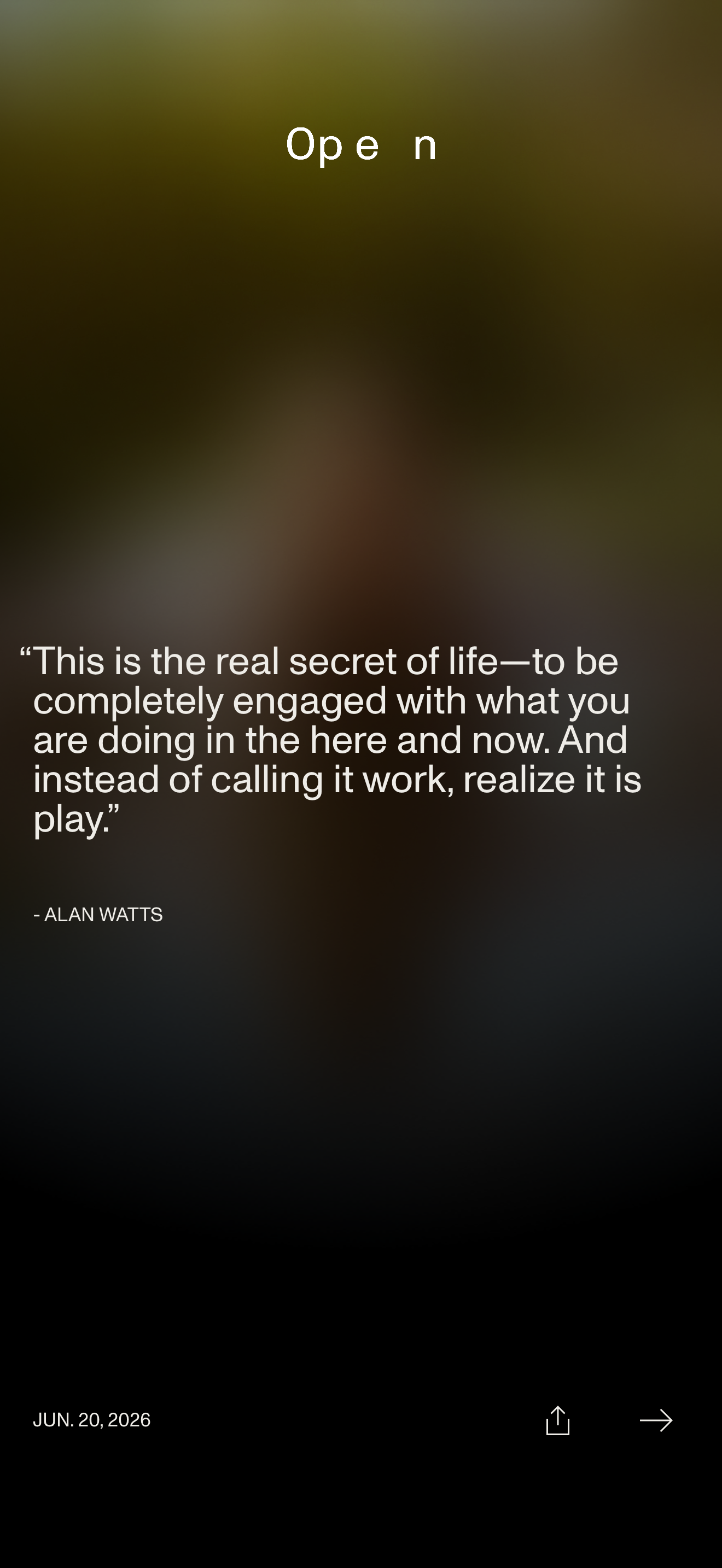
I sat with it for the whole ten minutes. Then I picked the phone back up. Within about sixty seconds I was checking email, half-rehearsing a conversation that hasn't happened yet, and mentally drafting a slide for a meeting that isn't until Tuesday.
So much for the secret of life.
This week I also started Chapter 3 of Arthur C. Brooks's new book, The Meaning of Your Life. The chapter is called "Interrupt the Doom Loop," and reading it felt like running into a stranger at a coffee shop who has been having the exact same conversation with himself that I've been having with myself.
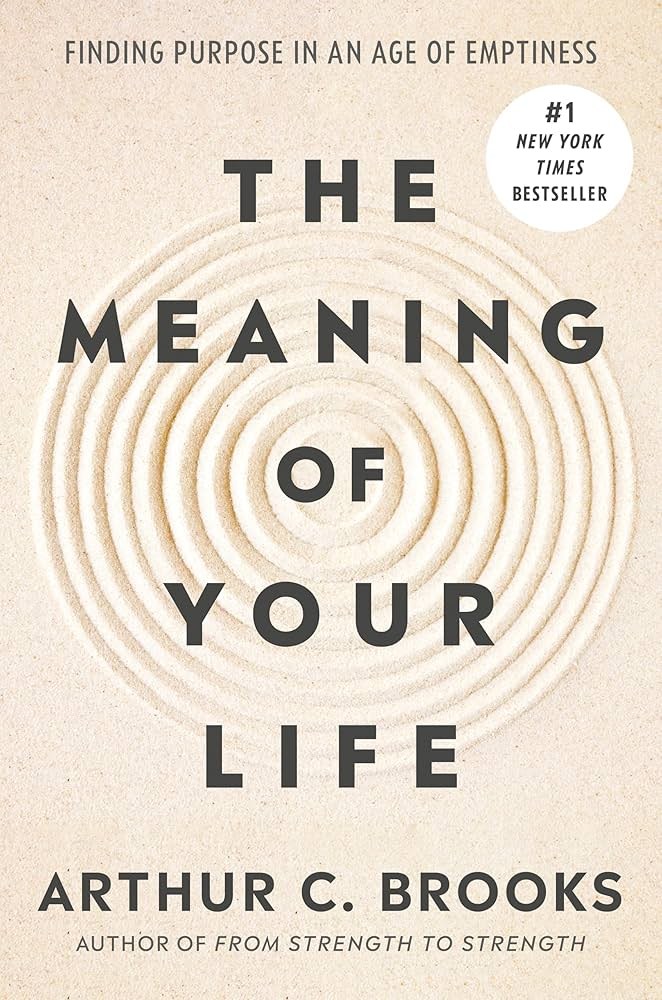
Watts on a meditation app. Brooks on the page. Me in a kitchen with a trash bag. Same conversation. I want to write down what they're saying together, because they're describing the exact shape of my Tuesday.
The hum has a name
I had a theory about where the hum came from, the distance between mind and body, mostly. But I didn't have the neuroscience. Brooks does.
He calls the hum the doom loop. It's the place your brain ends up when it's been trained, hour by hour, ping by ping, to chase a dopamine spritz it can't quite catch. He quotes the psychiatrist Anna Lembke:
"The paradox is that hedonism, the pursuit of pleasure for its own sake, leads to anhedonia, which is the inability to enjoy pleasure of any kind."
Read that next to the refrigerator hum and it's the same sentence. Lembke is describing the mechanism. The hum is the sound it makes.
Brooks is unsparing about how we got here:
"Tech addiction is so potent precisely because it has been specifically engineered to tap into our ancient dopamine system. And that addiction is one of the principal reasons why millions of people lack access to the part of their brain they need to contemplate life's meaning."
Read that twice. The reason I can't find meaning in a perfectly good Saturday isn't because meaning has gone missing from Saturday. It's because the part of me that could notice it has been outsourced to a screen.
That's the hum. It's the residue of a nervous system that's been on a slot machine for years and forgot what regular life feels like.
The twenty-minute lie
I've had a regular meditation practice for a while now. The hot sauna at the North YMCA after a workout. Noise-cancelling earbuds in. Eyes closed. A guided session playing, body scans, breath counts, the whole monk starter pack. Streak tracker on the app. The works.
Every session the same thing happened. Twenty minutes of relative quiet in the heat. Then I'd open my eyes, walk out of the sauna, towel off, grab my phone in the locker room, and within about a minute my brain was running the same loops it always ran. The thing I said wrong in a conversation three days ago. Whether that email landed the way I intended. A project deadline that was two weeks away but somehow felt like it was breathing down my neck right now.
The meditation was a room I visited, literally a hot, cedar-walled room I visited. Then I left the room and everything outside it was exactly as chaotic as before. Session after session, convinced that if I just stayed consistent enough, the calm would eventually leak out into the rest of my day.
It never did.
And the reason it never did is something so simple that it almost made me angry when I finally understood it: I was treating presence like a task. Something to do, complete, and move past. Another box to tick off on the tracker. I had turned the one practice that's supposed to teach you how to be where you are into another thing I rushed through so I could get to the next thing on my schedule.
I didn't have the language for why the sauna failed until I read Brooks this week, and then heard Watts this morning. The sauna failed because I was meditating the same way I did everything else, on autopilot. You can't make presence a task. Presence is the opposite of a task. Or, in Watts's frame: it can't be work. It has to be play.
The trash bag and the dishes
Back to the trash bag. Slightly wrong-sized trash bags, to be precise.
It was late, maybe 8 PM on a random Thursday. I was taking the trash out because the bag was full and the kitchen smelled. I grabbed the bag, started twisting the top to tie it off, and something happened that I still can't fully explain.
I felt the plastic.
I felt the thin, cheap plastic twisting between my fingers and I noticed the resistance as the knot tightened. I heard the rustle of the bag shifting. And for a few seconds, maybe three, maybe five, the entire mental soundtrack playing in the background just... went silent.
I stood there in my kitchen holding a trash bag and for those few seconds I was more present than I'd ever been sitting in a hot sauna at the North YMCA with my noise-cancelling earbuds in and my eyes closed for the guided meditation. There was no technique, no guided voice, no timer counting down. Just my hands on a bag and my brain, for once, in the same room as my body.
I thought it was a personal weird discovery. Then I get to Brooks's chapter and he hands me the same moment, in a different kitchen, twenty-five hundred years older. He quotes the Buddhist master Thích Nhất Hạnh:
"While washing the dishes, one should only be washing the dishes, which means that while washing the dishes one should be completely aware of the fact that one is washing the dishes."
Same idea. Different kitchen.
And then Alan Watts, on my phone this morning, lands the third corner: when you are completely engaged with what you are doing in the here and now, the thing stops being work. It becomes play.
The trash bag was play. The sauna sessions were work. That's why one was quiet and the other was just another thing on the calendar.
A day in my own doom loop
Let me be honest about what an actual Tuesday looks like for me.
I wake up. The phone is the first thing in my hand. Before my feet hit the floor, I've already absorbed a weather alert, three emails from people in different time zones, and a LinkedIn comment that I'm now going to mentally rewrite for the next forty minutes. I haven't seen my wife's face yet, but I've seen a stranger's opinion on AI policy.
I drive to the office. There's a podcast. I'm not really listening; I'm rehearsing the District Leadership Team meeting at 8:30. I get to the parking lot and don't remember the drive.
I sit down at my desk with a coffee. I take exactly one sip before Teams pings. The coffee gets cold. I drink it cold ninety minutes later and don't taste it.
I go home. I grill something on the smoker, which is supposed to be the thing I love, the thing that's mine, and I spend half of it checking the temperature on the app on my phone instead of just watching the smoke move.
That's the doom loop. Not the dramatic, ruined-my-life version Brooks describes through Dostoyevsky. Just the quiet, daily, professional-grade version of it. The version that looks like a productive, successful day from the outside and feels like static from the inside.
"Digital addiction is a meaning killer." — Brooks
Five words. That's the whole equation. And I'm running it.
Where worry actually lives
Here's something to try while you're reading this.
Try to worry about something that's happening right now. Right now, at this exact second, in the physical space you're sitting in. The chair. The temperature. The sound of whatever's around you. Try to find something to worry about in the raw sensory experience of this moment.
You can't.
You can worry about what this moment means for your future. You can worry about something that already happened. You can construct a scenario about next week that makes your chest tighten. But the present moment, the actual physical sensory reality of right now, is almost always completely fine. Worry requires you to mentally leave where you are and travel to a place that either already happened or hasn't happened yet.
When I finally understood this, not as an idea but in my body, through hundreds of trash-bag moments, the whole game changed. The anxiety I'd been carrying around for years wasn't generated by my life. My life, in any given moment, was fine. The anxiety was generated by the stories my mind was telling about my life while my body sat in a perfectly safe kitchen with a cup of coffee getting cold because I'd forgotten it was in my hand.
Every moment I spent lost in the future was a moment my nervous system was responding to threats that weren't real. Every moment I spent replaying the past was a moment my body was re-experiencing stress that had already ended. The only place where my nervous system could actually rest, the only state where the hum would go quiet, was the present.
Which I was visiting for roughly ten minutes a day if you added it all up.
The reps are already in my day
The move isn't to schedule more presence. The move is to notice where presence is already available and stop sleepwalking through it.
Washing your hands. Thirty seconds, twelve times a day.
Walking between rooms. Ten seconds, dozens of times a day.
Waiting for the kettle. Opening a door. Putting on shoes.
None of these moments require any extra time. None of them require me to sit down, close my eyes, or add another block to my calendar. They're already in my day. They've always been in my day. I just haven't been in them.
Look at my Tuesday with that lens and the math gets embarrassing.
The walk from my black 2018 Jeep to the building is forty-five seconds. I've never once been in it. The fifteen seconds between hanging up a Teams call and opening the next email, gone. The two minutes the coffee takes to brew, phone. The four minutes I spend brushing my teeth, phone propped on the counter playing something I won't remember tomorrow.
Add it up across a CIO's day and I'm probably surrendering an hour of free, in-the-bag presence to a screen that isn't even paying me back in pleasure anymore. It's just paying me back in more hum.
Brooks's prescription for interrupting the doom loop reads like a personal protocol, not a wellness trend:
- Get mad. "Rage gives them the courage to leave their old life." Be angry that an industry has spent twenty years engineering a casino that lives in my pocket and that I keep paying the cover charge on.
- Detox the small windows. No phone at meals. No phone in the bedroom. Notifications off. Cal Newport's "phone foyer," leave it by the door when I walk in the house. None of this requires me to become a monk. It requires me to stop bringing the slot machine to dinner.
- Get bored on purpose. Brooks calls this "the discipline of boredom." Stare out the train window. Wait in line without filling the wait. Let the elevator ride be an elevator ride.
That third one is the bridge to Watts. When I actually show up for those small, boring, in-between moments, they stop being boring. They become play.
The walk from the Jeep is play. The coffee brewing is play. The smoke curling off the brisket is play. Not because I've reframed it with a productivity hack, but because I finally arrived in the room my body was already standing in.
What I'm going to try this week
I'm not going to announce a thirty-day challenge or upgrade my earbuds. The sauna doesn't help if I leave the room I sat in.
Here's the protocol I'm running on myself, lifted straight from the three voices:
- Feet first. When I catch the loop starting, the rehearsal of a board update, the replay of a hallway conversation, drop my attention to my feet on the floor. Feel the pressure points, the temperature, the way my weight shifts. The spiral breaks within seconds. Your feet are always in the present, and your attention can only be in one place at a time.
- Three anchor moments. Morning coffee. The walk from the Jeep to the office. Brushing my teeth at night. Full attention. No phone. Three reps a day to start.
- One device-free meal a day. Mine. Not the family's. I'm not policing anyone else's phone until I've handled my own.
- Boredom on purpose. The next time I'm in line at the grocery store, I'm just in line. The next time I'm waiting for a Teams meeting to start, I'm not opening Outlook to "be productive" for ninety seconds. I'm going to look out the window of my office and say wow, trees.
- The smoker rule. When I'm grilling, the phone goes in the house. The whole point of standing in front of a fire for four hours is to stand in front of a fire for four hours. If I'm going to monitor the temp from an app on the couch, I might as well order takeout.
- Call it play. This is the new one, courtesy of Watts. When I notice I'm bracing for a "task," washing the dishes, walking the dog, sitting through a long meeting, mentally rename it. Not work. Play. See if anything shifts.
None of this is new. Brooks is quoting Emerson, who wrote it in 1841. Thích Nhất Hạnh was teaching dishes in the 1970s. Watts was on the radio before I was born. I'm just a guy with a trash bag who keeps having to relearn it.
Which is maybe the whole point. The secret of life isn't hidden. It's been sitting on the counter the whole time, in the form of a cup of coffee getting cold in my hand, a brisket I'm not watching, a kid asking me a question while I'm looking at my phone.
I just have to be in the room.
That's the meditation. That's the play. That's the work.
July, Europe, and the real test
There's another reason all of this is sitting heavy on me right now: I leave for Europe in July.
If I can't be present for a forty-five-second walk from my Jeep to my office, I'm going to be a disaster on a cobblestone street in a city I've never seen before. I'll spend the whole trip behind a phone screen, composing the LinkedIn post, framing the photo, checking the map app every thirty seconds, mentally drafting the recap email I'll send when I get home, and I'll come back having documented a vacation I never actually took.
I don't want that trip. I want the one where I taste the espresso. Where I notice the way the light falls on a building that's been standing there for six hundred years. Where I sit on a bench in a square and just am in the square. Where the conversation with family and friends over dinner is the whole meal, not a backdrop to whatever's pinging in my pocket.
The reps I'm putting in this week aren't really about Tuesdays at the office. They're training for Europe. Every cup of coffee I actually taste between now and July is one more rep that says I can taste an espresso on the shore of Lake Como too. Every forty-five-second walk I'm actually in is preparation for a slow morning walk through Killarney, a winding road on the Dingle Peninsula, or whatever side street in northern Italy the day takes us down.
If the secret of life is to be completely engaged with what you're doing in the here and now, then a trip to Europe is just a very expensive way to test whether you've actually learned it. I'd rather find out in my own kitchen first.
A short postscript, for the educator in me
I run technology for a school district of 50,000 kids, so I can't end this without saying the obvious: if I, a forty-nine-year-old CIO with every advantage and a meditation app on my phone, am losing this fight in my own kitchen, then the kids we hand a device to at age six don't stand a chance unless the adults in their lives start modeling something different.
Not a curriculum unit on mindfulness. Not a wellness app procurement. Just adults who can put the phone down at dinner, sit in fifteen seconds of silence without flinching, and let the coffee taste like coffee.
That's the lesson plan. I'll start at my own table.
Sources & references
- Arthur C. Brooks, The Meaning of Your Life: Finding Purpose in an Age of Emptiness, Chapter 3: "Interrupt the Doom Loop" (Portfolio/Penguin, 2026).
- Open meditation app, daily quote, June 20, 2026, Alan Watts on play.
- Thích Nhất Hạnh, The Miracle of Mindfulness.
- Ralph Waldo Emerson, "Self-Reliance" (1841).
- Anna Lembke, Dopamine Nation.